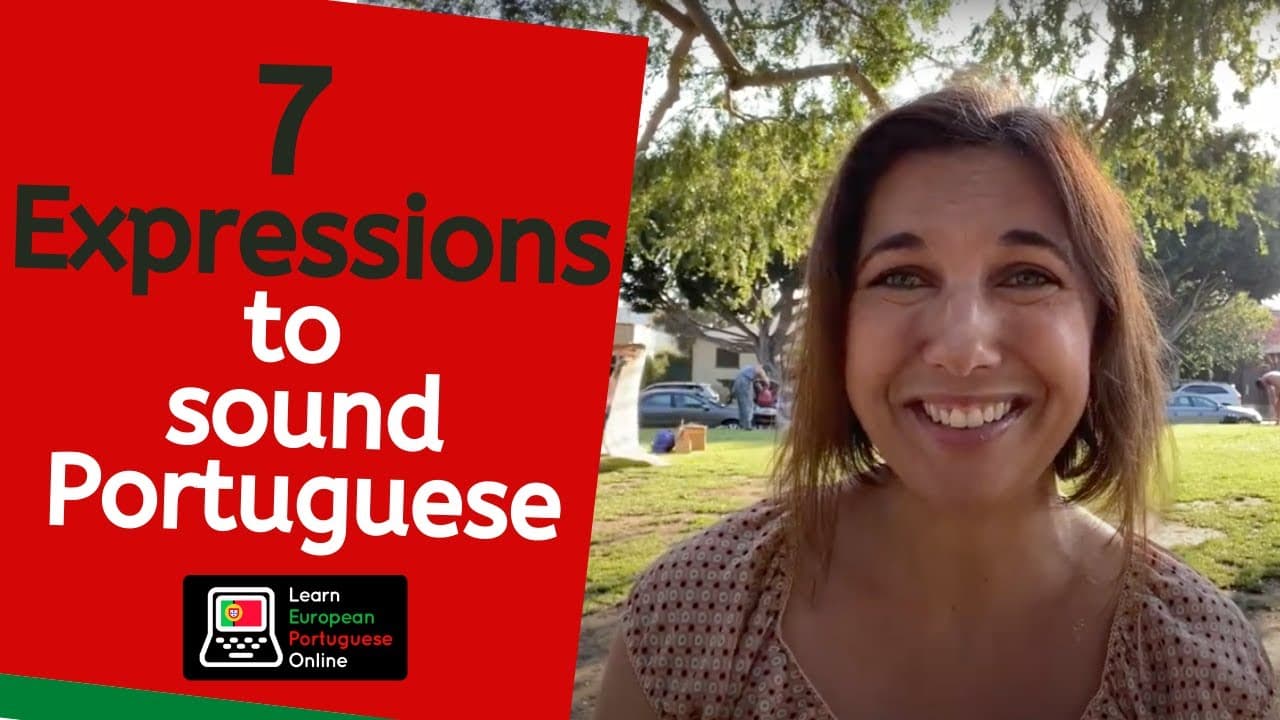
7 European Portuguese EXPRESSIONS to SOUND LIKE A NATIVE
TL;DR
Learn seven expressions to sound like a native Portuguese speaker.
Transcript
hola hi everyone i'm so happy you guys enjoyed my last video if you didn't have a chance to see it click above in this episode i want to walk you through seven portuguese words and expressions that will make you sound more like a native these come very handy when you need to respond to someone and more than using see now you will be able to express... Read More
Key Insights
- The video introduces seven Portuguese expressions that enhance conversational skills, making speakers sound more native-like.
- The expression 'A sério?' is used to show surprise or disbelief, similar to saying 'Really?' or 'Seriously?' in English.
- Combining expressions like 'Não acredito' and 'A sério?' can amplify the sense of surprise in a conversation.
- For congratulating someone, 'Parabéns' is commonly used, and the video references a full video on celebration expressions.
- Instead of simply saying 'Sim' (Yes), expressions like 'Claro' and 'Com certeza' can be used for more enthusiastic agreement.
- If unable to attend an event, 'Que pena' and 'Fica para a próxima' are polite ways to express regret.
- The verb 'Combinar' and adjective 'Combinado' are useful for planning and agreeing on arrangements, making speech sound more native.
- Watching Portuguese soap operas is recommended for learning these expressions and understanding their contextual usage.
Install to Summarize YouTube Videos and Get Transcripts
Explore YouTube Video Summarizer or Get YouTube Transcript Extractor
Questions & Answers
Q: What are some expressions to show surprise in Portuguese?
Expressions like 'A sério?' and 'Não acredito' are used to convey surprise or disbelief in Portuguese. These phrases are equivalent to saying 'Really?' or 'I can't believe it' in English. Combining these expressions can enhance the level of surprise conveyed in a conversation.
Q: How can you express agreement more enthusiastically than just saying 'Yes'?
Instead of simply saying 'Sim' (Yes), you can use expressions like 'Claro' (Of course) and 'Com certeza' (Certainly) to express agreement more enthusiastically. These expressions add a level of positivity and eagerness to your response, making the conversation more engaging.
Q: What should you say if you can't attend an event in Portuguese?
If you can't attend an event, you can politely express regret by saying 'Que pena' (What a shame) or 'Fica para a próxima' (Maybe next time). These expressions show that you are sorry for not being able to make it and leave the door open for future opportunities.
Q: How can the verb 'Combinar' be used in conversations?
The verb 'Combinar' is used in Portuguese to discuss plans and arrangements. Instead of using 'Planejar' (to plan), 'Combinar' is more commonly used among native speakers. Once an agreement is reached, you can say 'Combinado' to confirm that the plan is set and agreed upon.
Q: Why are soap operas recommended for learning Portuguese expressions?
Soap operas are recommended because they provide context for how expressions are used in real-life situations. Watching these shows allows learners to hear the intonation, emphasis, and context of expressions, aiding in better understanding and application in everyday conversations.
Q: What is the purpose of learning these seven expressions?
The purpose of learning these seven expressions is to help Portuguese learners sound more like native speakers. By incorporating these expressions into conversations, learners can engage more naturally and effectively, expressing emotions such as surprise, enthusiasm, and agreement in a manner that resonates with native speakers.
Q: How can 'Parabéns' be used in conversations?
'Parabéns' is commonly used to congratulate someone in Portuguese. It can be used in various contexts, from celebrating achievements to offering best wishes. The video also mentions a separate video dedicated to celebration expressions, indicating a broader range of phrases for different occasions.
Q: What is a formal expression for agreement in Portuguese?
A more formal expression for agreement in Portuguese is 'Com certeza,' which translates to 'Certainly.' This expression can be used in formal conversations to express strong agreement or confirmation, providing a more polished and respectful response compared to casual alternatives.
Summary & Key Takeaways
-
The video teaches seven key Portuguese expressions that can help learners sound more like native speakers. These expressions are particularly useful for responding with enthusiasm, surprise, or agreement in conversations.
-
Expressions such as 'A sério?', 'Claro', and 'Não acredito' are highlighted for their effectiveness in making interactions more engaging and authentic. The video also suggests using these expressions in formal and informal settings.
-
To further improve language skills, the video recommends watching Portuguese soap operas to see these expressions in action, thereby enhancing understanding and usage in real-life situations.
Read in Other Languages (beta)
Share This Summary 📚
Summarize YouTube Videos and Get Video Transcripts with 1-Click
Try YouTube Summary with ChatGPT & Claude or YouTube Transcript Generator
Explore More Summaries from Learn European Portuguese Online 📚



Summarize YouTube Videos and Get Video Transcripts with 1-Click
Try YouTube Summary with ChatGPT & Claude or YouTube Transcript Generator