How to Calculate the Z-Transform of a Cosine Signal
TL;DR
To calculate the Z-transform of a cosine wave, multiply the cosine sequence by the unit step function to restrict it to the right-hand side. This leads to the formula: (z^2 - zcos(omega))/(z^2 - 2zcos(omega) + 1), derived by substituting exponential values and simplifying, making it essential for understanding Z-transforms.
Transcript
click the bell icon to get latest videos from ekeeda hello friends and today we are going to study a z transform of co standard cell signal or a cosine residual sequence basically whatever sinusoidal it is nothing but a simple a cos wave or cos sequence now basically we are not able to find out a cos wave in z transform because z transform definiti... Read More
Key Insights
- 👋 The Z-transform of a cosine wave can be calculated on either the right-hand or left-hand side by using appropriate techniques.
- 👋 Multiplying the cosine wave by the unit step function restricts the Z-transform to the right-hand side.
- 🤪 The Z-transform formula is used to obtain a complex expression, which is then simplified by substituting the values of the exponential terms.
- 🤪 The final result of the Z-transform derivation for the cosine wave is (z^2 - zcos(omega))/(z^2 - 2zcos(omega) + 1).
Install to Summarize YouTube Videos and Get Transcripts
Explore YouTube Video Summarizer or Get YouTube Transcript Extractor
Questions & Answers
Q: Why is the Z-transform of a cosine wave not directly obtainable?
The Z-transform definition starts from negative infinity to infinity, while the cosine wave has a periodic nature. Hence, its Z-transform can only be calculated on either the right-hand or left-hand side using appropriate techniques.
Q: How does multiplying the cosine wave by the unit step function help in obtaining the Z-transform on the right-hand side?
By multiplying the cosine wave by the unit step function (u[n]), the Z-transform is restricted to the right-hand side, covering the period from 0 to infinity. This allows for a specific calculation of the Z-transform.
Q: How is the Z-transform formula applied to the given function?
The Z-transform formula is applied by substituting the given function (cos(omega*n)*u[n]) and performing necessary algebraic manipulations. This leads to a complex expression involving exponential terms.
Q: How is the Z-transform of the cosine wave derived from the complex expression?
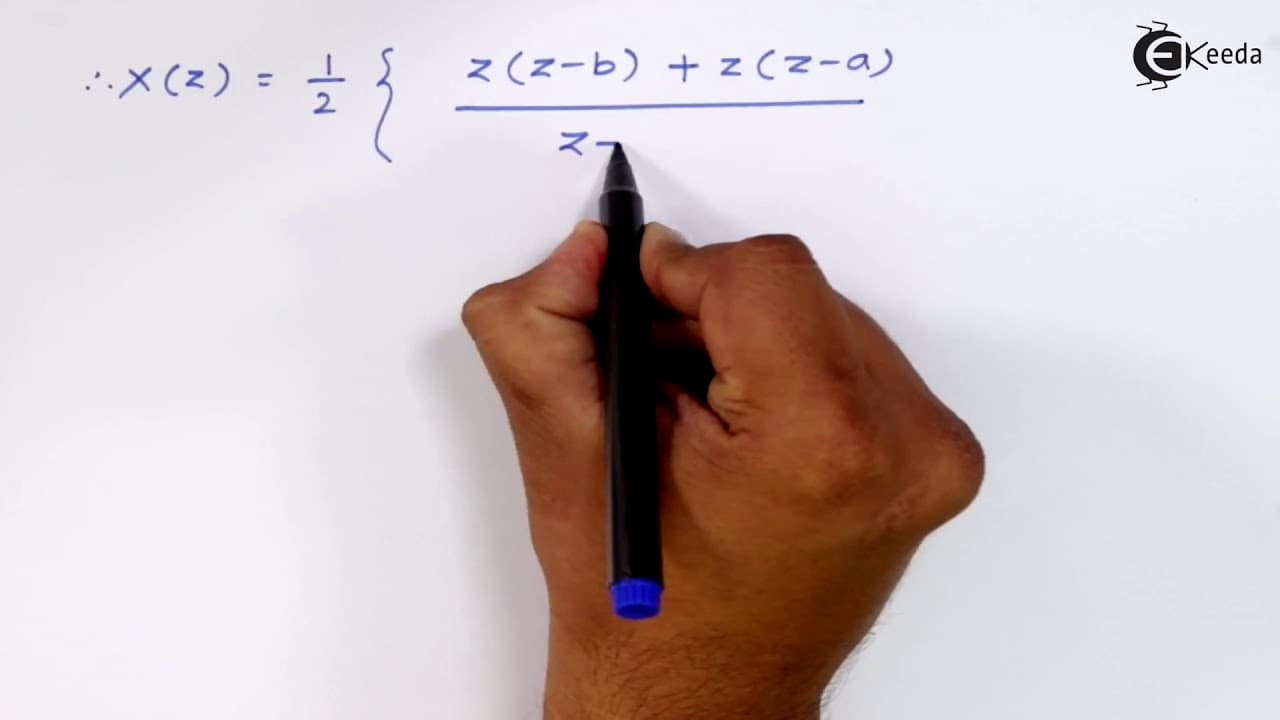
By substituting the values of the exponential terms, the complex expression can be simplified. The numerator is rearranged to get twice the cosine of omega, and the denominator is formed using the resulting expression. The final result is the Z-transform of the cosine wave.
Summary & Key Takeaways
-
The video discusses the Z-transform of a cosine wave or sequence, which is not directly obtainable due to the definition of the Z-transform.
-
To calculate the Z-transform of a cosine wave on the right-hand side, it can be multiplied by the unit step function (u[n]).
-
The formula for the Z-transform is applied to the given function, resulting in a complex expression that can be simplified by substituting the values of the exponential terms.
-
Finally, the Z-transform of the cosine wave is derived as (z^2 - zcos(omega))/(z^2 - 2zcos(omega) + 1).
Read in Other Languages (beta)
Share This Summary 📚
Summarize YouTube Videos and Get Video Transcripts with 1-Click
Try YouTube Summary with ChatGPT & Claude or YouTube Transcript Generator
Explore More Summaries from Ekeeda 📚






Summarize YouTube Videos and Get Video Transcripts with 1-Click
Try YouTube Summary with ChatGPT & Claude or YouTube Transcript Generator