Problem 02 on Chomsky Normal Form
TL;DR
This content explains how to convert a context-free grammar to the Chomsky normal form.
Transcript
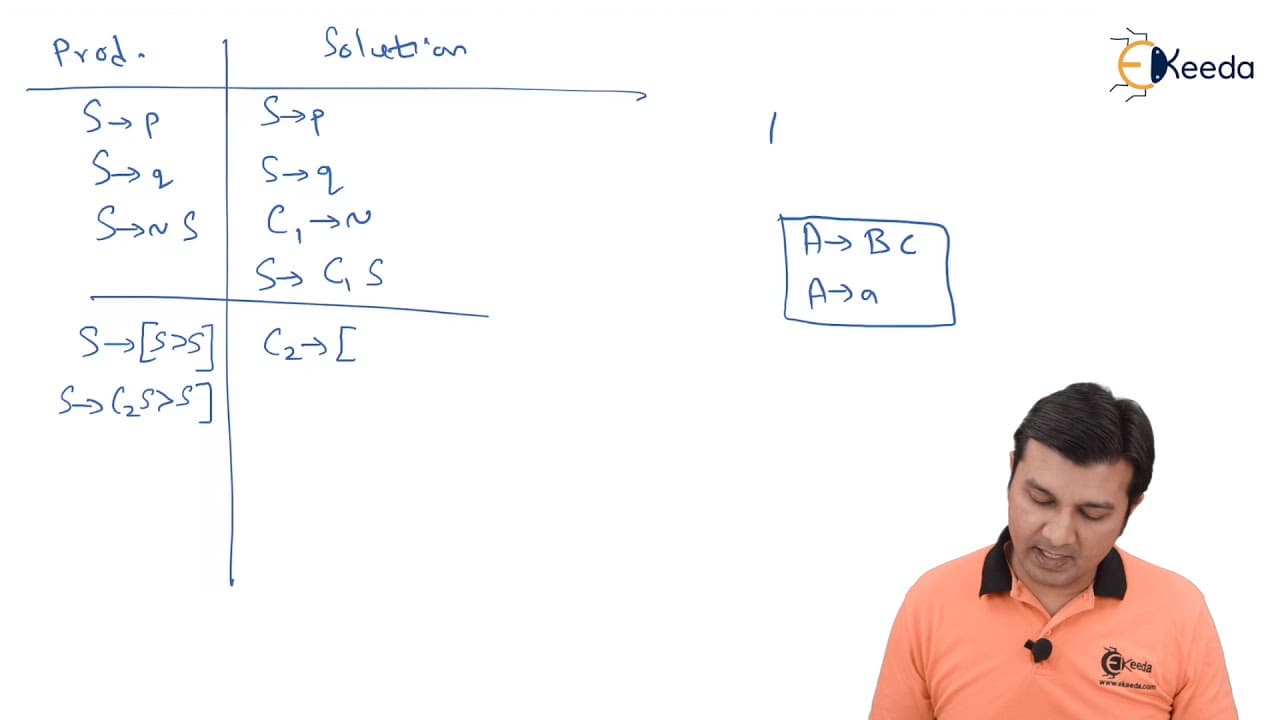
hello friends welcome to the second problem of CNF so let's get started with the problem so the question which is given to us is I have s gives me something like this s again gives me something like this s gives me a small peak something which we are familiar with and s gives me a small Q now when a problem like this comes to us first and foremost ... Read More
Key Insights
- 🔠 Variables are represented by capital letters, and terminals are any symbols other than those found in the production rules.
- 🥶 Converting a context-free grammar to Chomsky normal form involves eliminating null, unitary, and useless productions.
- 🚱 Temporary variables are introduced to rewrite non-CNF productions.
- 💁 The Chomsky normal form requires productions in the form A -> BC or A -> a, where A, B, C are variables and a is a terminal.
Install to Summarize YouTube Videos and Get Transcripts
Explore YouTube Video Summarizer or Get YouTube Transcript Extractor
Questions & Answers
Q: What is the purpose of converting a context-free grammar to Chomsky normal form?
Converting a grammar to CNF simplifies its analysis and enables efficient algorithms for parsing. It ensures that every production is either of the form A -> BC or A -> a, where A, B, C are variables and a is a terminal.
Q: How do you identify null, unitary, and useless productions?
Null productions are those that derive the empty string, unit productions are of the form A -> B, and useless productions are ones that are not reachable or do not derive any sentence. A production is considered useless if the variable on the left side is not reachable from the start state.
Q: What is the process for eliminating null, unitary, and useless productions?
To eliminate null productions, we remove the null production and add new productions that derive the same terminals and variables without the null symbol. Unit productions can be eliminated by replacing them with their corresponding productions recursively. Useless productions can be eliminated by removing variables that are not reachable from the start state or do not derive any sentence.
Q: How are temporary variables introduced for non-CNF productions?
Temporary variables are introduced to replace non-CNF productions and ensure that every production is in the form A -> BC or A -> a. Temporary variables are created to represent the constituents of the non-CNF production, and the original production is rewritten using these new variables.
Summary & Key Takeaways
-
The content discusses the process of converting a context-free grammar to Chomsky normal form (CNF).
-
It highlights the difference between variables and terminals in the grammar.
-
The step-by-step solution includes the elimination of null, unitary, and useless productions, as well as the introduction of temporary variables for non-CNF productions.
Read in Other Languages (beta)
Share This Summary 📚
Summarize YouTube Videos and Get Video Transcripts with 1-Click
Try YouTube Summary with ChatGPT & Claude or YouTube Transcript Generator
Explore More Summaries from Ekeeda 📚

Summarize YouTube Videos and Get Video Transcripts with 1-Click
Try YouTube Summary with ChatGPT & Claude or YouTube Transcript Generator