Proof: the derivative of ln(x) is 1/x | Advanced derivatives | AP Calculus AB | Khan Academy
TL;DR
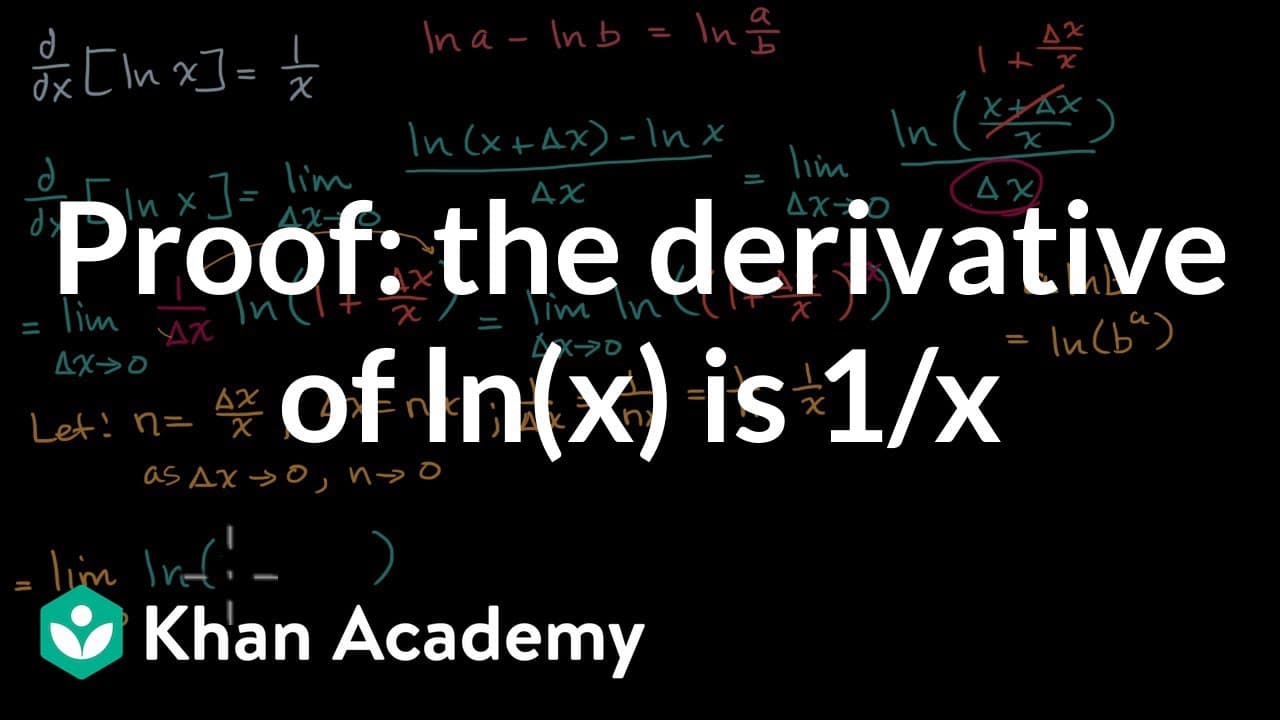
The video proves that the derivative of natural log of X is equal to 1/X using the definition of a derivative, logarithm properties, and exponent properties.
Transcript
- [Instructor] What we're going to do in this video is prove to ourselves that the derivative with respect to X of natural log of X is indeed, equal to one over X. So let's get started. So just using the definition of a derivative if I were to say the derivative with respect to X of natural log of X that is gonna be the limit as delta X approaches ... Read More
Key Insights
- 😒 The video uses the definition of a derivative, logarithm properties, and exponent properties to prove the derivative of natural log of X is 1/X.
- 😚 A change of variable is used to simplify the expression and bring it closer to the definition of the number E.
- 🧑💻 The derivative of natural log of X is a fundamental result in calculus.
- 👍 The video showcases the power of mathematical properties and techniques in proving results.
- 😒 The use of limits allows for the determination of values that are otherwise undefined or indeterminate.
- 🧑💻 The natural log function is closely related to exponential functions and their derivatives.
- ❓ The proof highlights the connection between calculus and algebraic manipulations.
Install to Summarize YouTube Videos and Get Transcripts
Explore YouTube Video Summarizer or Get YouTube Transcript Extractor
Questions & Answers
Q: What is the definition of a derivative?
The derivative of a function at a certain point is the limit of the slope of the function's tangent line at that point as the change in x approaches zero.
Q: How are logarithm properties used to simplify the expression?
Logarithm properties are used to rewrite ln(X + delta X) - ln(X) as ln((X + delta X)/X) in order to simplify the expression.
Q: How are exponent properties used in the derivation?
Exponent properties are used to rewrite ln(1 + N)^(1/N) as (ln(1 + N))^(1/N) to bring the term 1/N out of the natural log function.
Q: What is the significance of the limit inside the natural log being equal to E?
The natural log of E is equal to 1. By showing that the limit inside the natural log is equal to E, it is proven that the derivative of natural log of X is 1/X.
Summary & Key Takeaways
-
The video uses the definition of a derivative to show that the derivative of natural log of X is equal to the limit as delta X approaches zero of (ln(X + delta X) - ln(X))/delta X.
-
Using logarithm properties, the expression is simplified to the limit of ln((X + delta X)/X) as delta X approaches zero.
-
The video then uses exponent properties and a change of variable to rewrite the expression as the limit of ln(1 + N)^(1/N) as N approaches zero.
-
Finally, it is shown that the limit inside the natural log is equal to the number E, resulting in the derivative of natural log of X being equal to 1/X.
Read in Other Languages (beta)
Share This Summary 📚
Summarize YouTube Videos and Get Video Transcripts with 1-Click
Try YouTube Summary with ChatGPT & Claude or YouTube Transcript Generator
Explore More Summaries from Khan Academy 📚



Summarize YouTube Videos and Get Video Transcripts with 1-Click
Try YouTube Summary with ChatGPT & Claude or YouTube Transcript Generator