Fossils and rock layers | The geosphere | Middle school Earth and space science | Khan Academy
TL;DR
Geologists use rocks, fossils, and various rules to determine the relative ages of rock layers and fossils, allowing them to create a timeline of Earth's history.
Transcript
- [Instructor] Have you ever wanted to travel back in time? Would you go meet your younger self? Would you go and ride a dinosaur? Or would you meticulously create a timeline of the Earth's 4.6-billion-year long history based on major geological events? Even though geologists can't go back in time, they've been able to do just that. Their timeline ... Read More
Key Insights
- 😒 Geologists use sedimentary rock layers to gather clues about Earth's history, including fossils and differences in mineral composition.
- 🤕 The Law of Superposition helps determine the relative ages of rock layers based on their position within undisturbed sequences.
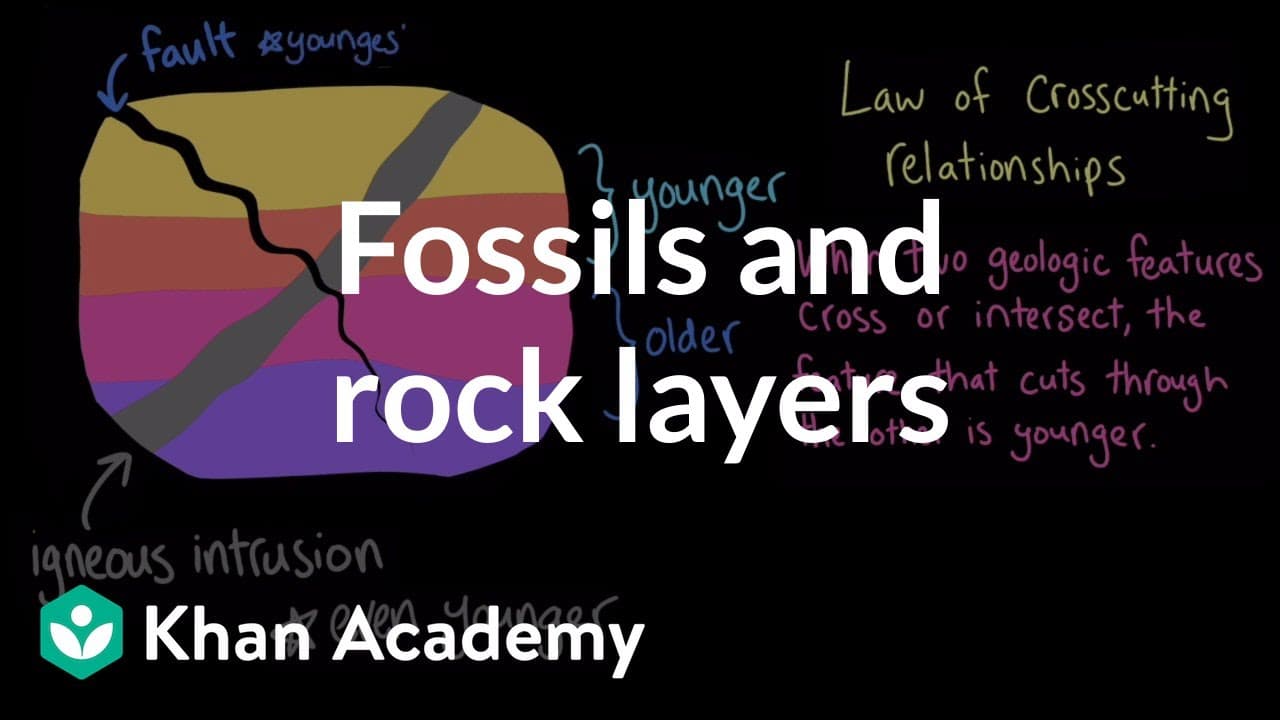
- 🤕 The Law of Crosscutting Relationships aids in determining the relative ages of geologic features by analyzing intersections.
- 🫰 Index fossils serve as markers for specific time periods within the geologic timescale.
- 👻 Relative dating has allowed scientists to understand the timeline of major events, the evolution of life, and the emergence of modern humans.
- 💢 Earth's 4.6-billion-year history is divided into eons and eras within the geologic timescale.
- 🪈 Relative dating helps establish the sequence of events and the order of the Earth's history.
Install to Summarize YouTube Videos and Get Transcripts
Explore YouTube Video Summarizer or Get YouTube Transcript Extractor
Questions & Answers
Q: How do geologists determine the ages of rock layers and fossils?
Geologists use various clues found in sedimentary rock layers, such as fossils and differences in mineral composition. They also apply the Law of Superposition, which states that undisturbed rock layers have the oldest ones at the bottom and the youngest ones at the top.
Q: What is the Law of Crosscutting Relationships?
The Law of Crosscutting Relationships states that when two geologic features intersect or cross, the one cutting through the other is younger. This helps geologists determine the relative ages of different rock layers and geologic features.
Q: How do index fossils help in relative dating?
Index fossils are fossils that are only found within a specific section of the geologic timescale. If a geologist finds the same index fossil in rock layers in two different locations, they can infer that those rock layers were formed during the same time period.
Q: How does relative dating contribute to our understanding of Earth's history?
Relative dating has allowed geologists to determine the timeline and sequence of major events in Earth's history, such as the extinction of Stegosauruses before the existence of T-Rex's and the emergence of modern humans around 200,000 years ago.
Summary & Key Takeaways
-
Geologists create a geologic timescale to map out Earth's 4.6-billion-year history, dividing it into eons and eras.
-
They gather clues from sedimentary rock layers, such as fossils and differences in mineral composition, to determine the ages of rocks and the events that occurred.
-
The Law of Superposition and the Law of Crosscutting Relationships are used to establish the relative ages of rock layers and geologic features.
Read in Other Languages (beta)
Share This Summary 📚
Summarize YouTube Videos and Get Video Transcripts with 1-Click
Try YouTube Summary with ChatGPT & Claude or YouTube Transcript Generator
Explore More Summaries from Khan Academy 📚



Summarize YouTube Videos and Get Video Transcripts with 1-Click
Try YouTube Summary with ChatGPT & Claude or YouTube Transcript Generator