Polynomial approximation of functions (part 2)
TL;DR
Understanding how to approximate functions using Maclaurin Series, which involves finding the infinite sum of the derivatives of the function at zero.
Transcript
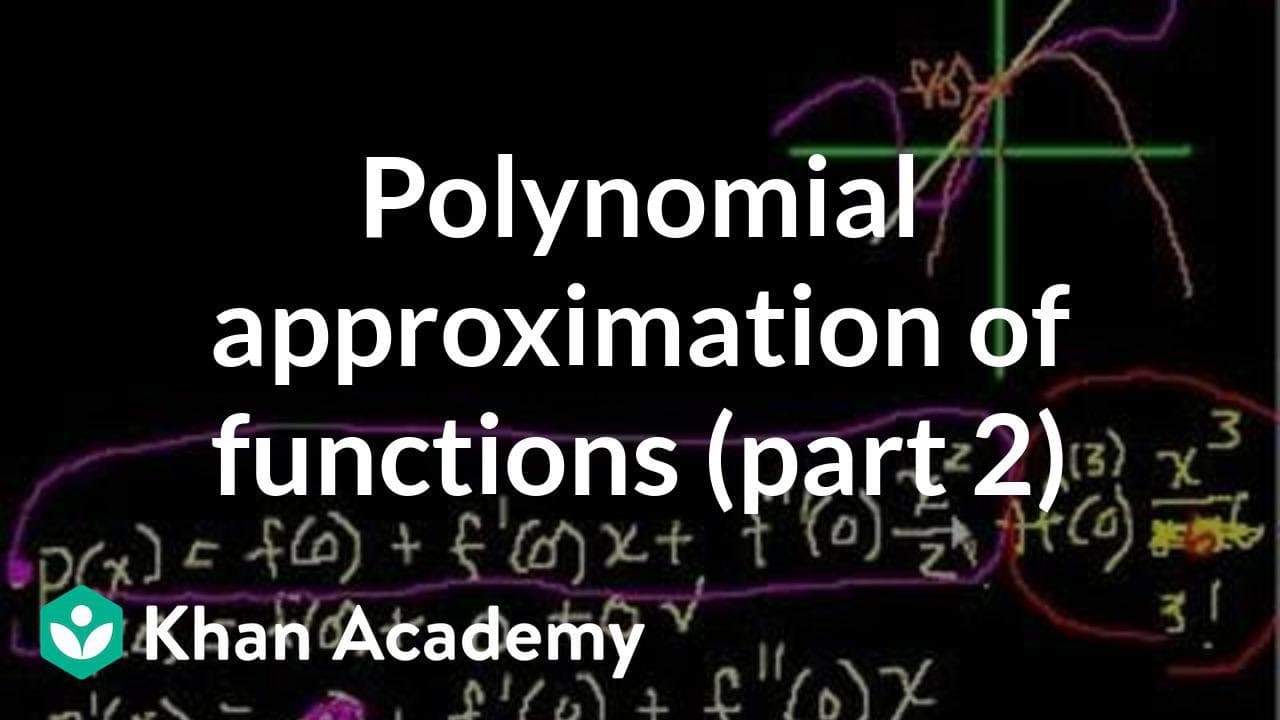
So where we left off in the last video, we kept trying to approximate this purple f of x with a polynomial. And we at first said we'll just make the polynomial a constant and set it -- it's just going to intersect f of 0 at x is equal to 0. So that's a first -- you can kind of all think of it as a 0 of order approximation of the function. Then we s... Read More
Key Insights
- 👻 The Maclaurin Series allows us to approximate functions using polynomials.
- 🍹 The series involves finding the infinite sum of derivatives of the function evaluated at zero.
- 🥡 The factorial in the denominator accounts for the number of derivatives taken.
- 🤲 The approximation gets more accurate as more terms of the series are included.
- ❓ The Maclaurin Series can be applied to various functions, including exponential functions like e^x.
- 💄 The derivatives of e^x are equal to e^x, which makes it an ideal function to demonstrate the Maclaurin Series.
- ✊ The Maclaurin Series is a specific example of the Taylor Series, which is a power series used for approximation.
Install to Summarize YouTube Videos and Get Transcripts
Explore YouTube Video Summarizer or Get YouTube Transcript Extractor
Questions & Answers
Q: What is the purpose of approximating functions with Maclaurin Series?
The purpose is to find a polynomial representation of a function that closely matches the behavior of the function near zero, making calculations easier.
Q: How are the derivatives of the function used in the Maclaurin Series?
Each term in the series is derived from the nth derivative of the function evaluated at zero, multiplied by x to the nth power, divided by n factorial.
Q: What is the significance of the factorial in the denominator of the Maclaurin Series?
The factorial accounts for the number of times the derivative is taken, ensuring that the correct coefficients are applied to each term in the series.
Q: Can the Maclaurin Series accurately represent any function?
The Maclaurin Series can approximate many functions, but not all. It works best for functions that have similar derivatives at zero.
Summary & Key Takeaways
-
In this video, the concept of approximating functions with polynomials using Maclaurin Series is explained.
-
The Maclaurin Series involves finding the infinite sum of derivatives of the function evaluated at zero.
-
The video demonstrates the process with various examples, including the approximation of e^x using Maclaurin Series.
Read in Other Languages (beta)
Share This Summary 📚
Summarize YouTube Videos and Get Video Transcripts with 1-Click
Try YouTube Summary with ChatGPT & Claude or YouTube Transcript Generator
Explore More Summaries from Khan Academy 📚



Summarize YouTube Videos and Get Video Transcripts with 1-Click
Try YouTube Summary with ChatGPT & Claude or YouTube Transcript Generator