What Are Server-Side Sessions for User Authentication?
TL;DR
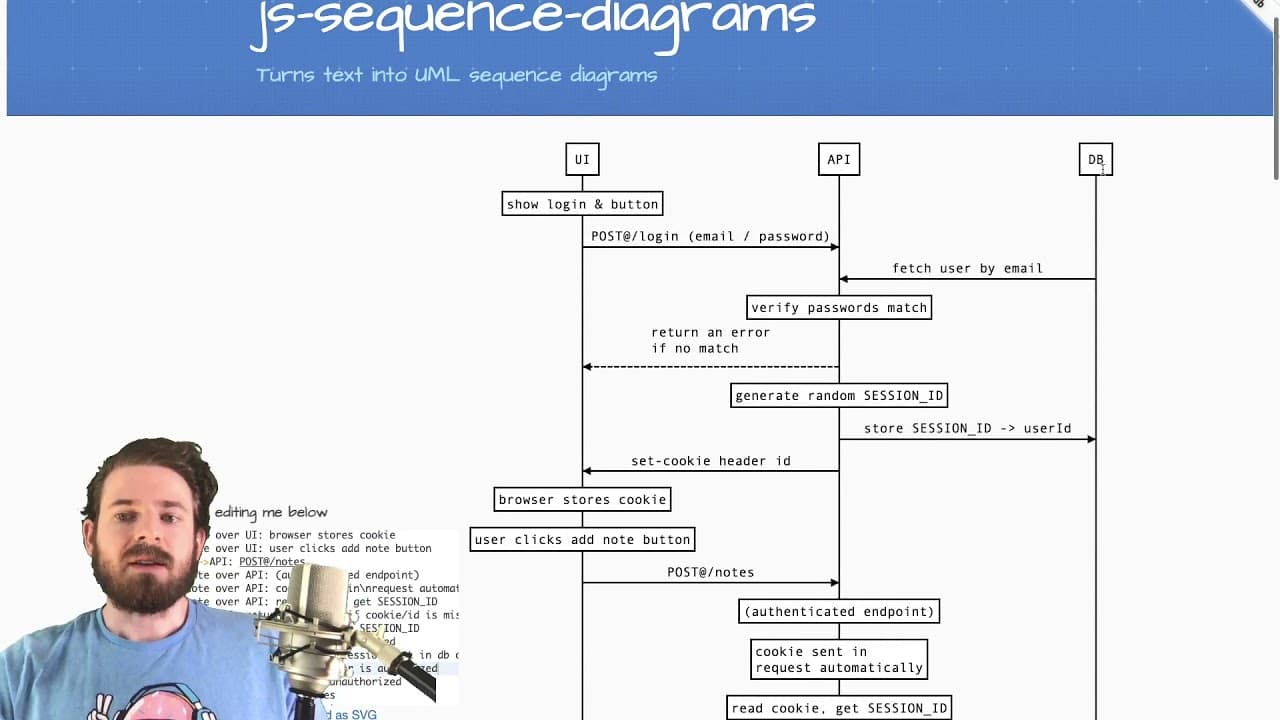
Server-side sessions store user authentication data securely, allowing users to maintain their login state across multiple requests. When a user logs in, a unique session ID is generated and stored, mapping it to the user's details in a fast-access storage like Redis. Proper management includes validating session expiration and user roles to ensure security and efficient access control.
Transcript
hey everyone i hope you guys are having a great day welcome back to another web dev junkie video so if you haven't seen my last video i published a sequence diagram where i talked about jwt and how you could potentially use it with your authentication on your applications uh and someone asked if i could do a session a server session talk where i ki... Read More
Key Insights
- 👤 Server sessions streamline the process of maintaining user authentication across multiple requests, which is vital for seamless user experiences.
- 🙃 Proper generation and storage of session IDs are fundamental in preventing security vulnerabilities like session fixation or hijacking.
- 🏪 Utilizing in-memory data stores like Redis offers significant performance benefits when retrieving session data on frequent requests.
- 👤 The flow from user login to session validation is critical to understand for building secure applications, guiding developers in implementing robust authentication systems.
- 🕸️ Handling session expiration and renewal is essential for ensuring long-term security in any web application using server-side sessions.
- 😘 Frameworks can simplify session management considerably, making it easier for developers to implement secure authentication without delving into low-level mechanics.
- 🔒 Constantly monitoring and updating session-related security measures is imperative as threats and vulnerabilities evolve.
Install to Summarize YouTube Videos and Get Transcripts
Explore YouTube Video Summarizer or Get YouTube Transcript Extractor
Questions & Answers
Q: What is the main purpose of server sessions in web applications?
Server sessions are primarily used to manage user authentication in web applications. They maintain a user's state throughout their interaction with the application, allowing for secure access to various functionalities, particularly authenticated endpoints. A session helps ensure that users remain logged in across multiple requests without re-entering credentials repeatedly.
Q: How does the session ID ensure security in user sessions?
The session ID must be a sufficiently long and complex value to prevent guessing or session hijacking attempts. Generating a random session ID that is associated only with an authenticated user prevents unauthorized access to session information, thereby enhancing the security of user data during a session.
Q: Why is it recommended to set session expiration times?
Setting expiration times for sessions is crucial for maintaining security. Expiration ensures that even if a session ID is compromised, the window of opportunity for an attacker is limited. Users can also log out or automatically be logged out after a period of inactivity, reducing the risk of unauthorized access to their accounts.
Q: What are some common storage options for session data?
Common storage options for session data include in-memory systems like Redis and traditional relational databases. In-memory caches are favored for their speed since session data is frequently accessed. However, the choice of storage depends on the application's requirements for performance, scalability, and persistence.
Q: What role does user authorization play in server-side sessions?
User authorization is critical in server-side sessions, as it determines whether a user has the right to access specific resources or endpoints. After validating a session, the application checks the user's role and permissions against the requested resource to ensure proper security and access control.
Q: How can developers implement session management without starting from scratch?
Many web frameworks, like Node.js with Passport.js or Django, come with built-in session management features. These frameworks abstract much of the complexity involved in creating and managing sessions, allowing developers to focus on implementing business logic without worrying about the underlying mechanics of session handling.
Summary & Key Takeaways
-
The video provides an overview of server sessions and their role in user authentication, contrasting them with JWTs previously discussed. It emphasizes the importance of managing session IDs securely.
-
It details the flow of user authentication, including the steps from submitting a login form, fetching user data, and creating a session ID that associates with the user's session.
-
The presenter discusses best practices for session management, like using in-memory caches for performance while ensuring timely expiration of sessions to maintain security.
Read in Other Languages (beta)
Share This Summary 📚
Summarize YouTube Videos and Get Video Transcripts with 1-Click
Try YouTube Summary with ChatGPT & Claude or YouTube Transcript Generator
Explore More Summaries from Web Dev Cody 📚

Summarize YouTube Videos and Get Video Transcripts with 1-Click
Try YouTube Summary with ChatGPT & Claude or YouTube Transcript Generator