Products
Features
YouTube Video Summarizer
Summarize YouTube videos
Web & PDF Highlighter
Highlight web pages & PDFs
Chat with PDF
Ask any PDF questions with AI
Ask AI Clone
Chat with your highlights & memories
Audio Transcriber
Transcribe audio files to text
Glasp Reader
Read and highlight articles
Kindle Highlight Export
Export your Kindle highlights
Idea Hatch
Hatch ideas from your highlights
Integrations
Obsidian Plugin
Notion Integration
Pocket Integration
Instapaper Integration
Medium Integration
Readwise Integration
Snipd Integration
Hypothesis Integration
Apps & Extensions
Chrome Extension
Safari Extension
Edge Add-ons
Firefox Add-ons
iOS App
Android App
Discover
Discover
Ideas
Discover new ideas and insights
Articles
Curated articles and insights
Books
Book recommendations by great minds
Posts
Essays and notes from readers
Quotes
Inspiring quotes collection
Videos
Curated videos and summaries
Explore Glasp
Glasp Newsletter
Weekly insights and updates
Glasp Talk
Interview series with great minds
Glasp Blog
Latest news and articles
Glasp Use Cases
Learn how others use Glasp
Build & Support
Glasp API
Access Glasp's API for developers
MCP Connector
Connect Glasp to Claude & ChatGPT
Community
Glasp Reddit Community
Students
Student discount and benefits
FAQs
Frequently Asked Questions
AboutPricing
DashboardLog inSign up

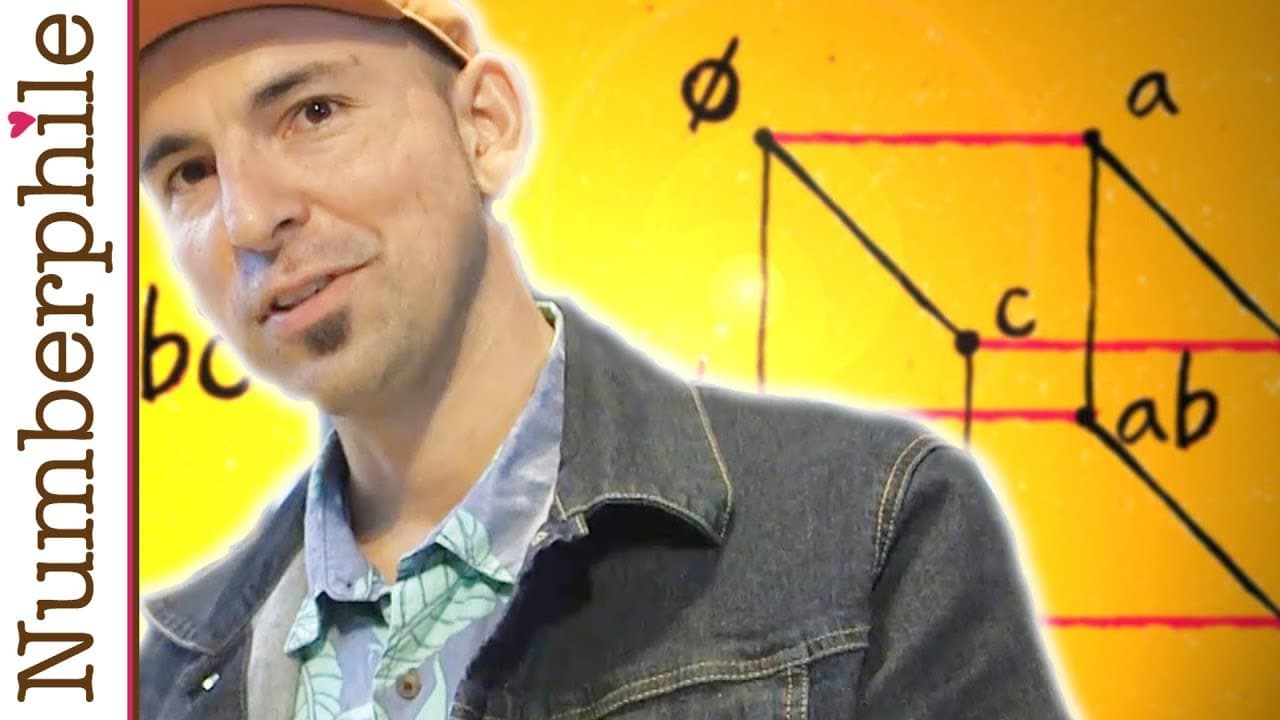
Combinatorics and Higher Dimensions - Numberphile
217.0K views
•
April 5, 2018
by
Numberphile
YouTube video player
Combinatorics and Higher Dimensions - Numberphile

TL;DR

Geometric combinatorics studies the possibilities and arrangements of subsets in a given set, with insights into their geometric representations and connections.

Transcript

Combinatorics is the study of possibilities. So, you know, if you have a given set, how many subsets might it have? Or if we have a given set, how can you arrange it in a line? So I want to talk about these questions but I want to talk about them from a geometric point of view. Let's do an example. So let's say, we have a set of 3 elements A, B, a... Read More

Key Insights

  • 😫 Combinatorics involves studying possibilities and arrangements in sets and subsets.
  • ❓ Geometric combinatorics provides a visual approach to understanding subsets and their structures through graphical representations.
  • 😫 Counting subsets can be achieved by making decisions for each element, resulting in 2^N possibilities for a set with N elements.

Install to Summarize YouTube Videos and Get Transcripts

Explore YouTube Video Summarizer or Get YouTube Transcript Extractor

Questions & Answers

Q: How can combinatorics be studied from a geometric perspective?

Geometric combinatorics approaches combinatorial questions by representing subsets in graphical forms, such as points, lines, squares, and cubes, to visualize their connections and structures.

Q: How are subsets counted in combinatorics?

Counting subsets can be achieved by making decisions for each element in the set (including or excluding), resulting in a total of 2^N possible subsets for a set with N elements.

Q: What is the significance of geometric models in combinatorics?

Geometric models offer a more detailed explanation for the multiplication formula used in combinatorics, showcasing visually how the number of subsets doubles with the addition of each new element.

Q: Can geometric combinatorics be applied to higher dimensions?

Yes, geometric combinatorics can be extended to higher dimensions, such as 4-dimensional shapes, by representing subsets and their connections in higher-dimensional figures.

Summary & Key Takeaways

  • Combinatorics is the study of possibilities and arrangements in sets and subsets, focusing on questions of counting and selecting elements.

  • Geometric combinatorics takes a geometric approach to these questions, representing subsets in graphical forms to understand their relationships.

  • Visualizing subsets as points, lines, squares, and cubes helps in understanding the connections and structures among them.


Read in Other Languages (beta)

English

Share This Summary 📚

Summarize YouTube Videos and Get Video Transcripts with 1-Click

Download browser extensions on:

Try YouTube Summary with ChatGPT & Claude or YouTube Transcript Generator

Explore More Summaries from Numberphile 📚

What Is the 10,958 Problem in Mathematics? thumbnail
What Is the 10,958 Problem in Mathematics?
Numberphile
Brown Numbers - Numberphile thumbnail
Brown Numbers - Numberphile
Numberphile
Professors React to 2048 - Numberphile thumbnail
Professors React to 2048 - Numberphile
Numberphile
Cow-culus and Elegant Geometry - Numberphile thumbnail
Cow-culus and Elegant Geometry - Numberphile
Numberphile
29 and Leap Years - Numberphile thumbnail
29 and Leap Years - Numberphile
Numberphile
The Girl with the Hyperbolic Helicoid Tattoo - Numberphile thumbnail
The Girl with the Hyperbolic Helicoid Tattoo - Numberphile
Numberphile

Summarize YouTube Videos and Get Video Transcripts with 1-Click

Download browser extensions on:

Try YouTube Summary with ChatGPT & Claude or YouTube Transcript Generator

Apps & Extensions

  • Chrome Extension
  • Safari Extension
  • Edge Add-ons
  • Firefox Add-ons
  • iOS App
  • Android App

Key Features

  • YouTube Video Summarizer
  • Web & PDF Summarizer
  • Web & PDF Highlighter
  • Chat with PDF
  • Ask AI Clone
  • Audio Transcriber
  • Glasp Reader
  • Kindle Highlight Export
  • Idea Hatch

Integrations

  • Obsidian Plugin
  • Notion Integration
  • Pocket Integration
  • Instapaper Integration
  • Medium Integration
  • Readwise Integration
  • Snipd Integration
  • Hypothesis Integration

More Features

  • APIs
  • MCP Connector
  • Blog & Post
  • Embed Links
  • Image Highlight
  • Personality Test
  • Quote Shots

Company

  • About us
  • Blog
  • Community
  • FAQs
  • Job Board
  • Newsletter
  • Pricing
Terms

•

Privacy

•

Guidelines

© 2026 Glasp Inc. All rights reserved.