Photoelectric Effect (7 of 8) Determining Planck's Constant
TL;DR
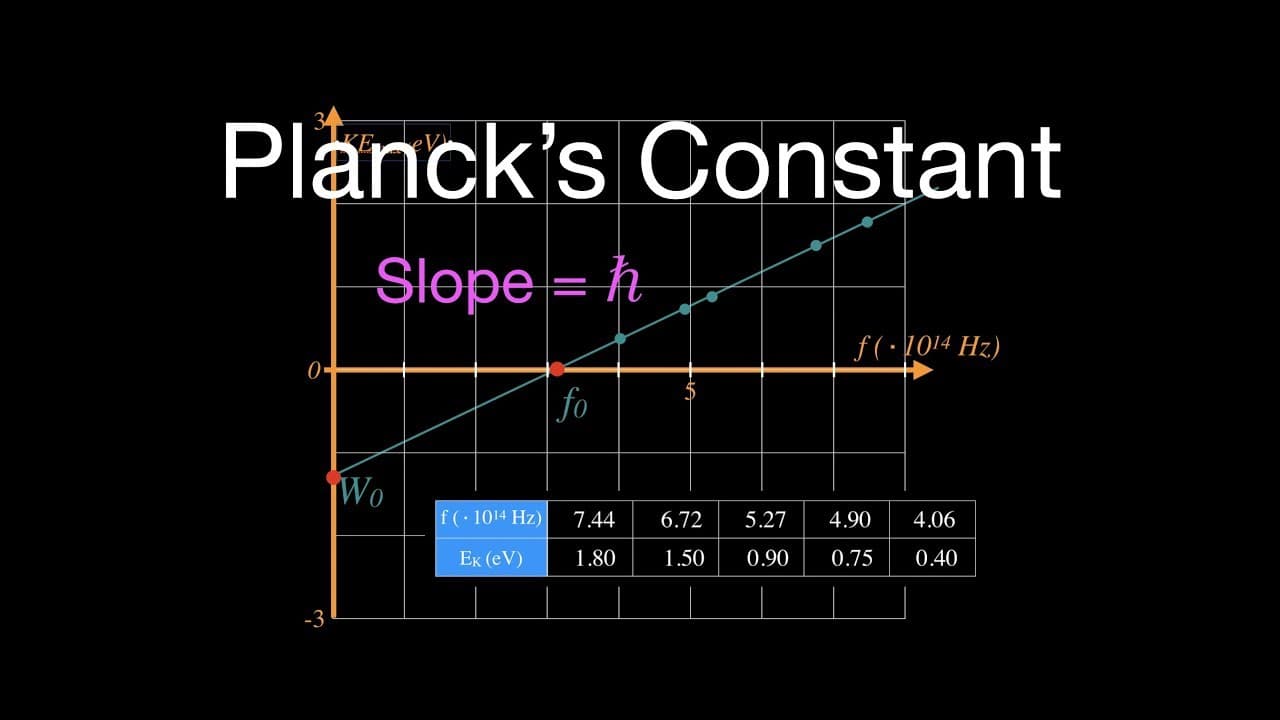
This video explains how to use the photoelectric effect to derive Planck's constant and determine other properties of a photocell.
Transcript
in today's video we're gonna go over another exciting video and the exciting topic of the photoelectric effect and today's video we are going to use the photoelectric effect to derive Planck's constant before we can start please don't forget subscribe to my channel to all my excellent physics chemistry and math videos and don't forget I've made sev... Read More
Key Insights
- 🙂 The photoelectric effect can be used to find Planck's constant by measuring the stopping potential of light of different wavelengths on a photocell.
- 👻 Converting wavelengths into frequency and stopping potential into kinetic energy allows for the creation of a graph showing the relationship between maximum kinetic energy and frequency.
- 💦 The cutoff frequency represents the minimum frequency needed for photoelectrons to have any kinetic energy, while the work function is the energy required to emit an electron from the photocell.
Install to Summarize YouTube Videos and Get Transcripts
Explore YouTube Video Summarizer or Get YouTube Transcript Extractor
Questions & Answers
Q: What is the photoelectric effect?
The photoelectric effect is the phenomenon where light of a certain frequency causes electrons to be emitted from a material. It played a crucial role in the development of quantum mechanics.
Q: How does the stopping potential relate to the energy of incident photons?
The stopping potential is the minimum potential difference needed to prevent photoelectrons from reaching the anode. As the wavelength of the incident light increases, the energy of the photons decreases, resulting in a lower stopping potential.
Q: How can the frequency of incident light be determined from the given wavelength?
The frequency can be calculated by dividing the speed of light by the wavelength. Since the speed of light is constant, a shorter wavelength corresponds to a higher frequency.
Q: What is the significance of the graph shown in the video?
The graph shows a linear relationship between the frequency of the incident light and the maximum kinetic energy of the photoelectrons. The slope of the graph is equal to Planck's constant.
Summary & Key Takeaways
-
The video discusses the use of the photoelectric effect to find Planck's constant by measuring the stopping potential of light of different wavelengths on a photocell.
-
It explains the process of converting wavelengths into frequency and stopping potential into kinetic energy to create a graph showing the relationship between maximum kinetic energy and frequency.
-
The video also covers the concepts of cutoff frequency and work function, and demonstrates how these can be calculated using the graph and data obtained from the experiment.
Read in Other Languages (beta)
Share This Summary 📚
Summarize YouTube Videos and Get Video Transcripts with 1-Click
Try YouTube Summary with ChatGPT & Claude or YouTube Transcript Generator
Explore More Summaries from Step by Step Science 📚

Summarize YouTube Videos and Get Video Transcripts with 1-Click
Try YouTube Summary with ChatGPT & Claude or YouTube Transcript Generator