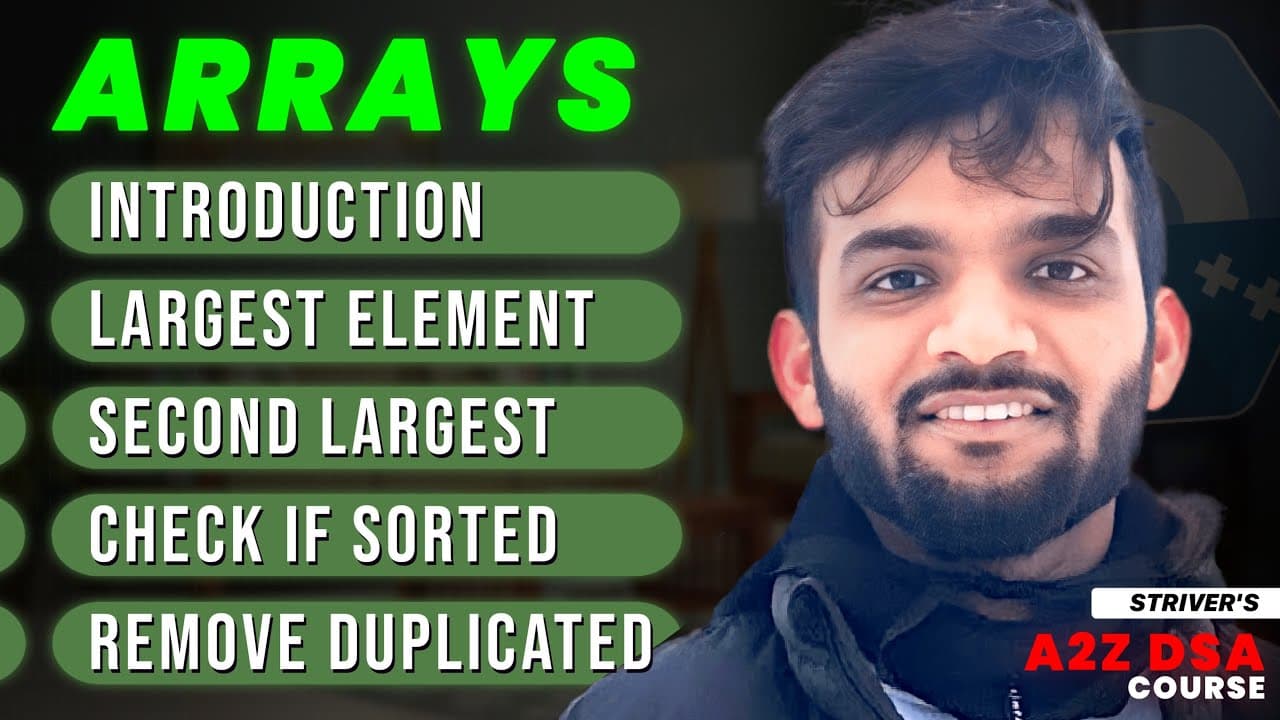
Find Second Largest Element in Array | Remove duplicates from Sorted Array | Arrays Intro Video
TL;DR
Introduction to arrays and problem-solving techniques with examples.
Transcript
hey everyone welcome back to the channel I hope you guys are doing extremely well so this is another lecture from the sters A2Z DSA course so just in case you're for the first time here this is world's most in-depth DS algo course why do I say that because you can go over the entire internet buy any of the paid courses none of them ... Read More
Key Insights
- The course covers the most in-depth DS Algo topics with 456 modules and 400+ problems, ensuring thorough preparation for interviews.
- Arrays are data structures that store elements of the same data type, such as integers or strings, and are indexed starting from zero.
- The maximum size of an array declared globally in C++ or Java can be 10^7, while locally it is 10^6.
- Array elements are stored in contiguous memory locations, and access is done via indices.
- Optimal problem-solving involves understanding brute force, better, and optimal solutions, focusing on time and space complexity.
- Finding the largest element in an array can be optimized from n log n to O(n) by avoiding sorting and using a single pass.
- The second largest element can be found using a two-pass approach or optimized to a single pass with careful comparisons.
- Removing duplicates from a sorted array can be efficiently achieved using a two-pointer technique, reducing space complexity.
Install to Summarize YouTube Videos and Get Transcripts
Explore YouTube Video Summarizer or Get YouTube Transcript Extractor
Questions & Answers
Q: What is the purpose of the DS Algo course mentioned in the video?
The DS Algo course aims to provide the most comprehensive preparation for data structure and algorithm interviews. It includes 456 modules and over 400 problems, ensuring that learners can clear DS Algo rounds in interviews for any company worldwide.
Q: How is an array defined and accessed in programming?
An array is a data structure that contains elements of the same data type, such as integers or strings. It is indexed starting from zero, and elements are stored in contiguous memory locations. Accessing elements is done via their indices, using a loop from index 0 to size-1.
Q: What is the difference between brute force and optimal solutions?
Brute force solutions involve the most straightforward approach, often using more time and space, like sorting an array to find the largest element. Optimal solutions are more efficient, reducing time and space complexity, such as finding the largest element in a single pass without sorting.
Q: How can the largest element in an array be found optimally?
The largest element in an array can be found optimally by initializing a variable with the first element and iterating through the array, updating the variable whenever a larger element is found. This approach has a time complexity of O(n), which is more efficient than sorting.
Q: What are the steps to find the second largest element in an array?
To find the second largest element, initialize the largest and second largest variables. Iterate through the array, updating the largest and second largest variables based on comparisons. If an element is greater than the largest, update the second largest with the previous largest and the largest with the current element.
Q: How is the two-pointer technique used to remove duplicates in a sorted array?
In a sorted array, the two-pointer technique involves using one pointer to iterate through the array and another to track the position for unique elements. As the first pointer finds unique elements, they are placed at the position of the second pointer, which is then incremented.
Q: What precautions should be taken when coding for array problems in interviews?
When coding for array problems in interviews, use meaningful variable and function names, follow a structured approach (brute, better, optimal), and be prepared to explain time and space complexity. Ensure the solution is efficient and meets the problem's constraints.
Q: What is the significance of understanding array basics before solving problems?
Understanding array basics is crucial because it provides the foundational knowledge needed to manipulate arrays effectively. It includes knowledge of memory allocation, indexing, and data type constraints, all of which are essential for implementing efficient solutions to array problems.
Summary & Key Takeaways
-
This video introduces arrays, discussing their structure, memory allocation, and indexing methods. It emphasizes understanding basic concepts before moving into problem-solving.
-
The instructor outlines a systematic approach to problem-solving, encouraging viewers to explore brute force, better, and optimal solutions, with emphasis on time and space complexity.
-
Several array-related problems are tackled, including finding the largest and second largest elements, checking if an array is sorted, and removing duplicates from a sorted array.
Read in Other Languages (beta)
Share This Summary 📚
Summarize YouTube Videos and Get Video Transcripts with 1-Click
Try YouTube Summary with ChatGPT & Claude or YouTube Transcript Generator
Explore More Summaries from take U forward 📚




Summarize YouTube Videos and Get Video Transcripts with 1-Click
Try YouTube Summary with ChatGPT & Claude or YouTube Transcript Generator