How Does Doping Concentration Affect Fermi Level in P-Type Semiconductors?
TL;DR
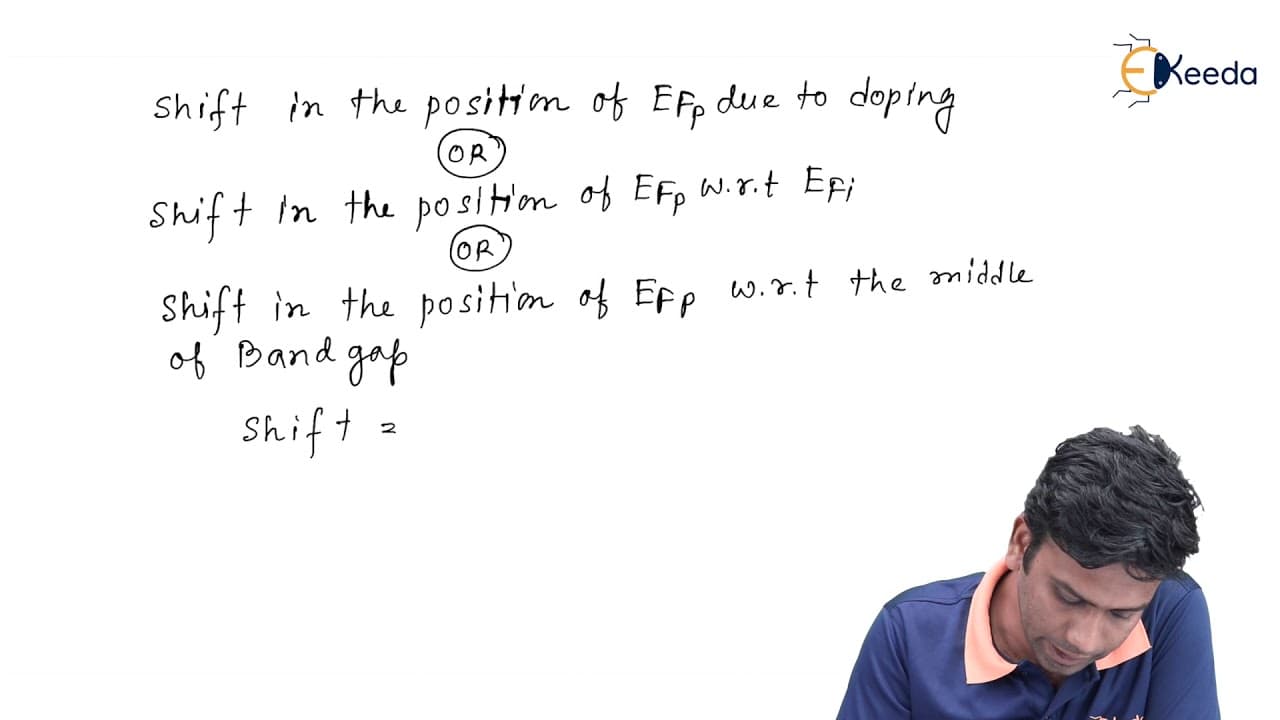
Doping concentration significantly influences the Fermi level in p-type semiconductors; as the concentration of acceptors increases, the Fermi level moves downward into the valence band, resulting in a p-type degenerate semiconductor. This shift increases conductivity, especially when the acceptor concentration surpasses the intrinsic carrier concentration.
Transcript
hello friends in this video we are going to discuss how the position of the Fermi level will change depending on the doping concentration in the p-type semiconductor so the doping concentration will control the position of the Fermi level in a p-type semiconductor let us see how it is controlling so effect of doping let us say that the doping conce... Read More
Key Insights
- 🧘 The position of the Fermi level in a p-type semiconductor depends on the doping concentration.
- 🎚️ When the doping concentration exceeds the intrinsic carrier concentration, the Fermi level moves below the valence band energy level.
- 🤯 Higher acceptor concentrations result in a lower Fermi level position, leading to increased conductivity in a p-type semiconductor.
- 😀 The shift in the position of the Fermi level in a p-type semiconductor due to doping can be calculated using the equation: shift = -KT ln(na/ni).
- 🧘 The position of the Fermi level determines the behavior and conductivity of semiconductors.
- 🅰️ A p-type degenerate semiconductor refers to a p-type semiconductor where the Fermi level is within the valence band.
Install to Summarize YouTube Videos and Get Transcripts
Explore YouTube Video Summarizer or Get YouTube Transcript Extractor
Questions & Answers
Q: How does the position of the Fermi level change in a p-type semiconductor with increased doping concentration?
As the acceptor concentration (doping concentration) increases, the Fermi level in a p-type semiconductor moves closer to the valence band, resulting in a lower Fermi level position.
Q: What happens when the acceptor concentration exceeds the intrinsic carrier concentration in a p-type semiconductor?
When the acceptor concentration is greater than the intrinsic carrier concentration, the Fermi level shifts below the energy level of the valence band, leading to a p-type degenerate semiconductor.
Q: How does the conductivity of a p-type semiconductor change with increasing acceptor concentration?
Increasing the acceptor concentration in a p-type semiconductor significantly increases its conductivity, as the Fermi level moves towards the valence band Maxima.
Q: What is the equation for calculating the shift in the position of the Fermi level in a p-type semiconductor due to doping?
The shift in the position of Fermi level (EAP) with respect to the intrinsic Fermi level (EFI) in a p-type semiconductor can be calculated using the equation: shift = -KT ln(na/ni), where na is the acceptor concentration and ni is the intrinsic carrier concentration.
Summary & Key Takeaways
-
Doping concentration in a p-type semiconductor controls the position of the Fermi level, with higher concentrations resulting in a lower Fermi level.
-
When the acceptor concentration is greater than the intrinsic carrier concentration, the Fermi level moves below the energy level of the valence band, leading to a p-type degenerate semiconductor.
-
Increasing the acceptor concentration in a p-type semiconductor increases its conductivity significantly.
Read in Other Languages (beta)
Share This Summary 📚
Summarize YouTube Videos and Get Video Transcripts with 1-Click
Try YouTube Summary with ChatGPT & Claude or YouTube Transcript Generator
Explore More Summaries from Ekeeda 📚





Summarize YouTube Videos and Get Video Transcripts with 1-Click
Try YouTube Summary with ChatGPT & Claude or YouTube Transcript Generator