What Is a JavaScript Closure and How Does It Work?
TL;DR
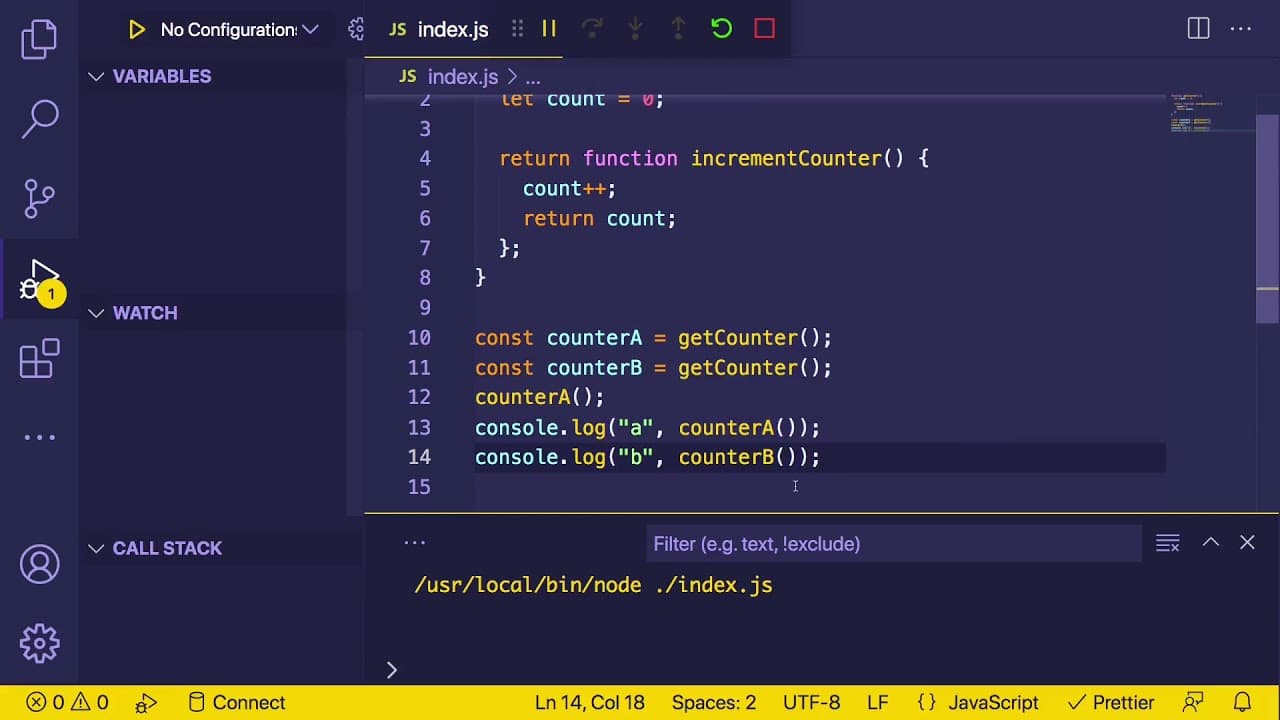
A JavaScript closure is a function that retains access to its lexical scope even when executed outside that scope. It allows for the creation of private variables and enables multiple independent instances of functions with their own state, resolving issues with shared variables. Understanding closures is essential for mastering advanced JavaScript concepts and for writing modular, maintainable code.
Transcript
so when i'm doing live streams one of the same questions i get asked a lot is can i explain javascript closure so i'm going to try to do that in a video and hopefully this makes sense for you all if you go up and try to read about closures some of the the terminology can be kind of confusing so let's just try to talk about this as easy as possible ... Read More
Key Insights
- 💨 Closures create a way to handle private variables in JavaScript, improving encapsulation and reducing global state pollution.
- 😒 The use of factory functions illustrates how closures can generate multiple independent function instances with their own private state.
- 💦 Understanding how scope works in JavaScript, including global and local contexts, is essential for effectively using closures.
- 👻 Closures can be powerful tools in functional programming, allowing for cleaner, more modular code structures.
- ❓ Learning about closures enhances a developer's problem-solving toolkit, enabling more robust JavaScript development.
- 🎮 The example in the video provides a practical approach to understanding closures through a relatable scenario of incrementing counters.
- ❓ Grasping closures is critical for mastering advanced JavaScript concepts like callbacks, promises, and event handling.
Install to Summarize YouTube Videos and Get Transcripts
Explore YouTube Video Summarizer or Get YouTube Transcript Extractor
Questions & Answers
Q: What are JavaScript closures?
JavaScript closures are functions that retain access to their lexical scope, even when called outside their original context. They allow functions to have private variables that can be manipulated and accessed only within the function that defines them, making them essential for managing state in various applications.
Q: How do closures help manage multiple counters?
Closures allow you to create separate instances of counters by encapsulating the count variable within a function. By returning another function, each instance has its own private count, which means you can increment each counter independently without interference from others.
Q: What is a higher-order function?
A higher-order function is a function that either takes another function as an argument or returns a function as its result. In the context of closures, the function that encapsulates private variables often serves as a higher-order function, showcasing the flexibility and power of JavaScript's functional programming model.
Q: Why is understanding closures important for JavaScript developers?
Understanding closures is vital for JavaScript developers because they enable more sophisticated and maintainable coding patterns, such as data encapsulation and functional programming paradigms. Mastering closures also demonstrates strong knowledge of JavaScript’s scoping rules and modular design patterns.
Q: Can you provide an example of using closures in real-world applications?
Yes, closures can be used in various scenarios, such as creating private methods in JavaScript classes or managing asynchronous operations like network requests. They effectively encapsulate behavior and data, allowing developers to control access to variables, which can enhance security and modularity.
Q: How does lexical scoping relate to closures?
Lexical scoping means that functions can access variables from their parent scope at the time of their definition. In closures, the inner function maintains a reference to its enclosing lexical context, allowing it to access private variables even after the outer function has executed.
Summary & Key Takeaways
-
The video addresses a common question about JavaScript closures by using a practical example of incrementing a counter. It explains how closures allow for private variables.
-
A single count variable can create issues with multiple counters, making it difficult to track increments separately. Closures solve this by encapsulating counts in factory functions.
-
Understanding closures involves grasping advanced JavaScript concepts, including lexical scoping and higher-order functions, which are crucial for effective JavaScript programming.
Read in Other Languages (beta)
Share This Summary 📚
Summarize YouTube Videos and Get Video Transcripts with 1-Click
Try YouTube Summary with ChatGPT & Claude or YouTube Transcript Generator
Explore More Summaries from Web Dev Cody 📚

Summarize YouTube Videos and Get Video Transcripts with 1-Click
Try YouTube Summary with ChatGPT & Claude or YouTube Transcript Generator