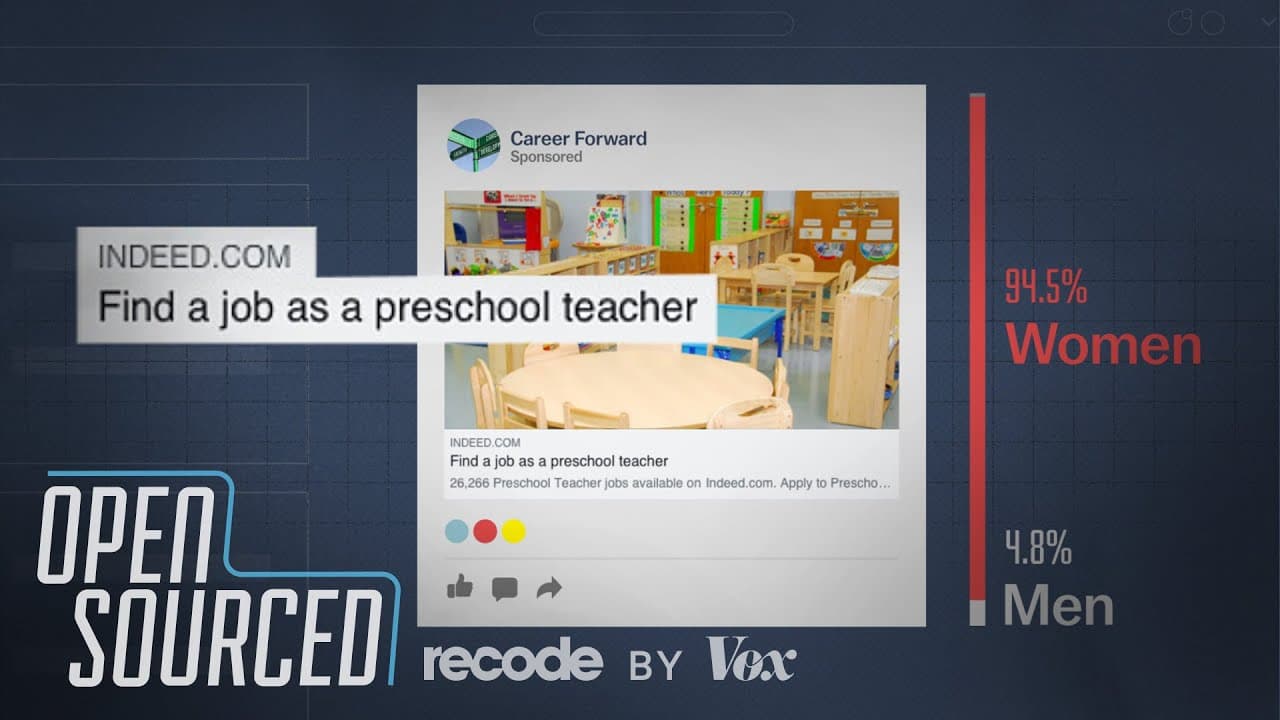
Facebook showed this ad to 95% women. Is that a problem?
TL;DR
Facebook's ad delivery can unintentionally create biased audience outcomes.
Transcript
Before the 1970s, people looking for jobs in the US would open up the “help wanted” section of their newspapers and see this. One set of opportunities for women, and one for men. We don’t see job ads like this anymore, largely because it’s been illegal for decades. But also because advertising is now much more targeted. Instead of one classified ... Read More
Key Insights
- Facebook's ad targeting algorithms can inadvertently create biased outcomes by displaying ads to skewed audiences based on ad content.
- Researchers at Northeastern University found that Facebook's algorithms often show job ads to gender-skewed audiences, even without explicit targeting.
- Facebook uses extensive user data, including browsing history and interests, to predict ad engagement, influencing who sees which ads.
- The study highlights challenges in ensuring fair ad delivery, especially for legally protected categories like housing and employment.
- Facebook has faced criticism and legal action over its ad targeting practices, leading to changes in how ads are delivered and targeted.
- Despite changes, Facebook's ad delivery system still struggles with bias, as seen in skewed audience demographics for various job ads.
- The research suggests that ad delivery algorithms across platforms like Google and Twitter may also face similar bias issues.
- The industry lacks clear guidelines on when algorithmic audience segregation becomes unacceptable, raising ethical concerns.
Install to Summarize YouTube Videos and Get Transcripts
Explore YouTube Video Summarizer or Get YouTube Transcript Extractor
Questions & Answers
Q: How do Facebook's ad targeting algorithms work?
Facebook's ad targeting algorithms use extensive user data, including browsing history, interests, and demographic information, to predict which users are most likely to engage with a given ad. This prediction influences who actually sees the ad, leading to potential biases in audience demographics, even when targeting options are neutral.
Q: What did the Northeastern University researchers discover about Facebook's ad delivery?
The researchers found that Facebook's ad delivery algorithms often result in gender-skewed audiences for job ads, even when no explicit targeting is used. For instance, ads for jobs like cleaners and nurses were shown mostly to women, while ads for taxi drivers skewed towards Black users, indicating inherent biases in the algorithm.
Q: What legal actions has Facebook faced regarding its ad targeting practices?
Facebook has faced criticism and legal action from civil rights groups and the US Department of Housing and Urban Development over its ad targeting practices. These actions have led to changes in how ads related to housing, employment, and credit are delivered, aiming to prevent discrimination against specific demographic groups.
Q: Why is Facebook's ad delivery system still considered biased?
Despite changes to its targeting options, Facebook's ad delivery system is still considered biased because its algorithms can result in skewed audience demographics based on ad content. This occurs even without explicit targeting, suggesting that the system's predictions reinforce existing disparities in interests and opportunities.
Q: How does Facebook determine which users see specific ads?
Facebook determines which users see specific ads by analyzing user data to predict engagement likelihood. This involves considering factors like browsing history, interests, and demographic information. The platform's algorithms then decide the most 'relevant' audience for the ad, which can lead to skewed outcomes if the predictions are biased.
Q: What challenges do ad delivery algorithms face in ensuring fairness?
Ad delivery algorithms face challenges in ensuring fairness because they can inadvertently create biased outcomes by targeting skewed audiences based on ad content. This is particularly concerning for legally protected categories like housing and employment, where fairness and non-discrimination are critical.
Q: Are other platforms facing similar ad targeting bias issues?
Yes, other platforms like Google, Twitter, and LinkedIn may face similar ad targeting bias issues. The general principles of ad delivery algorithms across these platforms are similar, suggesting that they might also struggle with ensuring fair and unbiased ad delivery to diverse audiences.
Q: What ethical concerns arise from algorithmic audience segregation?
Algorithmic audience segregation raises ethical concerns because it can reinforce existing societal biases and disparities. When algorithms decide that certain audiences are more 'relevant' for specific ads, it can lead to exclusion and discrimination, particularly in areas like employment and housing, where equal opportunity is crucial.
Summary & Key Takeaways
-
Facebook's ad delivery algorithms can create biased outcomes by showing ads to skewed audiences based on ad content. Researchers found that even with neutral targeting, job ads often reached gender-skewed audiences. This raises concerns about fairness in ad delivery, especially for legally protected categories like housing and employment.
-
Northeastern University researchers discovered that Facebook's algorithms often display job ads to gender-skewed audiences, even without explicit targeting. The platform uses extensive user data to predict ad engagement, influencing who sees which ads. Despite changes, Facebook's ad delivery system still faces bias challenges.
-
Facebook has faced legal action over its ad targeting practices, leading to changes in ad delivery and targeting methods. However, the platform still struggles with bias, as seen in skewed audience demographics for various job ads. The industry lacks guidelines on when algorithmic audience segregation becomes unacceptable, raising ethical concerns.
Read in Other Languages (beta)
Share This Summary 📚
Summarize YouTube Videos and Get Video Transcripts with 1-Click
Try YouTube Summary with ChatGPT & Claude or YouTube Transcript Generator
Explore More Summaries from Vox 📚



Summarize YouTube Videos and Get Video Transcripts with 1-Click
Try YouTube Summary with ChatGPT & Claude or YouTube Transcript Generator