What is the Future of NLP with Deep Learning?
TL;DR
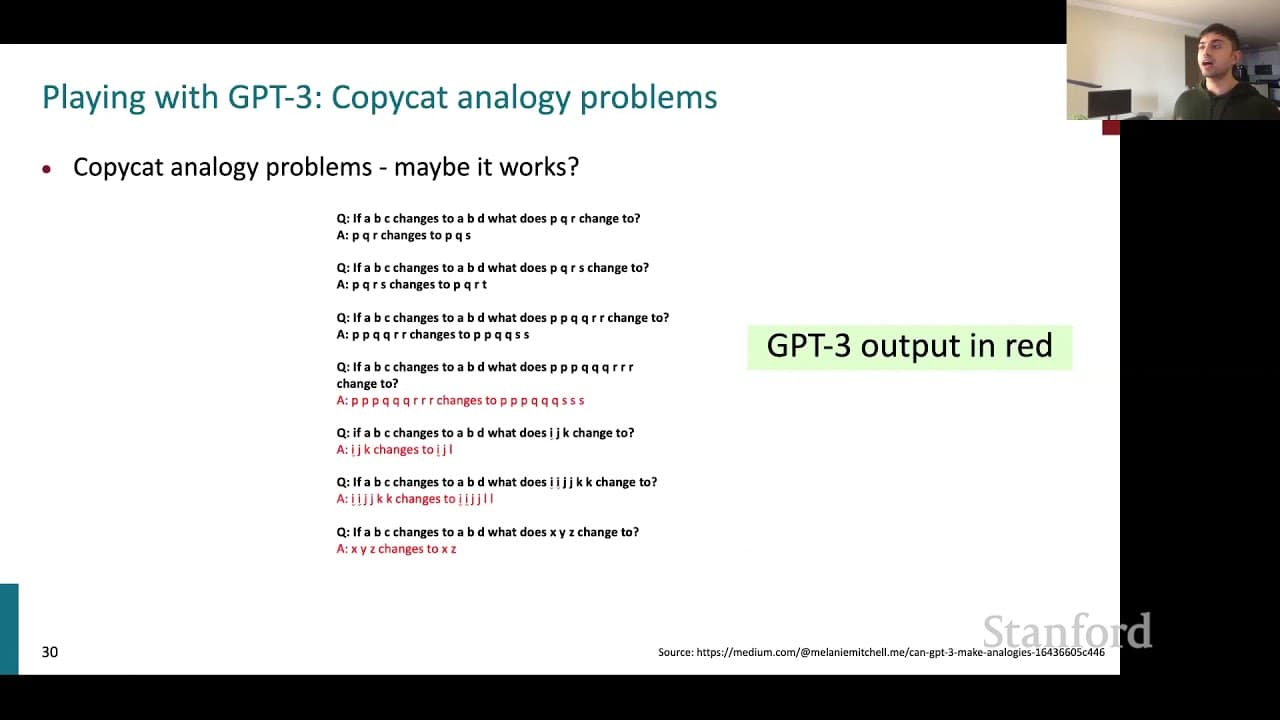
The lecture explores advancements in neural NLP, emphasizing large language models like GPT-3 and their role in tasks like language modeling and comprehension. Key challenges include the need for better evaluation metrics that reflect real-world performance and the exploration of modalities beyond text to improve language understanding. Practical tips for progressing in NLP research are also discussed.
Transcript
good afternoon folks uh welcome to lecture 18. today we'll be talking about some of the latest and greatest developments in neural nlp where we've come and where we're headed uh chris just to be sure uh are my present and what's visible from this part is it fine you're visible okay uh but none of my presenters right correct okay great thank you um ... Read More
Key Insights
- 🤳 The popularity of large language models like GPT-3 is due to advancements in hardware, system infrastructure, and self-supervised training with vast amounts of unlabeled data.
- 🌸 Training large language models follows a general representation learning recipe, involving data conversion, defining loss functions, and training on extensive data.
- 📕 GPT-3's architecture and training on a vast amount of data enable it to excel in language modeling, text completion, and knowledge-intensive tasks like close book QA and reading comprehension.
- 👻 In-context learning allows GPT-3 to adapt to new tasks more efficiently, demonstrating its potential as a few-shot learner.
- ⚖️ The scale and architecture of GPT-3 showcase the challenges involved in scaling up models, necessitating non-trivial engineering and algorithmic improvements.
- 🌍 Evaluating large language models like GPT-3 requires the development of better benchmarks that reflect real-world task performance and address limitations in logical and mathematical reasoning.
- ⚾ Moving beyond text-based language learning and exploring other modalities is essential to enhance the understanding and capabilities of neural language models.
- 🫠 Practical tips for progress in neural NLP research include reading extensively, understanding the mathematical foundations, learning about language, honing software skills, and effectively debugging models.
Install to Summarize YouTube Videos and Get Transcripts
Explore YouTube Video Summarizer or Get YouTube Transcript Extractor
Questions & Answers
Q: How can extremely large language models like GPT-3 learn to perform non-trivial tasks with just a few demonstrations?
GPT-3's ability to perform non-trivial tasks with few demonstrations is a result of its training on massive amounts of unlabeled data. By converting data into sequences of integers, defining loss functions, and training on ample data, these models can learn complex tasks even with minimal input.
Q: What are the limitations of GPT-3 and similar models in terms of logical and mathematical reasoning?
GPT-3 struggles with logical and mathematical reasoning tasks that involve multiple steps of reasoning. It is not adept at arithmetic, solving work problems, or making analogies. These limitations stem from the models' lack of explicit logical reasoning and systematic generalization.
Q: How can we make neural language models exhibit human-like generalization and systematicity?
Achieving human-like generalization and systematicity in neural language models requires further research and exploration. Researchers can focus on refining evaluation benchmarks, introducing curriculum learning and reinforcement learning techniques, and incorporating other modalities in training to improve the models' understanding and generalization capabilities.
Q: Are there attempts to crowdsource dynamic benchmarks for evaluation and online learning in NLP?
Yes, dynamic benchmarks are being created by deploying models to platforms where humans can interact with them and provide feedback. Crowdsourcing is employed to generate new examples that the model fails to classify but humans can understand. Platforms like Dynabench facilitate the construction of ever-changing test sets for better evaluation of model performance.
Summary & Key Takeaways
-
The lecture begins with announcements regarding project milestones and reports. It then delves into the topic of extremely large language models and their popularity.
-
The speaker emphasizes the importance of compositionality and generalization of neural models and discusses the challenges in evaluating their real-world task performance.
-
The need to go beyond text-based language learning and explore other modalities is highlighted, along with practical tips for neural NLP research and the final project.
Read in Other Languages (beta)
Share This Summary 📚
Summarize YouTube Videos and Get Video Transcripts with 1-Click
Try YouTube Summary with ChatGPT & Claude or YouTube Transcript Generator
Explore More Summaries from Stanford Online 📚
Summarize YouTube Videos and Get Video Transcripts with 1-Click
Try YouTube Summary with ChatGPT & Claude or YouTube Transcript Generator