6.6: Steering Behaviors: Path Following - The Nature of Code
TL;DR
This content explains the concept and implementation of path following steering behavior in vehicles.
Transcript
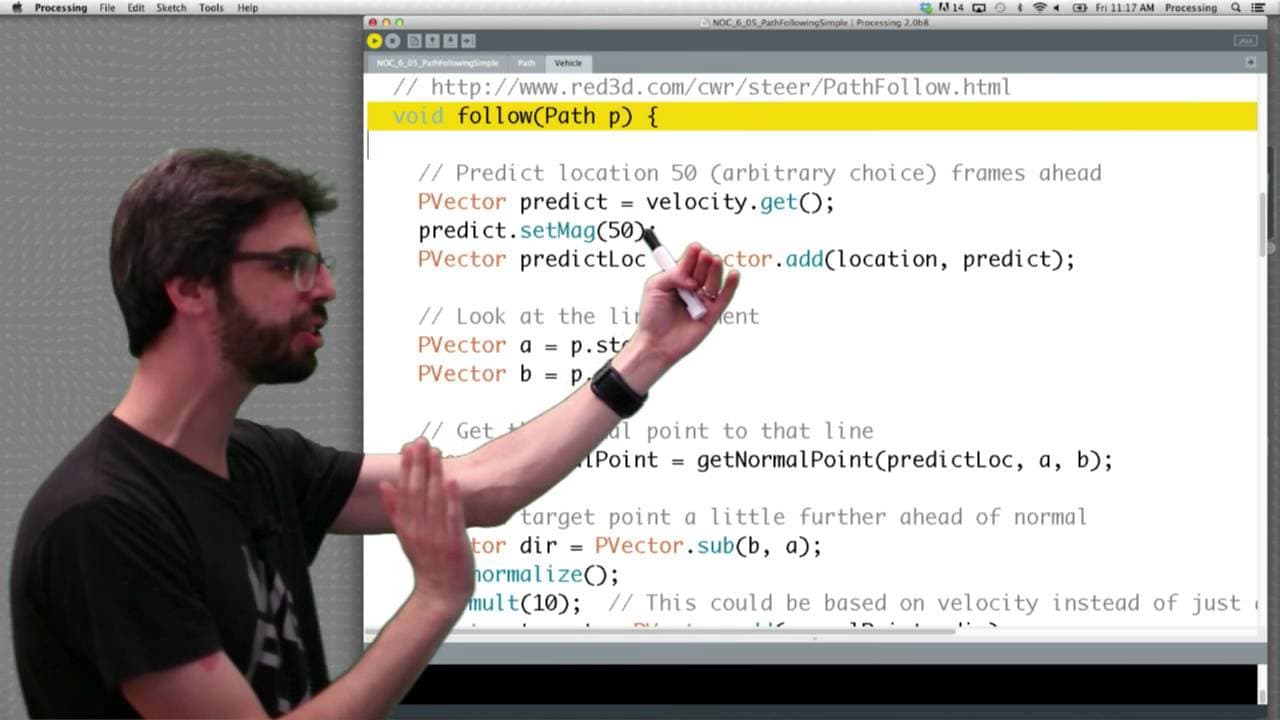
now that we've looked at the dot product and we understand the concept of scalar projection we're ready to look at the path following example the path following steering Behavior so let's say for a moment we have a path and a path we're going to Define as a line between two points something like this so what is our goal here I mean first of all we ... Read More
Key Insights
- 👻 Path following steering behavior allows vehicles to track and stay on a defined path accurately.
- 🚙 The algorithm checks the vehicle's future location to determine if it is already on the path.
- 🔯 Scalar projection and dot product calculations are used to find the closest point on the path to the vehicle's future location.
- 📌 The algorithm includes steps to predict a future location on the path and seek towards that location for path correction.
- 🫥 The complexity of the path can vary by using different techniques such as curved paths or paths with multiple line segments.
- ⌛ The behavior can be implemented in programming languages such as Processing for real-time simulations.
- 🐎 Different parameters such as path radius, maximum force, and maximum speed can be adjusted to achieve different path following behaviors.
Install to Summarize YouTube Videos and Get Transcripts
Explore YouTube Video Summarizer or Get YouTube Transcript Extractor
Questions & Answers
Q: What is the goal of path following steering behavior?
The goal is to create a flexible and lifelike behavior where a vehicle stays on a defined path, instead of being locked to it.
Q: How does the algorithm check if the vehicle is already on the path?
The algorithm checks the future location of the vehicle, which is calculated based on its current velocity. If the future location is already on the path, no steering behavior is applied.
Q: How is the closest point on the path found?
The algorithm finds the closest point on the path by calculating the distance between the vehicle's future location and each line segment of the path. The point with the shortest distance is selected.
Q: What is the purpose of seeking a target along the path?
If the vehicle is not on the path, a target location is determined by moving a certain distance along the path from the closest point. The vehicle then uses a seeking behavior to steer towards the target and get back on the path.
Summary & Key Takeaways
-
The content explores the concept of path following steering behavior, where a vehicle tries to stay on a defined path.
-
It discusses the steps involved in the path following algorithm, including checking the vehicle's future location and finding the closest point on the path.
-
A programming example in the Processing language is provided to demonstrate the implementation of path following behavior with a simple path consisting of straight line segments.
Read in Other Languages (beta)
Share This Summary 📚
Summarize YouTube Videos and Get Video Transcripts with 1-Click
Try YouTube Summary with ChatGPT & Claude or YouTube Transcript Generator
Explore More Summaries from The Coding Train 📚





Summarize YouTube Videos and Get Video Transcripts with 1-Click
Try YouTube Summary with ChatGPT & Claude or YouTube Transcript Generator