Types of Pavements - Design of Highway Pavements - Transportation Engineering - I
TL;DR
A comprehensive analysis of flexible, rigid, semi-rigid, and composite pavements, including their components, characteristics, and design considerations.
Transcript
hello students today we are going to study types of pavement a pavement is the load bearing and load distribution component of a road payment can be classified as flexible payment now what do you mean by flexible payment a flexible payment is one that is made up of one or more layers of materials the highest quality material forming the top layer l... Read More
Key Insights
- 📶 Flexible pavements distribute stress and load through the layers to the subgrade, while rigid pavements rely on the strength of concrete slabs.
- ⚾ The components of a flexible pavement include the subgrade, sub-base course, base course, and surface course.
- ⚾ Semi-rigid pavements have higher flexural strength than flexible pavements due to the use of bonded materials in the base and sub-base layers.
- 🅰️ Composite pavements combine different pavement types in their layers to achieve a mixture of characteristics and performance.
- 🍘 Pavement failures in flexible pavements are often fatigue cracking and rutting, whereas rigid pavements may experience fatigue cracking and pumping.
- 🎨 Indian Road Congress provides design guidelines for both flexible and rigid pavements.
- 🇨🇷 Flexible pavements have low initial construction costs but higher maintenance costs, while rigid pavements have higher initial costs but lower maintenance costs.
Install to Summarize YouTube Videos and Get Transcripts
Explore YouTube Video Summarizer or Get YouTube Transcript Extractor
Questions & Answers
Q: What is a flexible pavement?
A flexible pavement is made up of layers of materials that distribute stress and load, transmitting them to the subgrade. It derives its load carrying capacity from load distribution properties rather than flexural strength.
Q: What are the components of a flexible pavement?
A typical flexible pavement consists of a subgrade, sub-base course, base course, and surface course. The subgrade is the top layer of natural soil, and the surface course is in direct contact with traffic load, providing friction, smoothness, and drainage.
Q: How does a rigid pavement differ from a flexible pavement?
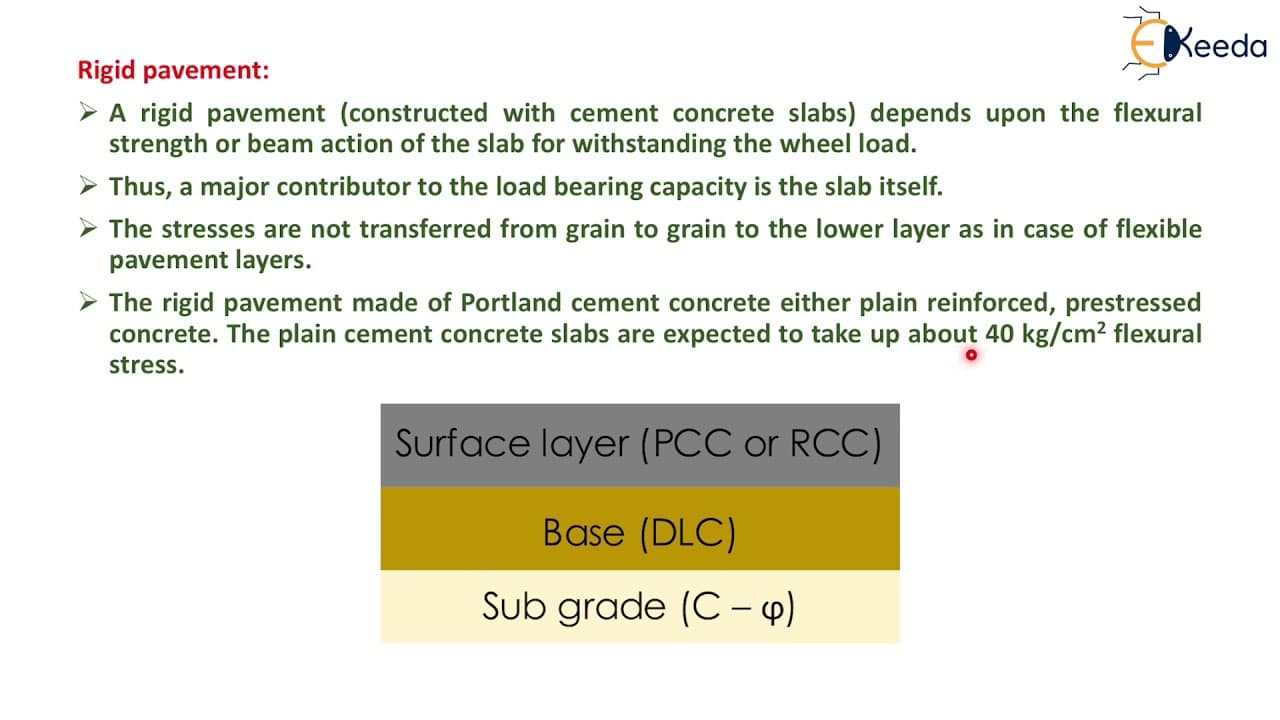
Unlike flexible pavements, rigid pavements rely on the strength of concrete slabs to bear wheel loads. The load is transferred through slab action from layer to layer, and the critical stress condition is the maximum flexural stress occurring in the slab.
Q: What is the difference between a semi-rigid pavement and a flexible pavement?
A semi-rigid pavement is an intermediate type that derives strength from load spreading and flexural action. When bonded materials like pozzolanic concrete are used in the base or sub-base layers, the pavement's flexural strength increases.
Summary & Key Takeaways
-
Flexible pavements consist of layers of materials that distribute stress and load through the pavement structure to the subgrade.
-
Rigid pavements rely on the flexural strength of concrete slabs to withstand wheel loads and temperature changes.
-
Semi-rigid pavements have higher flexural strength than flexible pavements, achieved by using bonded materials in the base and sub-base layers.
-
Composite pavements combine different pavement types in their layers, providing a mixture of characteristics and performance.
Read in Other Languages (beta)
Share This Summary 📚
Summarize YouTube Videos and Get Video Transcripts with 1-Click
Try YouTube Summary with ChatGPT & Claude or YouTube Transcript Generator
Explore More Summaries from Ekeeda 📚






Summarize YouTube Videos and Get Video Transcripts with 1-Click
Try YouTube Summary with ChatGPT & Claude or YouTube Transcript Generator