Newton's 2nd Law (14 of 21) Free Body Diagrams; An Explanation
TL;DR
This video discusses force diagrams, balance, unbalance, and acceleration, providing insights into how objects either maintain their state of motion or change their velocity.
Transcript
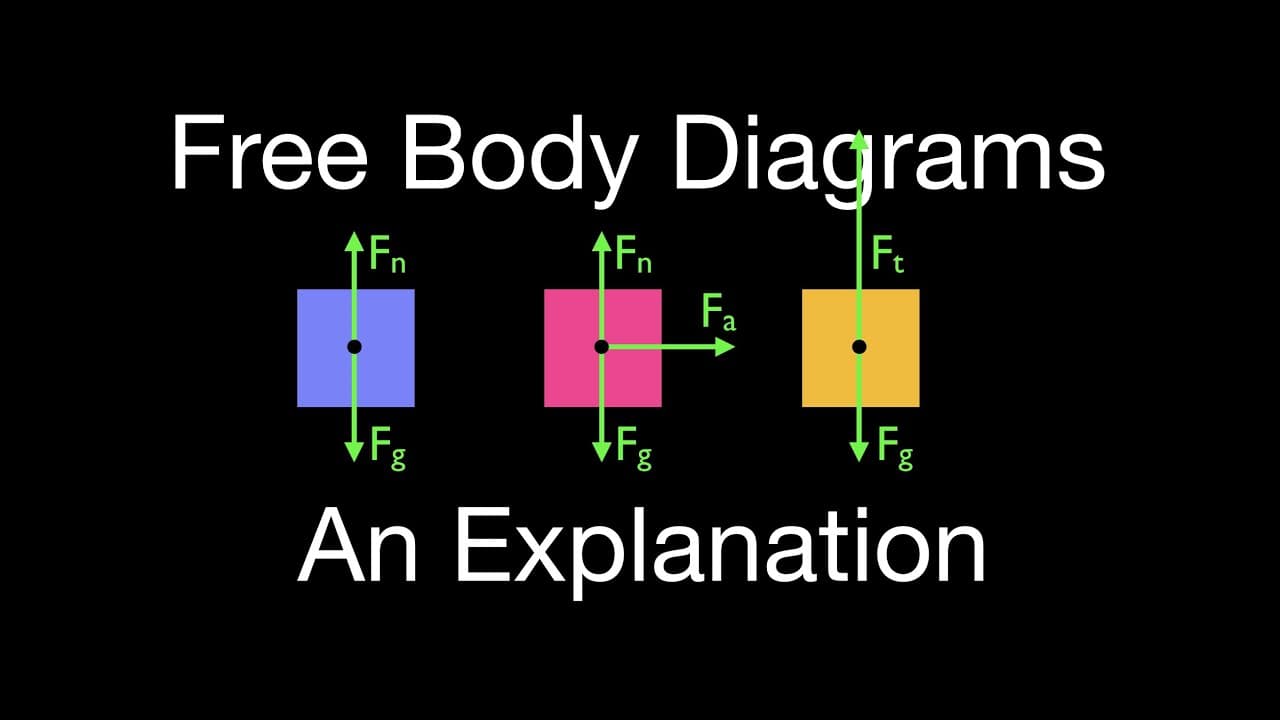
all right I thought i' just make a quick video to talk about what we' been doing in class with the force diagrams I titled the video what could it be doing not what is it doing because we don't really know what it is doing but there usually is one of two things that it could be doing and these the force diagrams we're talking about the Box represen... Read More
Key Insights
- 😒 Force diagrams use arrows to represent forces, with length indicating magnitude and direction indicating force direction.
- 🧍 Balanced forces have a net force of zero, resulting in either a constant velocity or standing still.
- 🐎 Unbalanced forces have a nonzero net force, causing acceleration and potential changes in speed or direction.
- 🐎 The direction of the net force determines whether the object is speeding up or slowing down.
- 🧍 Constant velocity or standing still can be achieved with balanced forces.
- 💱 Objects can change direction without changing speed through the application of a force.
- ❓ The magnitude and direction of forces determine an object's acceleration.
Install to Summarize YouTube Videos and Get Transcripts
Explore YouTube Video Summarizer or Get YouTube Transcript Extractor
Questions & Answers
Q: What do force diagrams represent?
Force diagrams use boxes to represent objects and arrows to represent the magnitude and direction of forces acting on them.
Q: How do you determine if forces are balanced or unbalanced?
Forces are balanced when all arrows in opposite directions are the same. Forces are unbalanced when there is a net force, which occurs when the arrows differ in magnitude or direction.
Q: What does it mean if forces are balanced?
If forces are balanced, the net force is zero, indicating no acceleration. The object can either be at a state of constant velocity or standing still.
Q: How can you determine if an object is accelerating?
If forces are unbalanced, resulting in a nonzero net force, the object is accelerating. It can either be speeding up, slowing down, or changing direction.
Q: How does the direction of the net force affect acceleration?
If the object is moving in the same direction as the net force, it will speed up. If the object is moving in the opposite direction, it will slow down.
Q: Can an object have balanced forces and still be moving?
Yes, an object with balanced forces can either be moving with a constant velocity or standing still. The force diagram alone does not indicate the object's specific motion.
Q: What happens when two forces have different magnitudes but the same direction?
If two forces have different magnitudes but the same direction, the net force will be in the direction of the larger force, causing the object to accelerate.
Q: Can an object change direction without changing speed?
Yes, an object can change direction without changing its speed, such as when going round and round on a merry-go-round. This change in direction still requires an applied force.
Summary & Key Takeaways
-
The video explains force diagrams, where a box represents an object and arrows represent forces with magnitude and direction.
-
Balanced forces result in a net force of zero, indicating no acceleration and either a state of constant velocity or standing still.
-
Unbalanced forces lead to a nonzero net force, causing acceleration, which can involve either speeding up, slowing down, or changing direction.
Read in Other Languages (beta)
Share This Summary 📚
Summarize YouTube Videos and Get Video Transcripts with 1-Click
Try YouTube Summary with ChatGPT & Claude or YouTube Transcript Generator
Explore More Summaries from Step by Step Science 📚


Summarize YouTube Videos and Get Video Transcripts with 1-Click
Try YouTube Summary with ChatGPT & Claude or YouTube Transcript Generator