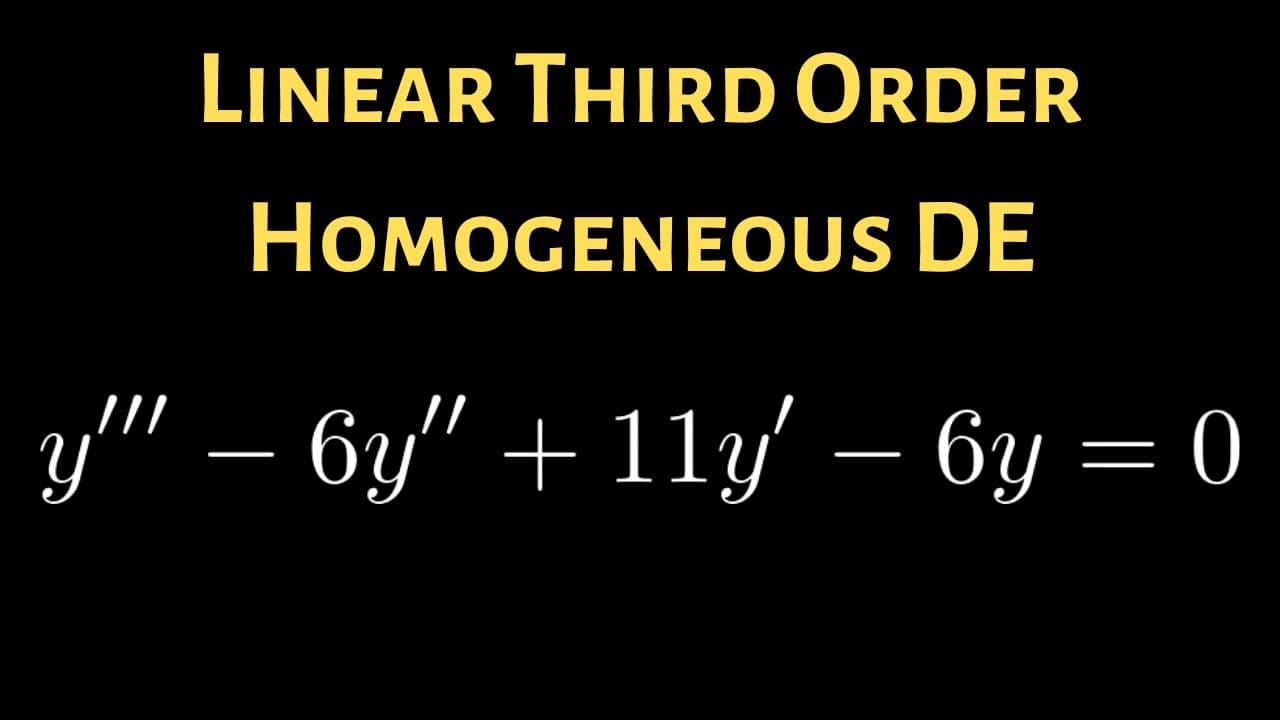
How to Solve the Linear Third Order Differential Equation y''' - 6y'' + 11y' - 6y = 0
TL;DR
This video explains how to solve a linear differential equation using the characteristic or auxiliary equation method.
Transcript
in this problem we're going to solve this differential equation so this is a linear differential equation so to do this problem we're going to start by writing down what's called the characteristic or auxiliary equation so what you do is you basically look at the order of the derivative so this is the third derivative so you write r to the third po... Read More
Key Insights
- ❓ The characteristic or auxiliary equation method is used to solve linear differential equations.
- 💁 The roots of the characteristic equation determine the form of the solution to the differential equation.
- 🫚 The rational roots theorem can be used to find the possible roots of the characteristic equation.
Install to Summarize YouTube Videos and Get Transcripts
Explore YouTube Video Summarizer or Get YouTube Transcript Extractor
Questions & Answers
Q: What is the characteristic or auxiliary equation method for solving linear differential equations?
The characteristic or auxiliary equation method involves writing down an equation based on the order of the derivatives in the differential equation and finding the roots of this equation.
Q: How do you find the roots of the characteristic equation?
The rational roots theorem can be used to find the possible rational roots of the characteristic equation. These roots are then tested using synthetic division to determine which ones are actual roots.
Q: What does it mean if synthetic division gives a result of zero?
If synthetic division yields a result of zero, it means that the tested number is a root of the characteristic equation and a solution to the differential equation.
Q: How do you find the solution to the differential equation once the roots are known?
If the characteristic equation has distinct real roots, the solution to the differential equation will be of the form y = c1e^(m1x) + c2e^(m2x) + c3e^(m3x), where m1, m2, m3, etc., are the roots.
Summary & Key Takeaways
-
The video discusses the characteristic or auxiliary equation method for solving linear differential equations.
-
The characteristics equation is derived by looking at the order of the derivatives and setting them equal to zero.
-
The roots of the characteristic equation are found using the rational roots theorem, and these roots determine the solution of the differential equation.
Read in Other Languages (beta)
Share This Summary 📚
Summarize YouTube Videos and Get Video Transcripts with 1-Click
Try YouTube Summary with ChatGPT & Claude or YouTube Transcript Generator
Explore More Summaries from The Math Sorcerer 📚


Summarize YouTube Videos and Get Video Transcripts with 1-Click
Try YouTube Summary with ChatGPT & Claude or YouTube Transcript Generator