Vertical Translation, Amplitude, Period, Phase Shift, and Range of Cosine and Sine Functions
TL;DR
This video explains the concepts of phase shift, amplitude, period, and vertical translations in trigonometric functions using examples and formulas.
Transcript
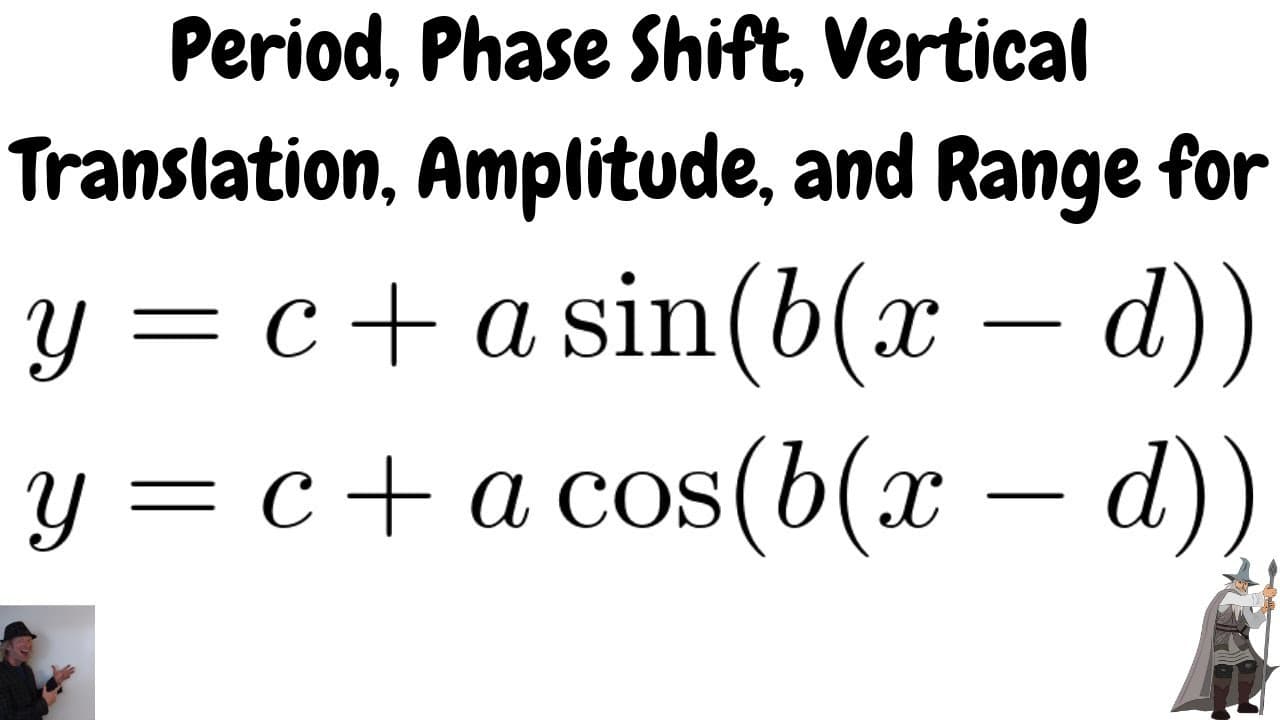
in this video we're going to put everything together we're going to talk about phase shifts amplitude period and also vertical translations so we have say y equals c plus a sign parenthesis b x minus d parenthesis so when we have something that looks like this or something that looks like this so I'm going to write the same thing except with the co... Read More
Key Insights
- 😄 The equation format for trigonometric functions is y = c + a sin(bx - d) or y = c + a cos(bx - d).
- 🚦 The vertical translation is denoted by the value of c in the equation.
- ❓ The amplitude is the absolute value of the coefficient a in the equation.
- 🗂️ The period of a trigonometric function is given by 2π divided by the coefficient of x, denoted by b.
- ☺️ The phase shift can be found by reversing the sign of the value inside the parentheses after x, denoted by d.
- 💁 Rewriting equations in the proper form helps identify and calculate the various aspects of trigonometric functions.
- 🧡 The range of a trigonometric function can be expanded or contracted based on the amplitude.
Install to Summarize YouTube Videos and Get Transcripts
Explore YouTube Video Summarizer or Get YouTube Transcript Extractor
Questions & Answers
Q: What are the four aspects discussed in the video regarding trigonometric functions?
The four aspects discussed in the video are vertical translations, amplitude, period, and phase shift.
Q: How do you find the period of a trigonometric function?
The period of a trigonometric function can be found by taking 2π divided by the coefficient of x in the equation.
Q: How can you identify the phase shift in a trigonometric function?
The phase shift can be identified by looking at the value inside the parentheses after x, and reversing its sign.
Q: How do you determine the amplitude of a trigonometric function?
The amplitude of a trigonometric function is the absolute value of the coefficient in front of the trigonometric term.
Summary & Key Takeaways
-
The video discusses the equation format for trigonometric functions and how to identify vertical translations, amplitude, period, and phase shift.
-
An example is used to demonstrate how to rewrite an equation in the correct format and find all the mentioned aspects.
-
The video also briefly mentions finding the range of the function and how it is affected by the amplitude.
Read in Other Languages (beta)
Share This Summary 📚
Summarize YouTube Videos and Get Video Transcripts with 1-Click
Try YouTube Summary with ChatGPT & Claude or YouTube Transcript Generator
Explore More Summaries from The Math Sorcerer 📚



Summarize YouTube Videos and Get Video Transcripts with 1-Click
Try YouTube Summary with ChatGPT & Claude or YouTube Transcript Generator