How to use Descartes Rule of Signs Example with a Cubic Function
TL;DR
Using Descartes Rule of Signs to determine the number of positive and negative real zeros.
Transcript
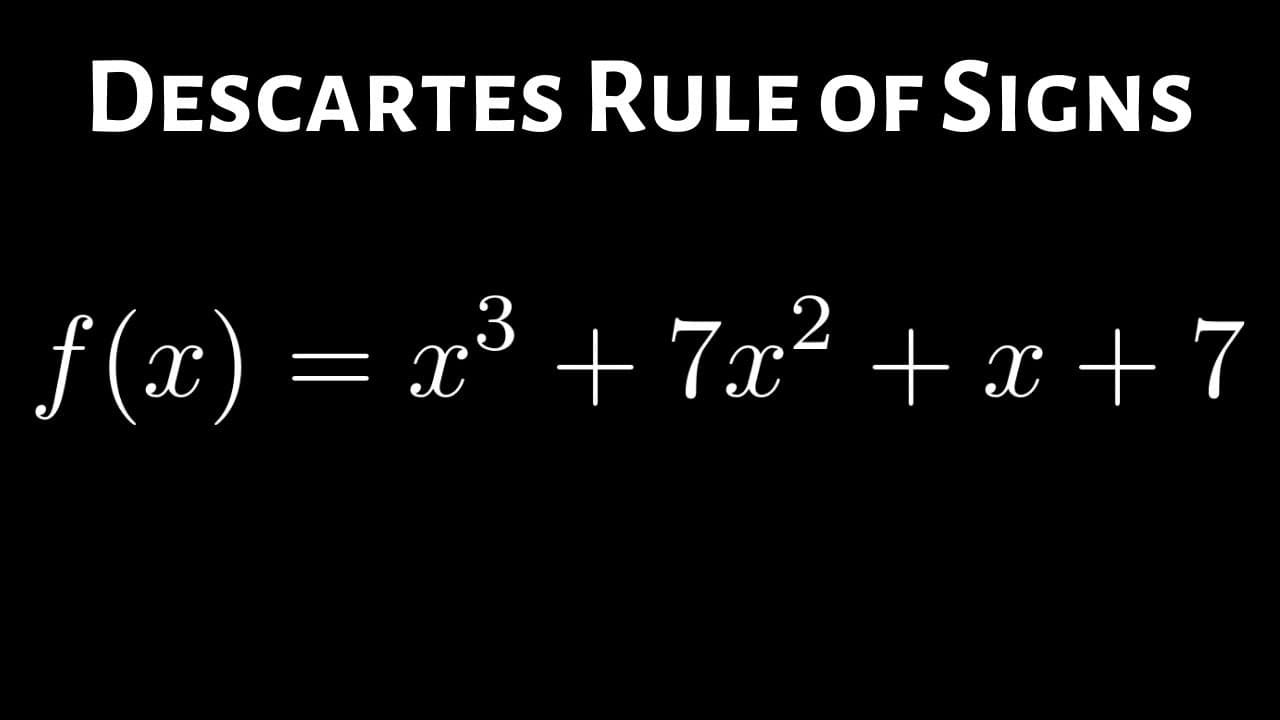
in this problem we're going to use descartes rule of signs to determine the number of positive real zeros and the number of negative real zeros let's start with the positive real zeros so to use descartes rule for positive real zeros we look at f of x and we count the number of sign changes so the number of positive real zeros is the number of sign... Read More
Key Insights
- 🤘 Descartes Rule of Signs determines the number of positive and negative real zeros by counting sign changes in the function.
- 🤘 If there are no sign changes, it implies no positive real zeros.
- ☺️ Replacing x with -x helps to determine the number of negative real zeros.
- 💱 Even powers do not affect the sign changes when replacing x with -x.
- #️⃣ The number of negative real zeros can be an odd number or an odd number minus an even number.
- 0️⃣ In the provided example, there are no positive real zeros and either 3 or 1 negative real zero.
- #️⃣ Descartes Rule of Signs simplifies the process of finding the number of real zeros in a function.
Install to Summarize YouTube Videos and Get Transcripts
Explore YouTube Video Summarizer or Get YouTube Transcript Extractor
Questions & Answers
Q: How is the number of positive real zeros determined using Descartes Rule of Signs?
The number of positive real zeros is equal to the number of sign changes in the function. In this case, since there are no sign changes, there are no positive real zeros.
Q: How is the number of negative real zeros determined using Descartes Rule of Signs?
To find the number of negative real zeros, we replace x with -x in the function and count the sign changes. In this case, there are three sign changes, indicating either 3 or 1 negative real zero.
Q: What happens when the function has an even power?
When the function has an even power, the negative sign disappears if we replace x with -x. This is because even powers do not affect the sign of the result.
Q: Can the number of negative real zeros be odd?
No, the number of negative real zeros can either be an odd number or an odd number minus an even number. In this case, since we have 3 sign changes, the number of negative real zeros is either 3 or 1.
Summary & Key Takeaways
-
The number of positive real zeros is determined by counting sign changes in the function.
-
The function has no sign changes, indicating no positive real zeros.
-
The number of negative real zeros is determined by counting sign changes in the function with x replaced by -x.
-
The function has 3 sign changes, suggesting either 3 or 1 negative real zero.
Read in Other Languages (beta)
Share This Summary 📚
Summarize YouTube Videos and Get Video Transcripts with 1-Click
Try YouTube Summary with ChatGPT & Claude or YouTube Transcript Generator
Explore More Summaries from The Math Sorcerer 📚


Summarize YouTube Videos and Get Video Transcripts with 1-Click
Try YouTube Summary with ChatGPT & Claude or YouTube Transcript Generator