Zaitsev's rule | Substitution and elimination reactions | Organic chemistry | Khan Academy
TL;DR
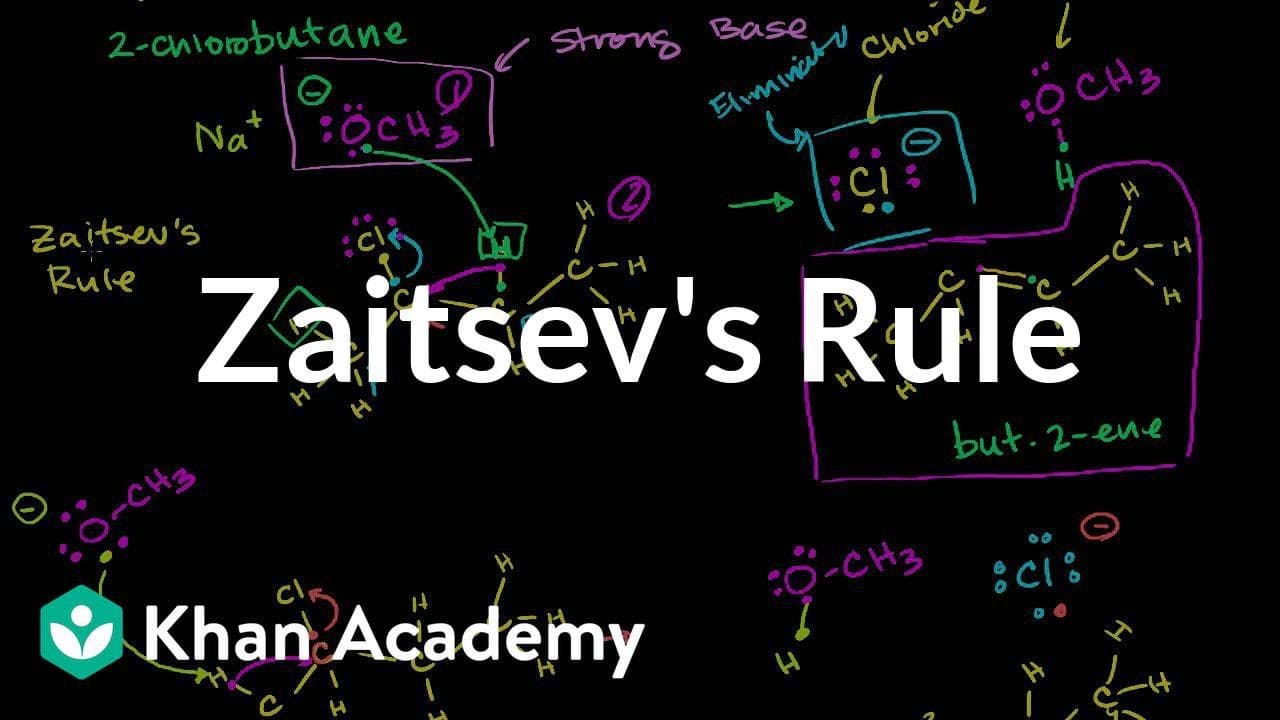
Strong bases can remove hydrogens from beta carbons in E2 reactions, and Zaitsev's rule states that the hydrogen with fewer hydrogens is more likely to be removed due to hyperconjugation.
Transcript
In the video on E2 reactions, I showed you how a strong base-- and all of this happened simultaneously-- a strong base can nab a hydrogen off of this carbon right here. And it's just nabbing the proton itself. It's not grabbing the hydrogen and the electron. And then that electron goes to this carbon right over there, and then that allows that carb... Read More
Key Insights
- 💪 E2 reactions involve the removal of a hydrogen from a beta carbon by a strong base.
- 📏 Zaitsev's rule states that the hydrogen with fewer hydrogens is more likely to be removed in an E2 reaction.
- 💁 Hyperconjugation helps stabilize the double bond formation in E2 reactions.
- 📏 Zaitsev's rule is also applicable in E1 reactions.
- ❓ The more substituted product is dominant in E2 reactions due to hyperconjugation.
- ❓ The dominance of the more substituted product can be observed experimentally.
- 💁 Zaitsev's rule is based on the concept of stability in double bond formation.
Install to Summarize YouTube Videos and Get Transcripts
Explore YouTube Video Summarizer or Get YouTube Transcript Extractor
Questions & Answers
Q: What happens in an E2 reaction?
In an E2 reaction, a strong base removes a hydrogen from a beta carbon, leading to the formation of a double bond between the beta and alpha carbons, and the expulsion of a leaving group.
Q: What is Zaitsev's rule?
Zaitsev's rule states that the hydrogen with fewer hydrogens is more likely to be removed in an E2 reaction. This is because the carbon with fewer hydrogens is more substituted, and hyperconjugation helps stabilize the resulting double bond.
Q: How does hyperconjugation contribute to Zaitsev's rule?
Hyperconjugation is the idea that neighboring carbons contribute electrons to stabilize the formation of the double bond. The more substituted carbon, with more neighboring carbons, is better able to stabilize the double bond, leading to the dominance of the more substituted product.
Q: Is Zaitsev's rule applicable in E1 reactions as well?
Yes, Zaitsev's rule holds true for E1 reactions too. The hydrogen with fewer hydrogens on the beta carbon is more likely to be removed by the strong base or acid, leading to the formation of a double bond.
Summary & Key Takeaways
-
E2 reactions involve the removal of a hydrogen from a beta carbon by a strong base, resulting in the formation of a double bond.
-
Zaitsev's rule states that the hydrogen with fewer hydrogens is more likely to be removed in an E2 reaction.
-
Hyperconjugation helps stabilize the double bond formation, leading to the dominance of the more substituted product.
Read in Other Languages (beta)
Share This Summary 📚
Summarize YouTube Videos and Get Video Transcripts with 1-Click
Try YouTube Summary with ChatGPT & Claude or YouTube Transcript Generator
Explore More Summaries from Khan Academy 📚



Summarize YouTube Videos and Get Video Transcripts with 1-Click
Try YouTube Summary with ChatGPT & Claude or YouTube Transcript Generator