Modeling ticket fines with exponential function | Algebra II | Khan Academy
TL;DR
Sarah Swift faces a fine for a speeding ticket, with the amount increasing exponentially based on the months delayed in payment.
Transcript
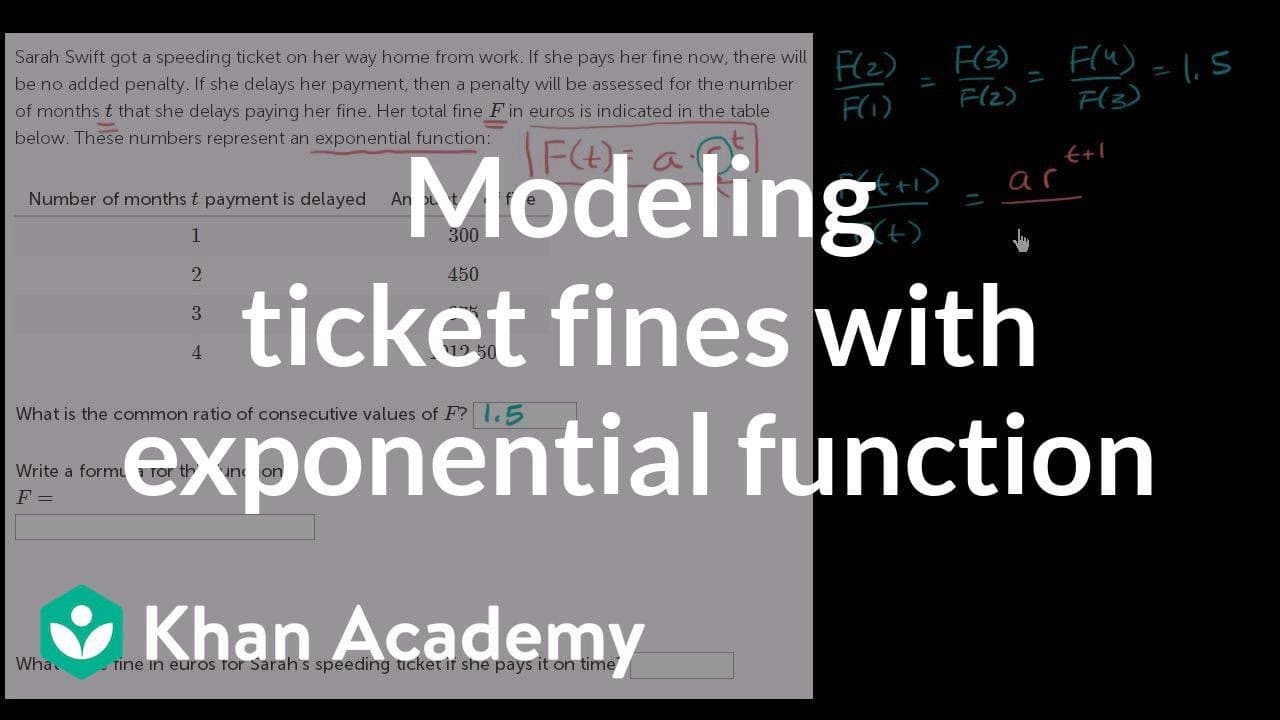
- [Instructor] Sarah Swift got a speeding ticket on her way home from work. If she pays her fine now there will be no added penalty. If she delays her payment then a penalty will be assessed for the number of months, t, that she delays paying her fine. Her total fine, F, in euros, is indicated in the table below. These numbers represent an exponent... Read More
Key Insights
- 🐎 The fine for Sarah Swift's speeding ticket increases exponentially based on the number of months delayed in payment.
- 🥳 The common ratio between consecutive fine values is 1.5, indicating consistent multiplication or division based on this ratio.
- 🔢 The formula for the fine function is F(t) = 200 * 1.5^t, where t is the number of months delayed.
- 🏤 Paying the ticket on time, corresponding to t=0, results in a fine amount of 200 euros.
- 🥳 Each successive month of delay multiplies the fine amount by the common ratio of 1.5.
- 🈷️ The exponential function represents the relationship between the months delayed and the fine amount.
- 🔢 Sarah can determine her fine for any number of months delayed by substituting the appropriate value of t into the formula.
Install to Summarize YouTube Videos and Get Transcripts
Explore YouTube Video Summarizer or Get YouTube Transcript Extractor
Questions & Answers
Q: What is the definition of the common ratio in this context?
In the context of the exponential fine function, the common ratio represents the ratio between consecutive fine values when the number of months delayed in payment is incremented by one. It remains constant throughout.
Q: How can we determine the common ratio between consecutive fine values?
By comparing the ratios of any two consecutive fine values, such as F(2)/F(1), F(3)/F(2), and F(4)/F(3), we find that the common ratio is 1.5. This ratio remains consistent for all consecutive values.
Q: What is the formula for calculating the fine amount for different months of delay?
The formula is F(t) = 200 * 1.5^t, where t represents the number of months delayed in payment. This formula gives the amount of the fine in euros based on the given exponential function.
Q: What is the fine amount if Sarah pays the speeding ticket on time?
If Sarah pays the speeding ticket on time, the number of months delayed (t) is zero. By substituting t=0 into the formula F(t) = 200 * 1.5^t, we find that the fine amount is 200 euros.
Summary & Key Takeaways
-
Sarah's fine for delaying payment of a speeding ticket increases exponentially based on the number of months she delays.
-
The function representing the fine can be expressed as F(t) = 200 * 1.5^t, with t being the number of months delayed.
-
The common ratio between consecutive fine values is 1.5.
Read in Other Languages (beta)
Share This Summary 📚
Summarize YouTube Videos and Get Video Transcripts with 1-Click
Try YouTube Summary with ChatGPT & Claude or YouTube Transcript Generator
Explore More Summaries from Khan Academy 📚



Summarize YouTube Videos and Get Video Transcripts with 1-Click
Try YouTube Summary with ChatGPT & Claude or YouTube Transcript Generator