Products
Features
YouTube Video Summarizer
Summarize YouTube videos
Web & PDF Highlighter
Highlight web pages & PDFs
Chat with PDF
Ask any PDF questions with AI
Ask AI Clone
Chat with your highlights & memories
Audio Transcriber
Transcribe audio files to text
Glasp Reader
Read and highlight articles
Kindle Highlight Export
Export your Kindle highlights
Idea Hatch
Hatch ideas from your highlights
Integrations
Obsidian Plugin
Notion Integration
Pocket Integration
Instapaper Integration
Medium Integration
Readwise Integration
Snipd Integration
Hypothesis Integration
Apps & Extensions
Chrome Extension
Safari Extension
Edge Add-ons
Firefox Add-ons
iOS App
Android App
Discover
Discover
Ideas
Discover new ideas and insights
Articles
Curated articles and insights
Books
Book recommendations by great minds
Posts
Essays and notes from readers
Quotes
Inspiring quotes collection
Videos
Curated videos and summaries
Explore Glasp
Glasp Newsletter
Weekly insights and updates
Glasp Talk
Interview series with great minds
Glasp Blog
Latest news and articles
Glasp Use Cases
Learn how others use Glasp
Build & Support
Glasp API
Access Glasp's API for developers
MCP Connector
Connect Glasp to Claude & ChatGPT
Community
Glasp Reddit Community
Students
Student discount and benefits
FAQs
Frequently Asked Questions
AboutPricing
DashboardLog inSign up

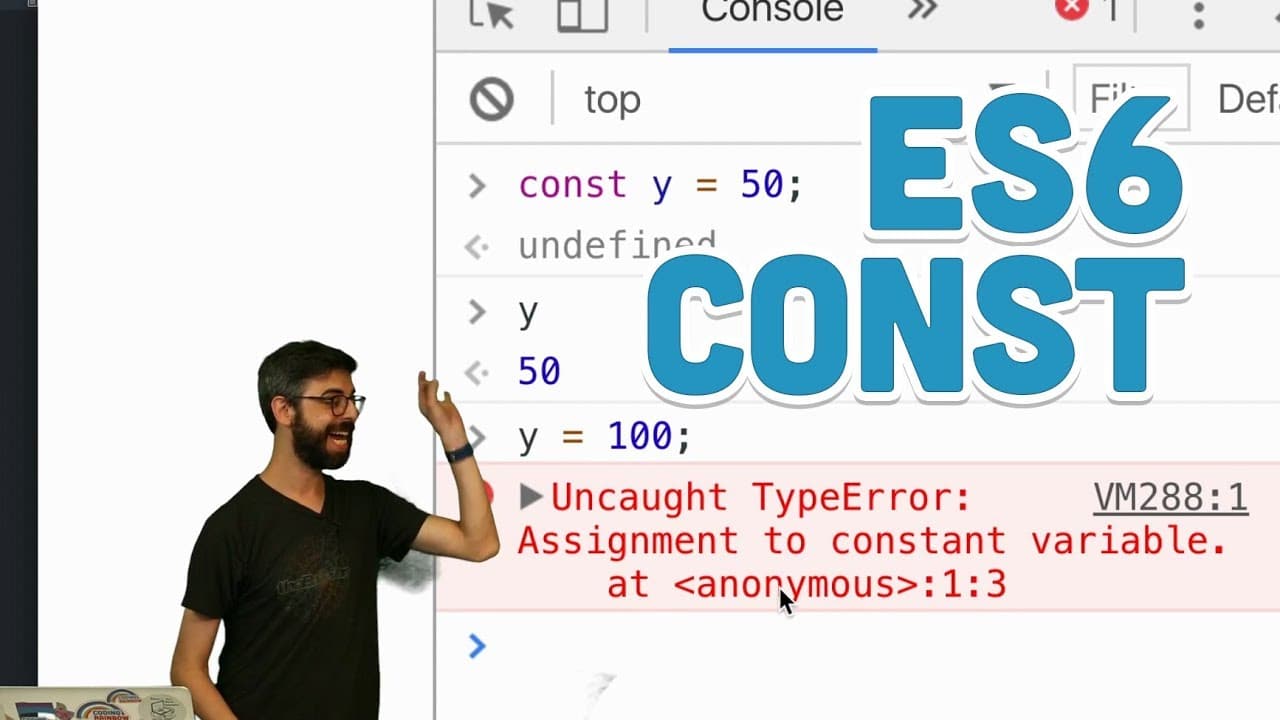
16.2: const - Topics of JavaScript/ES6
74.6K views
•
September 28, 2017
by
The Coding Train
YouTube video player
16.2: const - Topics of JavaScript/ES6

TL;DR

Const in JavaScript is used to declare variables that cannot be reassigned, offering optimization benefits for code efficiency.

Transcript

okay I'm back for another video about stuff that's a es6 again if you're just watching my beginner programming videos and just learned about programming you might just go back to watching those this is a little bit of behind the scenes stuff very technical but it is interesting and it can be useful the thing that I want to talk I talked in the prev... Read More

Key Insights

  • 🥹 Const is used in JavaScript to declare variables that hold constant values and cannot be reassigned.
  • 🏪 It is particularly beneficial for variables storing numbers or data that never change.
  • 👷 Object properties can be modified when using const, but the entire object cannot be reassigned.
  • 👻 Using const allows for code optimization and efficient memory usage.
  • 😕 Const syntax can be confusing for beginners, which is why more familiar syntax may be used in teaching.
  • 😒 Both let and const use block scope in JavaScript.

Install to Summarize YouTube Videos and Get Transcripts

Explore YouTube Video Summarizer or Get YouTube Transcript Extractor

Questions & Answers

Q: What is the difference between let and const in JavaScript?

In JavaScript, let allows variables to be reassigned with different values, while const declares variables that cannot be reassigned once assigned a value. This offers optimization benefits in terms of memory usage and code efficiency.

Q: Can object properties be modified when using const?

Yes, when an object is declared using const, its properties can still be manipulated. However, the entire object cannot be reassigned to a different value.

Q: How does the use of const affect code optimization?

By using const, code can be more optimized as it specifies that certain variables hold constant values. This allows the computer to manage memory more efficiently, avoiding unnecessary allocation.

Q: Why is const less commonly used in teaching and beginner programming?

Const can be confusing for beginners as it restricts the ability to reassign variables. Therefore, the more familiar syntax of function declarations and let variables is often used in teaching to simplify concepts.

Summary & Key Takeaways

  • Const is a term used in JavaScript to declare variables that hold constant values, which are not intended to be changed.

  • It is particularly useful for variables that store numbers or data that will never change.

  • While const doesn't prevent manipulation of object properties, it disallows reassignment of the entire object.


Read in Other Languages (beta)

English

Share This Summary 📚

Summarize YouTube Videos and Get Video Transcripts with 1-Click

Download browser extensions on:

Try YouTube Summary with ChatGPT & Claude or YouTube Transcript Generator

Explore More Summaries from The Coding Train 📚

Text Generation using Spell with Nabil Hassein thumbnail
Text Generation using Spell with Nabil Hassein
The Coding Train
9.4: Genetic Algorithm: Looking at Code - The Nature of Code thumbnail
9.4: Genetic Algorithm: Looking at Code - The Nature of Code
The Coding Train
Classifying Poses with ml5.js Part 2 thumbnail
Classifying Poses with ml5.js Part 2
The Coding Train
Computer Mouse Conference Demos! (node.js + tensorflow.js) thumbnail
Computer Mouse Conference Demos! (node.js + tensorflow.js)
The Coding Train
ITP/IMA Winter Show 2018 thumbnail
ITP/IMA Winter Show 2018
The Coding Train
ITP/IMA Winter Show 2019 thumbnail
ITP/IMA Winter Show 2019
The Coding Train

Summarize YouTube Videos and Get Video Transcripts with 1-Click

Download browser extensions on:

Try YouTube Summary with ChatGPT & Claude or YouTube Transcript Generator

Apps & Extensions

  • Chrome Extension
  • Safari Extension
  • Edge Add-ons
  • Firefox Add-ons
  • iOS App
  • Android App

Key Features

  • YouTube Video Summarizer
  • Web & PDF Summarizer
  • Web & PDF Highlighter
  • Chat with PDF
  • Ask AI Clone
  • Audio Transcriber
  • Glasp Reader
  • Kindle Highlight Export
  • Idea Hatch

Integrations

  • Obsidian Plugin
  • Notion Integration
  • Pocket Integration
  • Instapaper Integration
  • Medium Integration
  • Readwise Integration
  • Snipd Integration
  • Hypothesis Integration

More Features

  • APIs
  • MCP Connector
  • Blog & Post
  • Embed Links
  • Image Highlight
  • Personality Test
  • Quote Shots

Company

  • About us
  • Blog
  • Community
  • FAQs
  • Job Board
  • Newsletter
  • Pricing
Terms

•

Privacy

•

Guidelines

© 2026 Glasp Inc. All rights reserved.