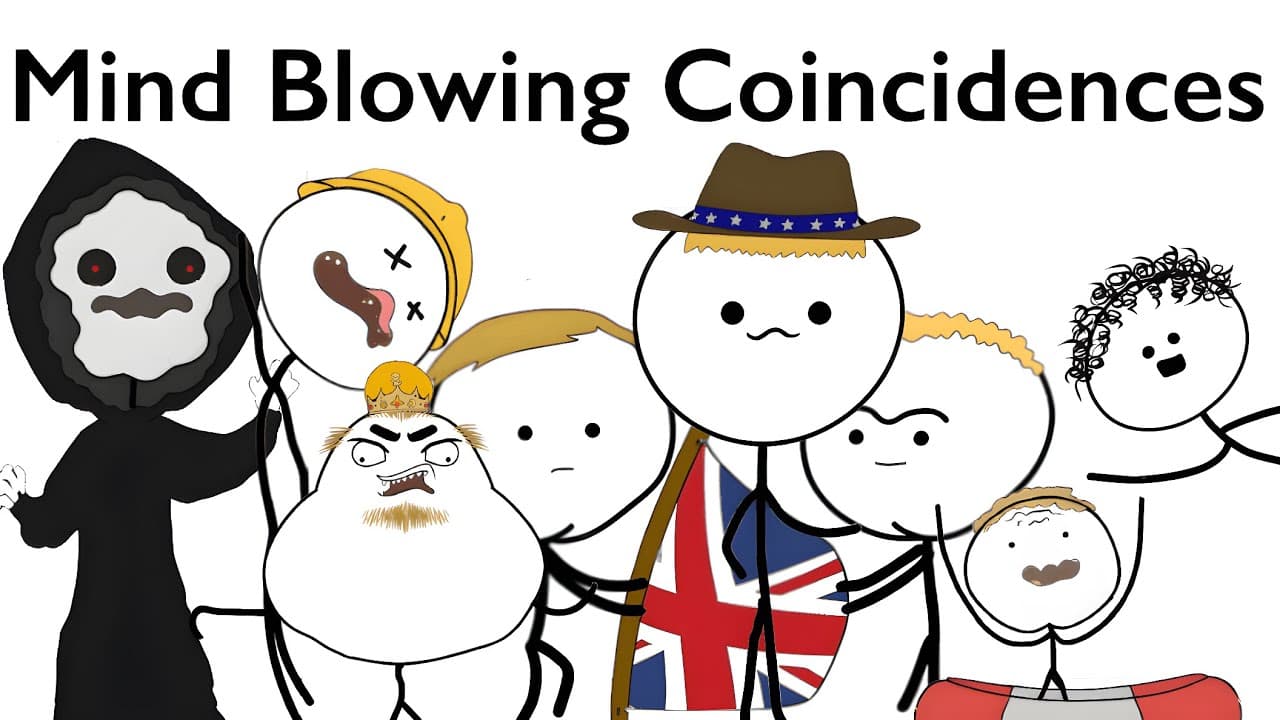
Mind-Blowing Coincidences in History
TL;DR
Explore astonishing coincidences throughout history involving survival, predictions, and luck.
Transcript
Read and summarize the transcript of this video on Glasp Reader (beta).
Key Insights
- Violet Jessup survived three major ship disasters, including the Titanic, showcasing an extraordinary streak of luck and resilience.
- Wilmer McLean's homes were the sites of both the start and end of the American Civil War, highlighting a bizarre twist of fate.
- Twice, typhoons saved Japan from Mongol invasions in the 1200s, events deemed as divine interventions, known as 'kamikaze.'
- Robert Lincoln, son of President Lincoln, was present at three presidential assassinations, earning him a reputation as a bad luck charm.
- A bizarre naval battle during WWI involved two ships disguised as each other, resulting in a unique encounter off the coast of Brazil.
- Three men named Hugh Williams survived shipwrecks in Wales over two centuries, each being the sole survivor, a mysterious coincidence.
- Edgar Allan Poe's story eerily predicted a real-life shipwreck and cannibalism incident involving a man named Richard Parker.
- A book published 14 years before the Titanic disaster predicted a similar ship's fate, raising questions about foresight and coincidence.
Install to Summarize YouTube Videos and Get Transcripts
Explore YouTube Video Summarizer or Get YouTube Transcript Extractor
Questions & Answers
Q: Who was Violet Jessup and what is significant about her story?
Violet Jessup was a stewardess and nurse who survived three significant ship disasters: the Olympic, Titanic, and Britannic. Her story is significant because it highlights an incredible streak of both misfortune and luck, as she survived each disaster unscathed. Her experiences reflect the unpredictability of life and the human capacity for resilience in the face of repeated adversity.
Q: What role did Wilmer McLean's homes play in the American Civil War?
Wilmer McLean's homes played a unique role in the American Civil War as the locations of its beginning and end. The war started in his front yard during the First Battle of Bull Run, and four years later, General Lee surrendered to General Grant in McLean's living room. This coincidence underscores the unpredictable nature of historical events and how they can impact ordinary individuals in extraordinary ways.
Q: How did the divine winds influence the Mongol invasions of Japan?
The divine winds, or 'kamikaze,' were two typhoons that thwarted Mongol invasions of Japan in the 1200s. The first storm destroyed Kublai Khan's fleet in 1274, and a second storm wrecked an even larger invasion force in 1281. These events were seen as divine interventions by the Japanese, preventing foreign conquest and shaping the course of Japanese history by preserving its sovereignty.
Q: What connection does Robert Lincoln have to presidential assassinations?
Robert Lincoln, son of President Abraham Lincoln, has a unique connection to presidential assassinations as he was present at three of them. He witnessed the aftermath of his father's assassination in 1865, was present when President Garfield was shot in 1881, and attended the event where President McKinley was assassinated in 1901. This series of events led him to avoid future presidential gatherings, fearing his presence brought bad luck.
Q: What was the outcome of the naval battle involving disguised ships during WWI?
During WWI, a naval battle occurred between two ships disguised to look like each other: the British HMS Carmania and the German SMS Cap Trafalgar. Despite the German ship's disguise, the real Carmania engaged and ultimately sank the Cap Trafalgar off the coast of Brazil. This unusual encounter demonstrated the lengths to which combatants would go to deceive the enemy and the challenges of naval warfare during the era.
Q: Who were the Hugh Williams, and what is their significance?
The name Hugh Williams is associated with a series of shipwrecks off the coast of Wales, where, on three separate occasions spanning over 150 years, the sole survivor was a man named Hugh Williams. This peculiar coincidence has captured public imagination, suggesting a mysterious pattern or supernatural element at play. It highlights the role of luck and chance in survival stories throughout history.
Q: How did Edgar Allan Poe's story predict a real-life event?
Edgar Allan Poe's 1838 story eerily predicted a real-life event when a shipwreck in 1884 led to the crew's cannibalism of a young sailor named Richard Parker, mirroring Poe's fictional narrative. Both the fictional and real Richard Parker were the youngest crew members. This uncanny resemblance raises questions about coincidence and the potential for literature to foreshadow real-world events, blurring the lines between fiction and reality.
Q: What was the significance of the book that predicted the Titanic disaster?
The book 'Futility,' written by Morgan Robertson 14 years before the Titanic disaster, predicted a similar ship's fate with remarkable accuracy. The fictional ship, named Titan, shared many characteristics with the Titanic, including its size, lack of lifeboats, and the circumstances of its sinking. This prediction has intrigued readers and historians alike, leading to speculation about Robertson's knowledge of maritime technology and the nature of coincidences in literature and history.
Summary & Key Takeaways
-
The transcript discusses a series of historical coincidences, such as Violet Jessup's survival of three shipwrecks and the Civil War's start and end at Wilmer McLean's homes. These stories highlight how chance and fate play out in history, creating narratives that seem too extraordinary to be true.
-
Other intriguing tales include the divine winds saving Japan from Mongol invasions, Robert Lincoln's presence at multiple presidential assassinations, and the strange naval battle involving disguised ships during WWI. Each story underscores the unpredictability of life and history.
-
Additional stories explore themes of prediction and luck, such as Edgar Allan Poe's fictional tale predicting a real shipwreck, a book foreshadowing the Titanic disaster, and the coincidence of Mark Twain's life aligning with Halley's Comet. These narratives blur the lines between fiction and reality.
Read in Other Languages (beta)
Share This Summary 📚
Summarize YouTube Videos and Get Video Transcripts with 1-Click
Try YouTube Summary with ChatGPT & Claude or YouTube Transcript Generator
Explore More Summaries from Chill Dude Explains 📚





Summarize YouTube Videos and Get Video Transcripts with 1-Click
Try YouTube Summary with ChatGPT & Claude or YouTube Transcript Generator