Hexadecimal to Binary Encoder | Number System and Code | Digital Circuit Design in EXTC Engineering
TL;DR
Learn how to design a hexadecimal to binary encoder in this video tutorial.
Transcript
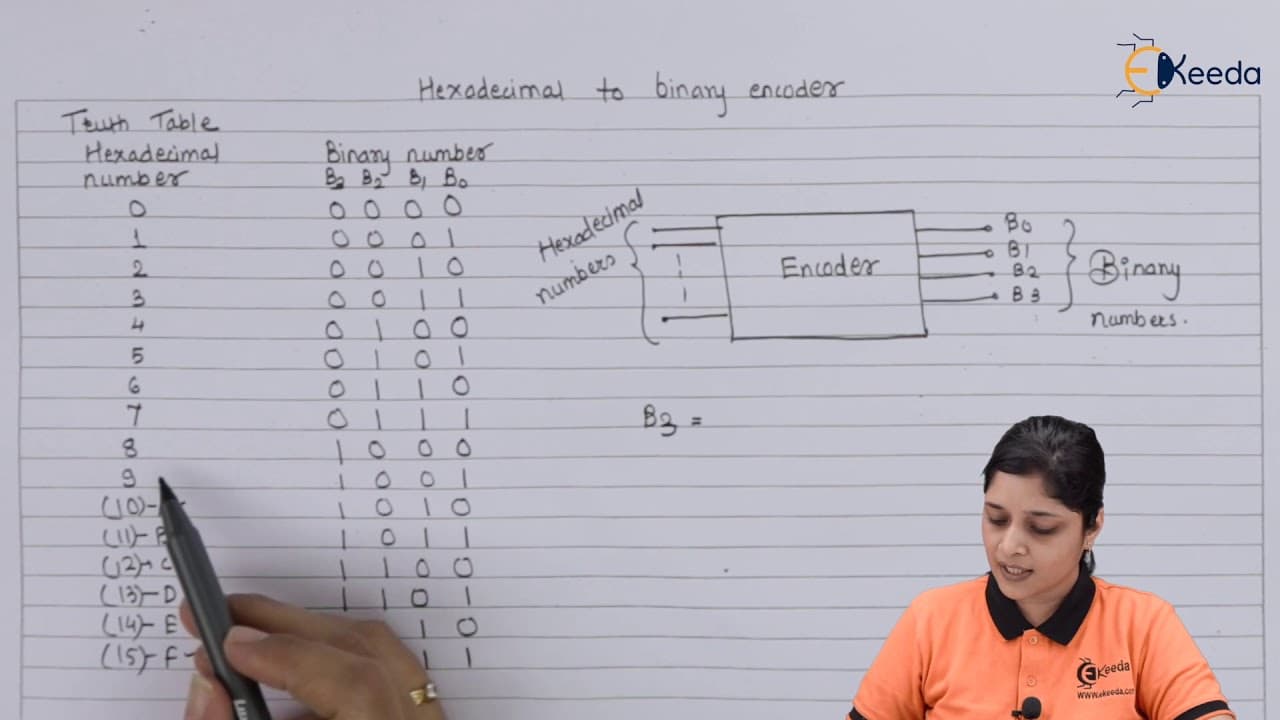
click the bell icon to get latest videos from akira hello friends now we are going to discuss about the hexadecimal to binary encoder let's start the discussion so our heading is hexadecimal to binary encoder so for to design the encoder exert a symbol to binary you have hexadecimal numbers add input side and binary numbers at output side hexadecim... Read More
Key Insights
- #️⃣ A hexadecimal to binary encoder is used to convert hexadecimal numbers to their binary equivalent.
- 🫦 Each hexadecimal digit is represented by a 4-bit binary number.
- 😑 The design involves creating a truth table, deriving expressions, and generating a block diagram with OR gates.
- 👻 The encoding process allows for compact representation and easy conversion between hexadecimal and binary systems.
- 🔢 The encoder design can be scaled to accommodate a larger number of inputs and outputs.
- #️⃣ The hexadecimal numbers 0 to 15 are represented as binary numbers 0000 to 1111.
- 😑 The expressions for each binary bit in the encoder can be derived by summing specific hexadecimal numbers.
- 🚫 The block diagram of the encoder consists of input lines for each hexadecimal digit and OR gates for each binary bit.
Install to Summarize YouTube Videos and Get Transcripts
Explore YouTube Video Summarizer or Get YouTube Transcript Extractor
Questions & Answers
Q: What is the purpose of a hexadecimal to binary encoder?
A hexadecimal to binary encoder is used to convert hexadecimal numbers to their equivalent binary representation, typically using 4 bits for each hexadecimal digit.
Q: How do you represent the hexadecimal numbers 0 to F in binary?
The binary representation for the hexadecimal numbers 0 to F are as follows: 0 - 0000, 1 - 0001, 2 - 0010, 3 - 0011, 4 - 0100, 5 - 0101, 6 - 0110, 7 - 0111, 8 - 1000, 9 - 1001, A - 1010, B - 1011, C - 1100, D - 1101, E - 1110, F - 1111.
Q: How do you design a hexadecimal to binary encoder?
The design process involves creating a truth table with the hexadecimal numbers as inputs and their corresponding binary numbers as outputs. Then, expressions are derived from the truth table, and a block diagram is created with OR gates representing each binary bit.
Q: Can you provide an example of how to design a hexadecimal to binary encoder for a specific hexadecimal number?
Let's take the example of designing the encoder for the hexadecimal number 5. The expression for b0 would be 0, b1 would be 1, b2 would be 0, and b3 would be 1. The block diagram would be created accordingly, connecting the respective lines to the OR gates.
Summary & Key Takeaways
-
This video tutorial explains how to design a hexadecimal to binary encoder.
-
The process involves representing each hexadecimal number as a 4-bit binary number.
-
The video demonstrates the creation of a truth table and the design of a block diagram for the encoder.
Read in Other Languages (beta)
Share This Summary 📚
Summarize YouTube Videos and Get Video Transcripts with 1-Click
Try YouTube Summary with ChatGPT & Claude or YouTube Transcript Generator
Explore More Summaries from Ekeeda 📚



Summarize YouTube Videos and Get Video Transcripts with 1-Click
Try YouTube Summary with ChatGPT & Claude or YouTube Transcript Generator