How Leonardo da Vinci made a "satellite" map in 1502
TL;DR
Leonardo da Vinci created a groundbreaking map of Imola in 1502.
Transcript
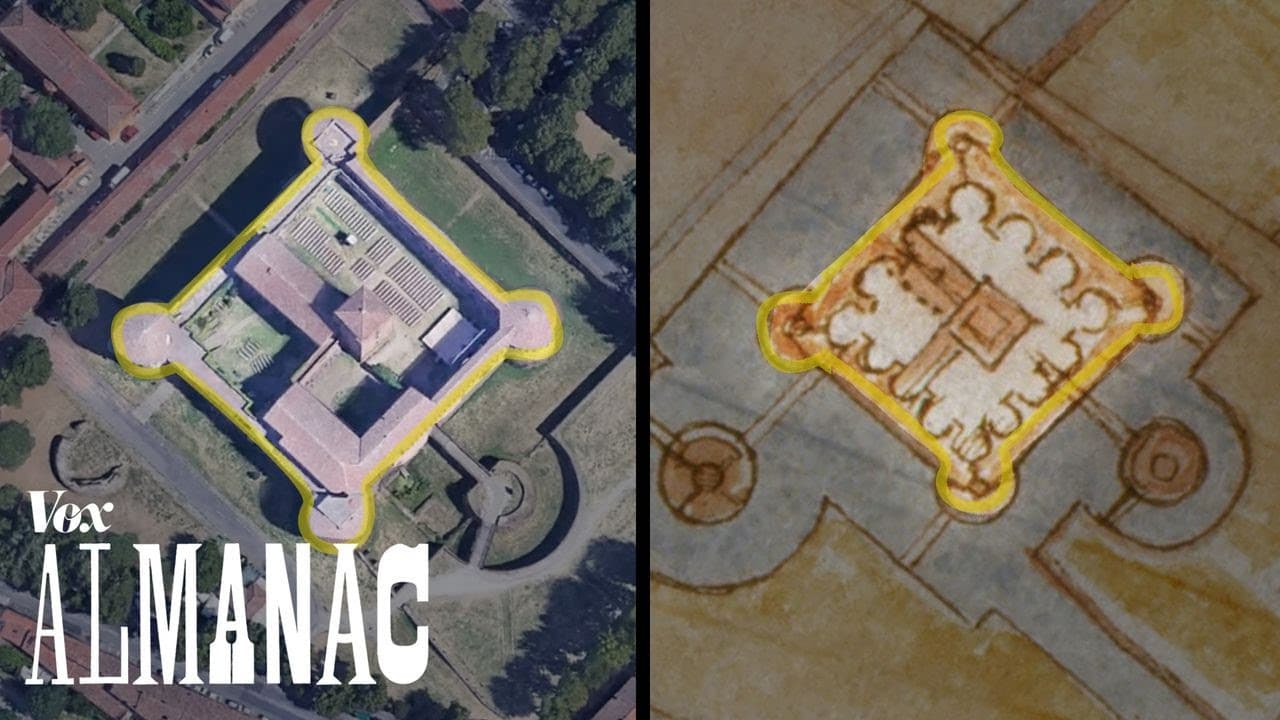
This map from 2019 was compiled using satellite and aerial imagery. Leonardo da Vinci made this one around 1502 — while stuck on the ground. How? When infamous Italian politician Cesare Borgia brought Leonardo da Vinci — the guy who drew this portrait — to the city of Imola, it was as a military engineer. He’d already established a good military re... Read More
Key Insights
- Leonardo da Vinci was tasked by Cesare Borgia to create a map of Imola, which required innovative techniques for accuracy.
- Traditional maps of the time were more artistic, featuring mythical creatures and lacked precise scale and shape.
- Leonardo aimed to create an 'ichnographic' map, a concept inspired by Roman engineer Vitruvius, showing a direct overhead view.
- Without modern technology, Leonardo used tools like a disk to measure angles and a compass to record orientations.
- To measure distances accurately, Leonardo likely paced them out or used a primitive odometer with gears and a bucket.
- Leonardo's map represented a shift from mythical geography to information-based mapping, a significant advancement in cartography.
- The map of Imola, while not perfect, was a precursor to modern mapping techniques, emphasizing accuracy over artistic representation.
- Leonardo's method demonstrated the potential for maps to serve military and strategic purposes beyond mere artistic expression.
Install to Summarize YouTube Videos and Get Transcripts
Explore YouTube Video Summarizer or Get YouTube Transcript Extractor
Questions & Answers
Q: How did Leonardo da Vinci create an accurate map of Imola without modern technology?
Leonardo da Vinci used innovative techniques to create an accurate map of Imola. He employed tools like a disk to measure angles and a compass to record orientations. To measure distances, he likely paced them out or used a primitive odometer, enabling him to create a detailed plan despite the lack of modern technology.
Q: What was the significance of Leonardo's map of Imola in the context of the time?
Leonardo's map of Imola was significant because it marked a transition from artistic, myth-based maps to information-driven cartography. It demonstrated the potential for maps to serve strategic and military purposes, emphasizing accuracy and clarity over artistic representation, which was a breakthrough in the early 1500s.
Q: What challenges did Leonardo face in creating the map of Imola?
Leonardo faced several challenges in creating the map of Imola, including the lack of modern technology and the need for precise measurements. He had to innovate with tools like a disk for measuring angles and a compass for orientation, and he likely used a primitive odometer or paced distances by foot to ensure accuracy.
Q: How did Leonardo's map of Imola differ from traditional maps of the time?
Leonardo's map of Imola differed from traditional maps of the time by focusing on accuracy and information rather than artistic representation. Traditional maps often featured mythical creatures and lacked precise scale, whereas Leonardo's map provided a clear overhead view, inspired by Vitruvius' concept of 'ichnographic' mapping.
Q: What tools did Leonardo use to ensure the map's accuracy?
To ensure the map's accuracy, Leonardo used a disk to measure street angles and a compass to record the orientation of the town's walls. He likely measured distances by pacing them out or with a primitive odometer, which helped him translate the city's layout onto paper accurately.
Q: Why is Leonardo's map of Imola considered a map of the future?
Leonardo's map of Imola is considered a map of the future because it introduced a new approach to cartography that emphasized information and accuracy. It moved away from the artistic and mythical elements of traditional maps, paving the way for modern mapping techniques and strategic uses.
Q: What was the impact of Leonardo's map on future cartography?
Leonardo's map had a profound impact on future cartography by demonstrating the importance of accuracy and information in mapmaking. It influenced the development of more precise mapping techniques and highlighted the potential for maps to serve strategic and military purposes, setting a new standard for cartographers.
Q: How did Leonardo's map of Imola reflect his skills as an artist and engineer?
Leonardo's map of Imola reflected his skills as both an artist and engineer by combining artistic imagination with technical precision. He innovatively used tools to measure and map the city accurately, showcasing his ability to blend creativity with practical engineering solutions, a hallmark of his diverse talents.
Summary & Key Takeaways
-
Leonardo da Vinci's map of Imola, created in 1502, was a groundbreaking achievement in cartography. Tasked by Cesare Borgia, Leonardo utilized innovative techniques to create an accurate representation of the city, marking a shift from artistic to information-based mapping.
-
Traditional maps of the time were often artistic, featuring mythical creatures and lacking precise scale. Leonardo's 'ichnographic' map, inspired by Vitruvius, aimed to provide a clear overhead view, using tools like a disk for measuring angles and a compass for orientation.
-
Despite lacking modern technology, Leonardo's map of Imola was a significant advancement. It demonstrated the potential for maps to serve strategic purposes, emphasizing accuracy and information over artistic flourishes, paving the way for future developments in cartography.
Read in Other Languages (beta)
Share This Summary 📚
Summarize YouTube Videos and Get Video Transcripts with 1-Click
Try YouTube Summary with ChatGPT & Claude or YouTube Transcript Generator
Explore More Summaries from Vox 📚


Summarize YouTube Videos and Get Video Transcripts with 1-Click
Try YouTube Summary with ChatGPT & Claude or YouTube Transcript Generator