Earth's fossil record | Evolution | Middle school biology | Khan Academy
TL;DR
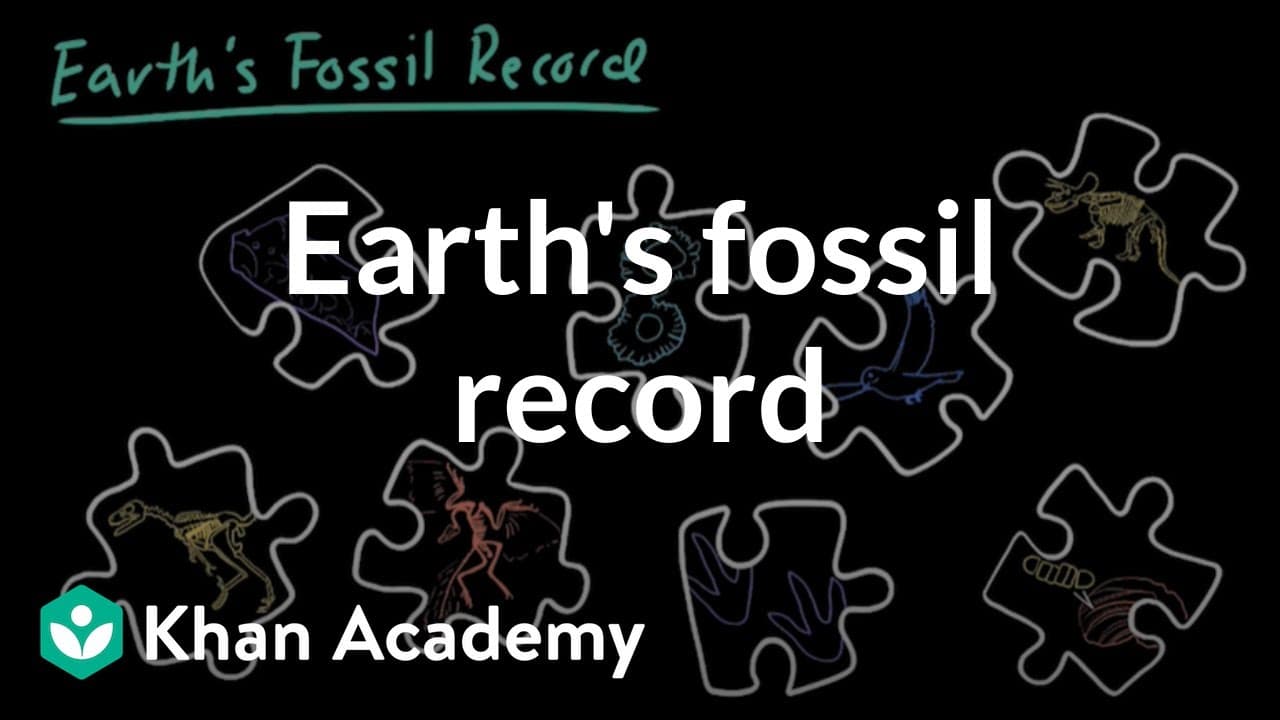
The fossil record provides a history of life on Earth, showing patterns of evolutionary changes, increases in complexity and diversity, and evidence of extinction events.
Transcript
- [Instructor] Life on Earth has existed for billions of years. Humans know this, not because we've been around the whole time, but instead, thanks to the discovery of fossils, which tell us about organisms that lived in the distant past. Scientists have found millions of fossils. Some, such as skeletons, document ancient organisms' anatomy or phys... Read More
Key Insights
- 🫀 Fossils provide evidence of the history of life on Earth, revealing anatomical features and behaviors of ancient organisms.
- 🛀 The fossil record shows an increase in organism complexity and diversity over time, with major transitions in life's complexity documented.
- 💋 The Cambrian Explosion marked a significant increase in animal diversity.
- 🐦 Fossils can demonstrate evolutionary transitions, such as the link between dinosaurs and birds.
- 🥺 Extinction events can be observed in the fossil record, with evidence of mass extinctions leading to the disappearance of certain species.
- 💗 The fossil record is continually growing and expanding our understanding of the past.
- 😒 Scientists use the fossil record to piece together the history of life on Earth.
Install to Summarize YouTube Videos and Get Transcripts
Explore YouTube Video Summarizer or Get YouTube Transcript Extractor
Questions & Answers
Q: How do fossils provide evidence of the history of life on Earth?
Fossils, such as skeletons and footprints, give us insight into the anatomy and behaviors of ancient organisms, helping us understand their place in the history of life on Earth.
Q: What can the fossil record tell us about evolutionary changes?
The fossil record shows an overall increase in organism complexity and diversity over time, documenting major leaps in life's complexity, such as the emergence of eukaryotic cells and multicellular organisms.
Q: What is the Cambrian Explosion?
The Cambrian Explosion refers to a period about 539 million years ago when there was a significant increase in the diversity of animal life on Earth, with many animal lineages appearing during this time.
Q: How do scientists study fossils to understand evolutionary lineages?
By examining the layers of sedimentary rocks in which fossils are found, scientists can determine their relative ages and piece together the evolutionary steps of how one type of organism could have evolved into the next.
Summary & Key Takeaways
-
Fossils, such as skeletons and footprints, provide information about ancient organisms' anatomy and behaviors.
-
The fossil record is a collection of fossils that documents the history of life on Earth.
-
By studying the fossil record, scientists can understand how life on Earth has evolved and changed over time.
Read in Other Languages (beta)
Share This Summary 📚
Summarize YouTube Videos and Get Video Transcripts with 1-Click
Try YouTube Summary with ChatGPT & Claude or YouTube Transcript Generator
Explore More Summaries from Khan Academy 📚



Summarize YouTube Videos and Get Video Transcripts with 1-Click
Try YouTube Summary with ChatGPT & Claude or YouTube Transcript Generator