Variance and standard deviation of a discrete random variable | AP Statistics | Khan Academy
TL;DR
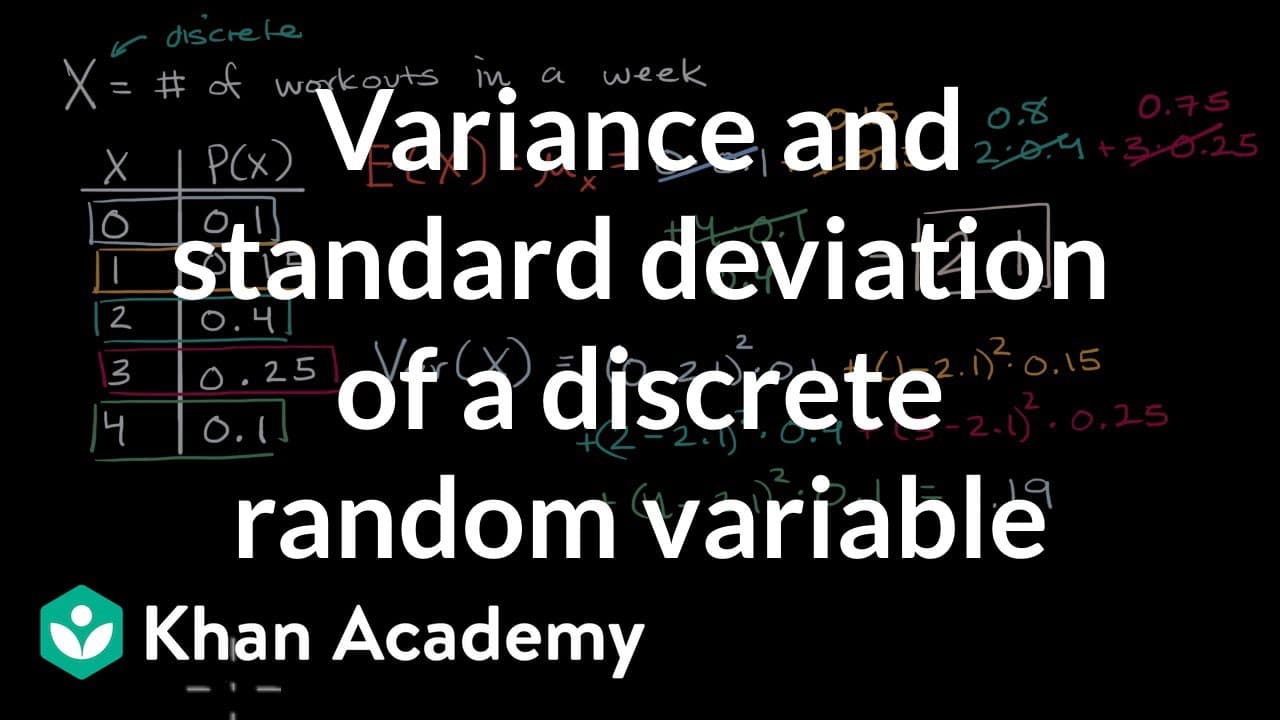
This video explains how to calculate the variance and standard deviation of a discrete random variable, using the example of the number of workouts done in a week.
Transcript
- [Instructor] In a previous video, we defined this random variable x. It's a discrete random variable. It can only take on a finite number of values, and I defined it as the number of workouts I might do in a week. And we calculated the expected value of our random variable x, which we could also denote as the mean of x, and we use the Greek lette... Read More
Key Insights
- 🥡 The expected value or mean of a random variable is obtained by taking the probability-weighted sum of the different outcomes.
- 🏋️ Variance is a measure of the spread of a random variable's values around the mean, and it is calculated by taking the squared difference between each outcome and the mean, weighted by their probabilities.
- 🫚 Standard deviation is the square root of variance, providing a measure of the dispersion of the random variable's values.
- 💁 The variance and standard deviation provide information about the variability of the random variable's values.
- 🇨🇫 The mean and standard deviation can be used to understand the central tendency and spread of a probability distribution.
- 🚱 Random variables can have non-integer means, indicating that the expected value is not necessarily one of the possible outcomes.
- ⏮️ The formula for calculating variance follows a similar structure to previous calculations of variance, involving differences, squares, and probabilities.
Install to Summarize YouTube Videos and Get Transcripts
Explore YouTube Video Summarizer or Get YouTube Transcript Extractor
Questions & Answers
Q: How is the expected value of a discrete random variable calculated?
The expected value or mean is calculated by taking the probability-weighted sum of the various outcomes. It involves multiplying each outcome by its respective probability and summing them all up.
Q: What is the formula for variance of a random variable?
The formula for variance involves taking the difference between each outcome and the mean, squaring that difference, and multiplying it by the probability of that outcome. These terms are then summed up to give the variance.
Q: How is the standard deviation related to variance?
The standard deviation is obtained by taking the square root of the variance. It provides a measure of the spread or dispersion of the random variable's values around the mean.
Q: Can the mean of a random variable be a non-integer value?
Yes, the mean of a random variable can be a non-integer value. This is because the mean is a weighted average of the possible outcomes, and the probabilities assigned to each outcome can result in a non-integer mean.
Summary & Key Takeaways
-
The video discusses the concept of expected value or mean of a discrete random variable, which is calculated by taking the probability-weighted sum of the various outcomes.
-
The variance of a random variable is determined by taking the difference between each outcome and the mean, squaring that difference, and multiplying it by the probability of that outcome.
-
The standard deviation is obtained by taking the square root of the variance.
Read in Other Languages (beta)
Share This Summary 📚
Summarize YouTube Videos and Get Video Transcripts with 1-Click
Try YouTube Summary with ChatGPT & Claude or YouTube Transcript Generator
Explore More Summaries from Khan Academy 📚



Summarize YouTube Videos and Get Video Transcripts with 1-Click
Try YouTube Summary with ChatGPT & Claude or YouTube Transcript Generator