Landscape Concepts: Far Distance Trees
TL;DR
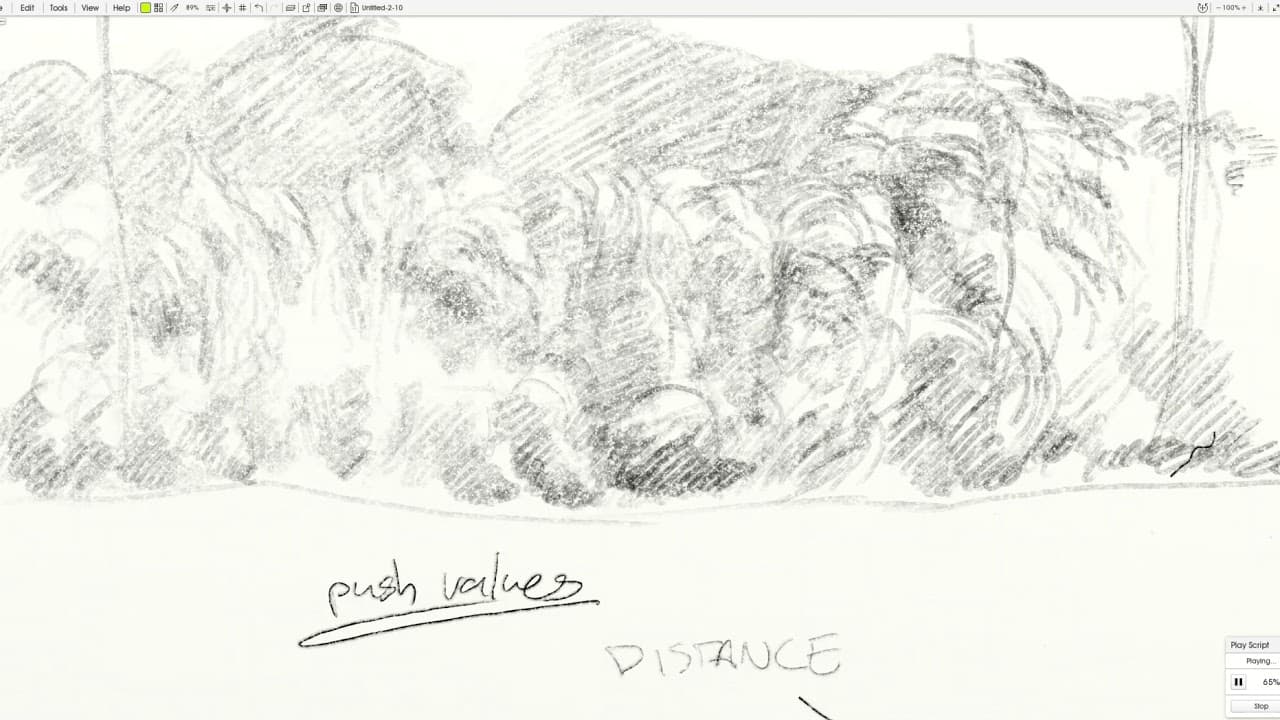
Learn techniques for drawing faraway trees in landscape art.
Transcript
Read and summarize the transcript of this video on Glasp Reader (beta).
Key Insights
- Understanding landscape composition is crucial; start by mapping horizon lines and landmarks before drawing trees.
- Approach faraway trees by focusing on large patches of value rather than intricate leaf textures.
- Trees generally have darker values, ranging from four to ten on the value scale, enhancing contrast with sky and grass.
- Initial sketches should prioritize value placement over detail, allowing for adjustments and corrections.
- Atmospheric perspective is key; distant trees should have lighter darks and darker lights to create depth.
- Use multiple passes to refine tree edges and add specific details, gradually increasing complexity.
- Erasers can be used creatively as drawing tools for edge control and adding texture to tree sketches.
- Incorporating overlapping lines and soft edges enhances depth perception and realism in landscape drawings.
Install to Summarize YouTube Videos and Get Transcripts
Explore YouTube Video Summarizer or Get YouTube Transcript Extractor
Questions & Answers
Q: How should one begin sketching a landscape with distant trees?
Start by creating a basic map of the landscape, identifying the horizon line and any significant landmarks. This helps in positioning the trees and understanding the overall composition. Initial sketches should focus on placing large patches of value to represent the trees, rather than getting caught up in intricate details.
Q: What is the main focus when drawing faraway trees?
The main focus should be on capturing the overall value of the trees rather than detailed textures. This involves using large patches of value to convey the idea of bushy foliage, with a balance of bright and dark areas that represent the tree's form and volume.
Q: How do values play a role in drawing trees?
Values are crucial in creating contrast and depth. Trees generally have darker values, starting around four or five on the value scale and reaching up to ten. This contrast makes the sky and grass appear brighter, enhancing the overall composition and realism of the landscape.
Q: What is the significance of atmospheric perspective in landscape drawing?
Atmospheric perspective is important for creating depth. In landscape drawing, it involves making distant trees appear lighter on the dark side and darker on the light side. This technique helps to convey the sense of distance and adds realism to the scene by simulating how light interacts with objects at varying distances.
Q: How can erasers be used creatively in drawing trees?
Erasers are not just for corrections; they can be used as drawing tools to create textures and define edges. By erasing certain areas, artists can achieve soft edges and subtle highlights, adding dimension and realism to the tree sketches. This technique allows for greater control over the final appearance of the drawing.
Q: What is the role of overlapping lines in landscape drawings?
Overlapping lines contribute to the perception of depth in a drawing. By allowing lines to drift in and out through the landscape, artists can create a sense of overlap, which is a simple yet effective way to convey depth. This technique is useful not only in landscape art but also in other types of drawing.
Q: Why is it important to avoid outlining trees in landscape art?
Outlining trees can make the edges appear harsh and rigid, which detracts from the natural look of the landscape. Soft edges are preferred as they help to maintain the illusion of depth and prevent the background from appearing too prominent. This subtlety is key in achieving a realistic and harmonious composition.
Q: What are the steps involved in refining tree drawings?
Refining tree drawings involves multiple passes. The first pass focuses on placing values, while subsequent passes involve pushing these values darker and adding details. Artists should gradually increase specificity, working on smaller patches and refining edges. This layered approach allows for detailed and realistic representations of trees.
Summary & Key Takeaways
-
The video provides a guide on drawing distant trees by focusing on value placement and atmospheric perspective. It emphasizes starting with a basic map of the landscape, identifying horizon lines and landmarks, and then proceeding with large patches of value to represent trees.
-
Faraway trees should be depicted with an emphasis on overall value rather than detailed textures. The approach involves using darker values for trees to contrast with the brightness of the sky and grass, and refining details through multiple passes.
-
Techniques such as using erasers for edge control and creating depth through overlapping lines are highlighted. The video stresses the importance of atmospheric perspective, suggesting lighter darks and darker lights for distant trees to achieve a sense of depth.
Read in Other Languages (beta)
Share This Summary 📚
Summarize YouTube Videos and Get Video Transcripts with 1-Click
Try YouTube Summary with ChatGPT & Claude or YouTube Transcript Generator
Explore More Summaries from Mead McLean 📚
Summarize YouTube Videos and Get Video Transcripts with 1-Click
Try YouTube Summary with ChatGPT & Claude or YouTube Transcript Generator