Set Operations - Query Processing and Optimization - Database Management System
TL;DR
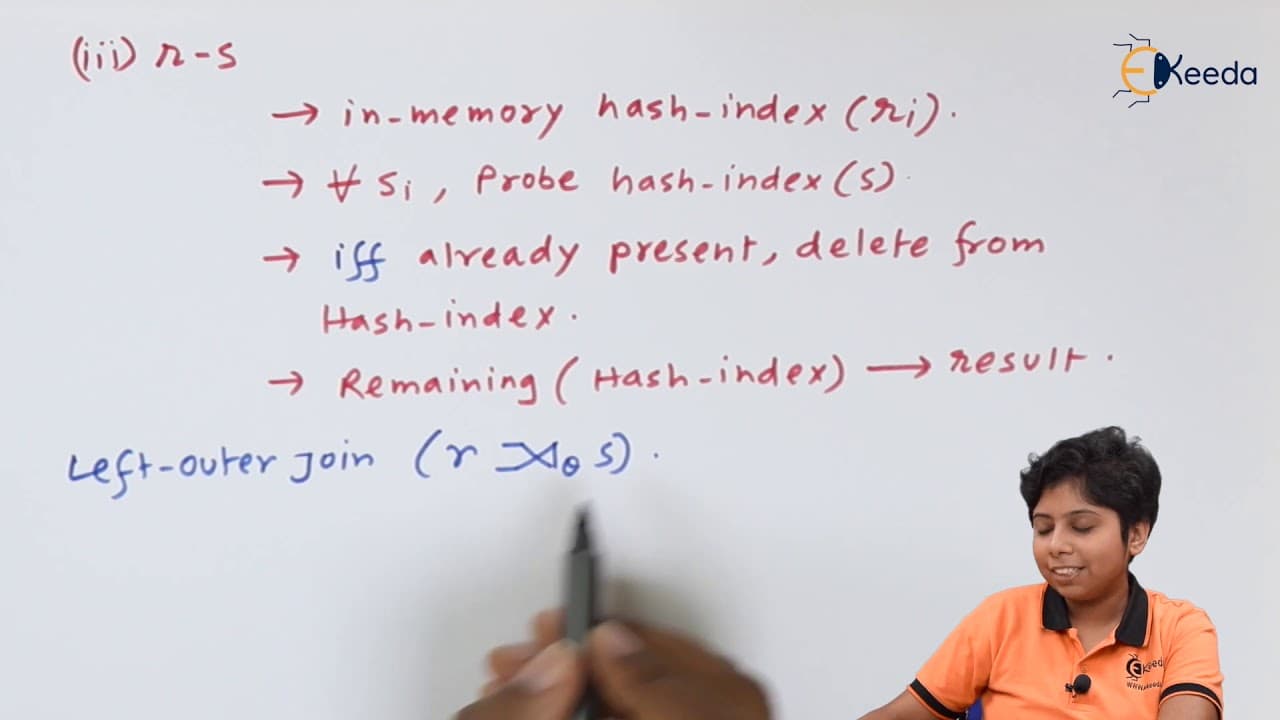
This video discusses the effects of set operations and outer joins on query processing, including union, intersection, difference, left outer join, right outer join, and full outer join.
Transcript
click the bell icon to get latest videos from akira hello friends today we will discuss about the effects of st. operations that includes all the Union intersection difference the aggregation and also the outer join relations into our query processing and see the effect of each one that how it cost analysis on the optimized query query processing s... Read More
Key Insights
- 😫 Set operations like union, intersection, and difference play a crucial role in combining or filtering attribute values between relations.
- 🗯️ Outer join operations, such as left outer join, right outer join, and full outer join, help retain tuples from one relation while joining with matching values from another relation.
- 😫 Aggregation operations like averaging can be efficiently performed on set bodies by grouping and applying appropriate functions.
Install to Summarize YouTube Videos and Get Transcripts
Explore YouTube Video Summarizer or Get YouTube Transcript Extractor
Questions & Answers
Q: What are set operations in query processing?
Set operations in query processing involve performing operations like union, intersection, and difference on sets of attribute values in relations. These operations help in combining or filtering common or unique values between two or more relations.
Q: How does the left outer join operation work in query processing?
In left outer join, all the tuples from the left relation are retained, and if there are matching values in the right relation, they are added to the resulting set. If there are missing values, null values are added instead. This operation can be performed by utilizing set operations like union and difference.
Q: What is the process of performing aggregation operations on set bodies in query processing?
Aggregation operations involve applying functions like average, sum, max, and count on set bodies. To perform the aggregation, the query may involve grouping the set bodies based on certain criteria, such as department name. This allows calculating the aggregate values for each group efficiently.
Q: How does the order by clause help in optimizing set operations in query processing?
The order by clause helps in arranging the result of set operations in a particular order, allowing for easier analysis and optimization. It can be used to sort the dataset based on specific attributes, enabling efficient execution of set operations and improving query performance.
Summary & Key Takeaways
-
The video explains the set operations of union, intersection, and difference, and how to perform cost analysis on query processing for each operation.
-
It also demonstrates the process of performing left outer join, right outer join, and full outer join, and their impacts on query processing.
-
Additionally, the video discusses the effects of aggregation operations, such as averaging, on set bodies in query processing.
Read in Other Languages (beta)
Share This Summary 📚
Summarize YouTube Videos and Get Video Transcripts with 1-Click
Try YouTube Summary with ChatGPT & Claude or YouTube Transcript Generator
Explore More Summaries from Ekeeda 📚






Summarize YouTube Videos and Get Video Transcripts with 1-Click
Try YouTube Summary with ChatGPT & Claude or YouTube Transcript Generator