Mathematics Public Lecture Moon Duchin
TL;DR
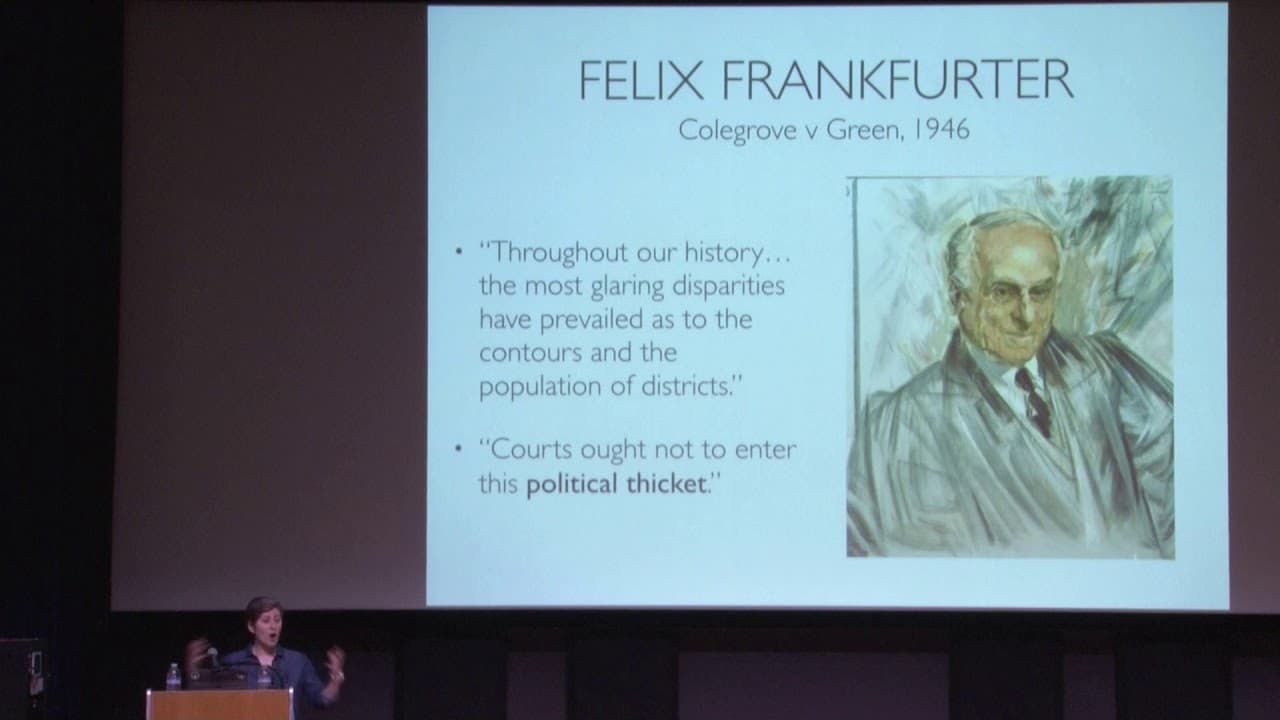
Redistricting and gerrymandering is a complex problem, and the mathematics involved in creating fair district lines is challenging and requires thoughtful consideration.
Transcript
hello hello welcome to this evening black gel my name is Eleni or nel and I am the chair of the mathematics department here at Stanford this lecture is part is one in a series of public lectures that is organized by Stanford mathematics department and it's sponsored by Stanford mathematical mathematical Research Center and the friends of Stanford m... Read More
Key Insights
- 🫥 Gerrymandering is a complex problem that involves manipulating district lines for political advantage.
- 🙈 Proportionality is often seen as a fair outcome, but achieving it can be challenging due to the variety of ways districts can be divided.
- 👾 Mathematical methods, such as Markov chains and random sampling, can help assess the fairness of districting plans by exploring the space of possibilities and considering different criteria.
Install to Summarize YouTube Videos and Get Transcripts
Explore YouTube Video Summarizer or Get YouTube Transcript Extractor
Questions & Answers
Q: What is the history of gerrymandering?
Gerrymandering has been a concern since the early 1800s, with the term "gerrymander" originating from Elbridge Gerry's district in Massachusetts that resembled a salamander. It involves manipulating district lines to favor one political party over another.
Q: How do district lines impact representation in the House of Representatives?
District lines determine the number of seats each political party receives in the House of Representatives. The goal is often to achieve proportionality, where the percentage of seats matches the percentage of votes for each party.
Q: How do mathematical methods like Markov chains help assess gerrymandering?
Markov chains allow for the exploration of different districting plans and the assessment of their fairness. By conducting random walks and sampling from the large space of possibilities, researchers can determine if a specific plan is within the expected range of fairness or is an extreme outlier.
Q: Can gerrymandering be eliminated by using different mathematical methods?
Different mathematical methods, such as recombination, have been introduced to explore the space of possibilities more effectively. While these methods can provide better mixing and faster exploration, they do not eliminate gerrymandering entirely. Ultimately, the issue of gerrymandering requires legal and political solutions.
Summary & Key Takeaways
-
Gerrymandering, the process of manipulating district lines for political advantage, has been a concern since the early 1800s.
-
The United States has its own unique gerrymandering problem due to the combination of elected officials drawing their own lines and the requirement to redistrict regularly.
-
Redistricting is a complex issue that involves a variety of rules and considerations, such as population balance, contiguity, compactness, racial fairness, and respect for boundaries and communities.
-
Mathematical methods, such as Markov chains and random sampling, can be used to explore the vast space of possible district plans and assess their fairness.
Read in Other Languages (beta)
Share This Summary 📚
Summarize YouTube Videos and Get Video Transcripts with 1-Click
Try YouTube Summary with ChatGPT & Claude or YouTube Transcript Generator
Explore More Summaries from Stanford 📚



Summarize YouTube Videos and Get Video Transcripts with 1-Click
Try YouTube Summary with ChatGPT & Claude or YouTube Transcript Generator