Composing 3x3 matrices | Matrices | Precalculus | Khan Academy
TL;DR
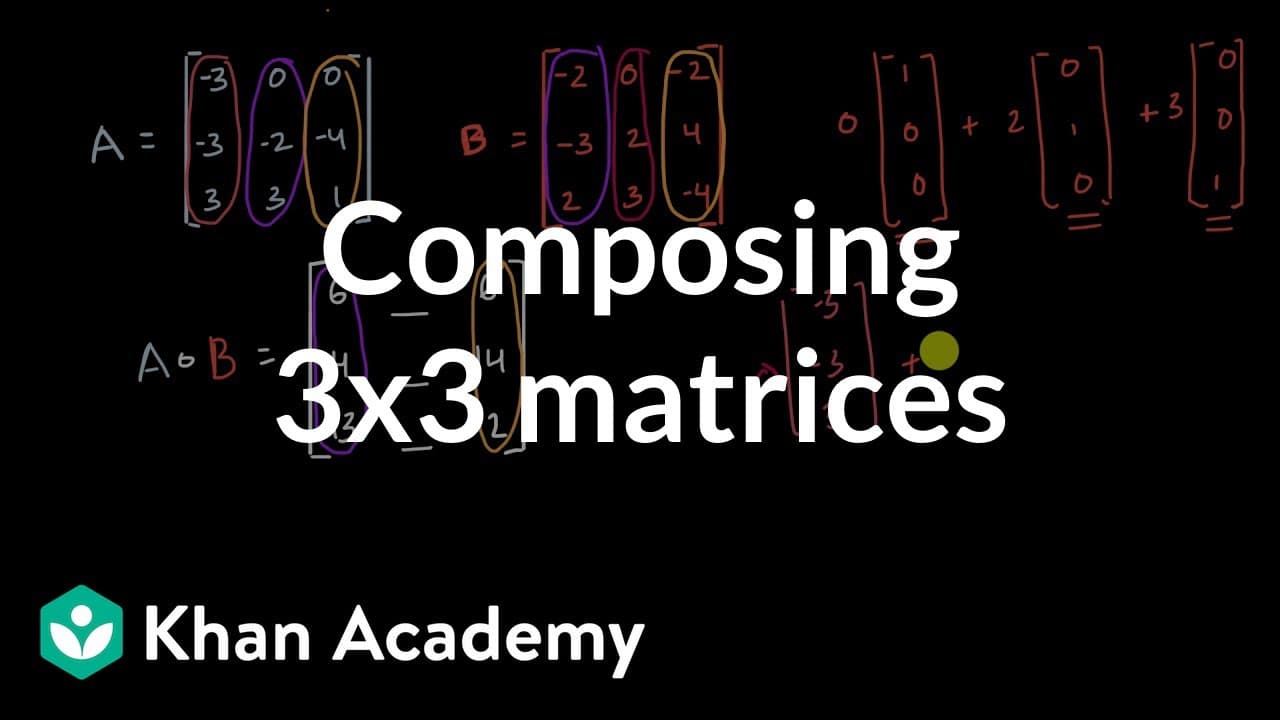
This video explains how to compose two three by three matrices as transformations in three-dimensional space.
Transcript
- [Instructor] So we have two, three by three matrices here, matrix A and matrix B. And we can of course, view each of them as a transformation in three dimensional space. Now, what we're going to think about in this video is the composition of A of Bs. So you can think of this as the transformation where you apply B first, and then you apply A aft... Read More
Key Insights
- 🛰️ Matrix A and matrix B can be viewed as transformations in three-dimensional space.
- 🔙 The composition of A of B can be represented by another three by three matrix.
- 🖕 In the composition, each column of matrix B is transformed using matrix A to determine the middle column of the resulting matrix.
- 🇦🇪 The basis vectors used in the transformation are the images of the standard unit vectors under the transformation of matrix A.
- 🖕 The middle column of the resulting matrix is obtained by multiplying each entry from the middle column of matrix B with the corresponding transformed basis vector.
- 🪚 The resulting entries are added up to obtain the final column of the composition.
- 😃 The composition represents the combined transformation of applying matrix B first, followed by matrix A.
Install to Summarize YouTube Videos and Get Transcripts
Explore YouTube Video Summarizer or Get YouTube Transcript Extractor
Questions & Answers
Q: How can we represent the composition of two matrices as transformations?
The composition of two matrices can be represented by applying the second matrix first and then applying the first matrix. This can be thought of as transforming each column of the second matrix with the first matrix.
Q: How is the middle column of the resulting matrix determined in the composition of A of B?
The middle column of the resulting matrix is determined by applying matrix A to the middle column of matrix B. Each entry in the middle column is transformed using the corresponding basis vectors under matrix A's transformation.
Q: What are the basis vectors used in the transformation?
Instead of using the standard unit vectors, the basis vectors used in the transformation are the images of the standard unit vectors under the transformation of matrix A.
Q: What is the process for finding the middle column of the resulting matrix?
To find the middle column, each entry is calculated by multiplying the corresponding entry from the middle column of matrix B with the transformed basis vectors under matrix A. The resulting entries are then added up to obtain the final column.
Summary & Key Takeaways
-
The video demonstrates how to compose two matrices A and B as transformations.
-
To compose A of B, each column of matrix B is transformed using matrix A.
-
The middle column of the resulting matrix is determined by applying matrix A to the middle column of matrix B.
Read in Other Languages (beta)
Share This Summary 📚
Summarize YouTube Videos and Get Video Transcripts with 1-Click
Try YouTube Summary with ChatGPT & Claude or YouTube Transcript Generator
Explore More Summaries from Khan Academy 📚



Summarize YouTube Videos and Get Video Transcripts with 1-Click
Try YouTube Summary with ChatGPT & Claude or YouTube Transcript Generator