Worked example: estimating sin(0.4) using Lagrange error bound | AP Calculus BC | Khan Academy
TL;DR
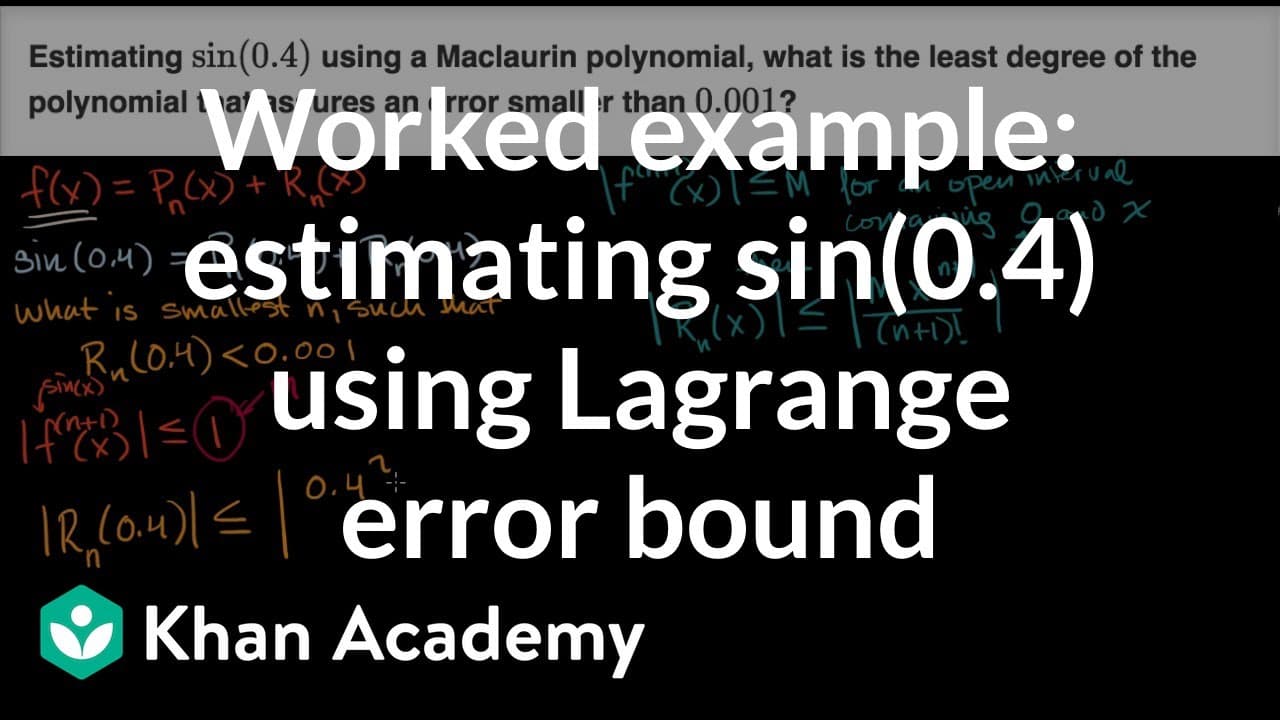
The video explains how to use a Maclaurin polynomial to estimate sine and determine the degree needed to achieve a specific error bound.
Transcript
- [Instructor] Estimating sine of 0.4 using a Maclaurin polynominal, what is the least degree of the polynominal that assures an error smaller than 0.001? So what are we talking about here? Well, we could take some function and estimate it with an nth degree Maclaurin polynomial, in fact, we could talk more generally about a Taylor polynominal, but... Read More
Key Insights
- ❓ Maclaurin polynomials are useful for approximating functions, especially when the function cannot be easily evaluated.
- ❓ The remainder in polynomial approximation quantifies the error introduced by the polynomial approximation.
- ⚾ The Lagrange error bound provides an upper bound on the remainder based on the (n+1)th derivative of the function.
- ✋ By choosing a sufficiently high degree for the polynomial, the error can be made smaller than a specified bound.
- 🆘 Differentiating the function helps determine the bounds for the Lagrange error bound.
Install to Summarize YouTube Videos and Get Transcripts
Explore YouTube Video Summarizer or Get YouTube Transcript Extractor
Questions & Answers
Q: What is a Maclaurin polynomial and how is it used in approximation?
A Maclaurin polynomial is a special case of a Taylor polynomial, centered at zero. It is used to approximate a function by expanding it as a power series around zero and selecting a finite number of terms in the series.
Q: What is the remainder in polynomial approximation?
The remainder in polynomial approximation is the difference between the actual value of the function and the value obtained from the polynomial approximation. It quantifies the error introduced by the approximation.
Q: How can the Lagrange error bound be applied to estimate the remainder?
The Lagrange error bound, also known as Taylor's Remainder Theorem, provides an upper bound on the remainder in terms of the (n+1)th derivative of the function. By ensuring the absolute value of the (n+1)th derivative is bounded over a given interval, the remainder can be bounded as well.
Q: How do you determine the minimum degree of a polynomial to achieve a specific error bound?
By evaluating the remainder expression using different degrees of the polynomial, one can determine the smallest degree that guarantees an error smaller than the specified bound. This involves substituting the value of x into the remainder expression and comparing it to the desired error bound.
Summary & Key Takeaways
-
The video discusses using an nth degree Maclaurin polynomial to approximate a function.
-
It introduces the concept of the remainder in polynomial approximation.
-
The problem of estimating the sine of 0.4 is used as an example to determine the minimum degree of the polynomial needed to achieve an error smaller than 0.001.
Read in Other Languages (beta)
Share This Summary 📚
Summarize YouTube Videos and Get Video Transcripts with 1-Click
Try YouTube Summary with ChatGPT & Claude or YouTube Transcript Generator
Explore More Summaries from Khan Academy 📚



Summarize YouTube Videos and Get Video Transcripts with 1-Click
Try YouTube Summary with ChatGPT & Claude or YouTube Transcript Generator