Products
Features
YouTube Video Summarizer
Summarize YouTube videos
Web & PDF Highlighter
Highlight web pages & PDFs
Chat with PDF
Ask any PDF questions with AI
Ask AI Clone
Chat with your highlights & memories
Audio Transcriber
Transcribe audio files to text
Glasp Reader
Read and highlight articles
Kindle Highlight Export
Export your Kindle highlights
Idea Hatch
Hatch ideas from your highlights
Integrations
Obsidian Plugin
Notion Integration
Pocket Integration
Instapaper Integration
Medium Integration
Readwise Integration
Snipd Integration
Hypothesis Integration
Apps & Extensions
Chrome Extension
Safari Extension
Edge Add-ons
Firefox Add-ons
iOS App
Android App
Discover
Discover
Ideas
Discover new ideas and insights
Articles
Curated articles and insights
Books
Book recommendations by great minds
Posts
Essays and notes from readers
Quotes
Inspiring quotes collection
Videos
Curated videos and summaries
Explore Glasp
Glasp Newsletter
Weekly insights and updates
Glasp Talk
Interview series with great minds
Glasp Blog
Latest news and articles
Glasp Use Cases
Learn how others use Glasp
Build & Support
Glasp API
Access Glasp's API for developers
MCP Connector
Connect Glasp to Claude & ChatGPT
Community
Glasp Reddit Community
Students
Student discount and benefits
FAQs
Frequently Asked Questions
AboutPricing
DashboardLog inSign up

3.2.3 CMOS Recipe

July 12, 2019
by
MIT OpenCourseWare
YouTube video player
3.2.3 CMOS Recipe

TL;DR

MOSFETs are used to build circuits that process digitally encoded information, following rules for using n-channel (NFET) and p-channel (PFET) MOSFETs as voltage-controlled switches.

Transcript

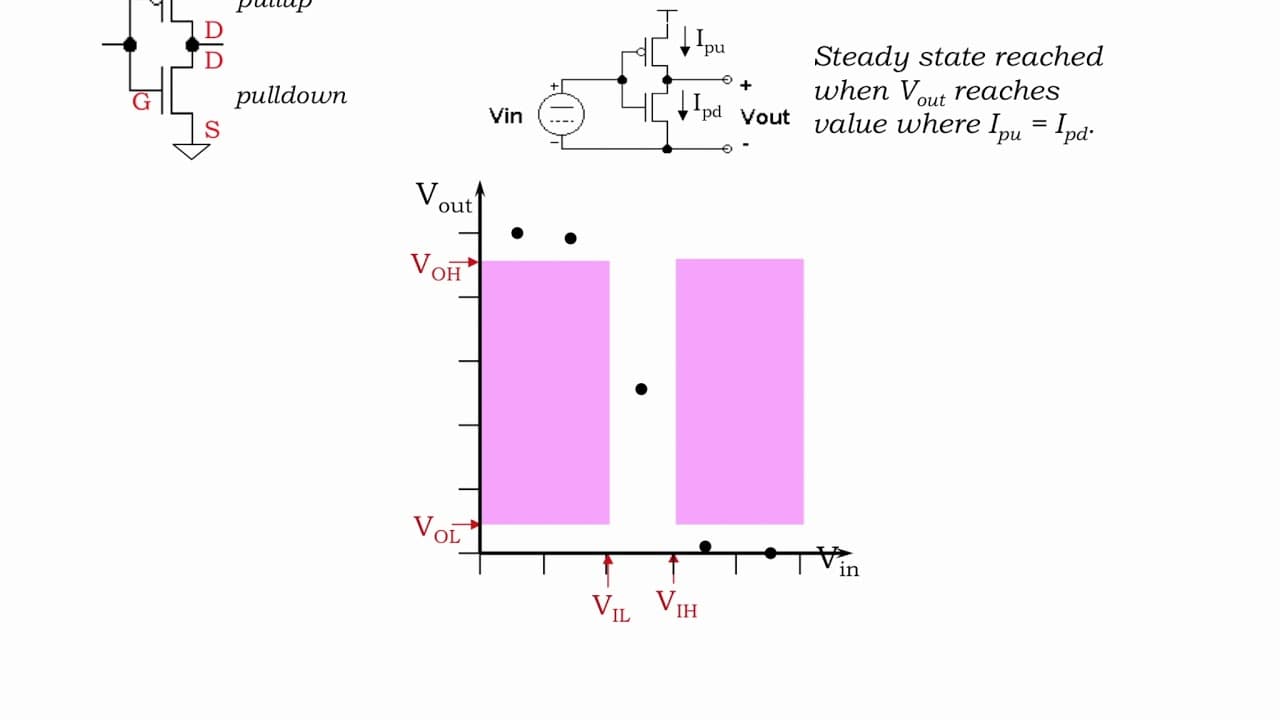
Now that we have some sense about how MOSFETs function, let's use them to build circuits to process our digitally encoded information. We have two simple rules we'll use when building the circuits, which, if they're followed, will allow us to abstract the behavior of the MOSFET as a simple voltage-controlled switch. The first rule is that we'll onl... Read More

Key Insights

  • 💁 MOSFETs can be used to build circuits for processing digitally encoded information.
  • 🎊 NFETs are used in pulldown circuits and PFETs are used in pullup circuits.
  • ⚡ The behavior of MOSFETs can be abstracted as voltage-controlled switches based on the gate-source voltage.
  • 💦 CMOS devices exhibit high gain and can work reliably in different operating environments.

Install to Summarize YouTube Videos and Get Transcripts

Explore YouTube Video Summarizer or Get YouTube Transcript Extractor

Questions & Answers

Q: What are the two rules for building circuits using MOSFETs?

The first rule is to use NFETs in pulldown circuits and PFETs in pullup circuits. The second rule is that the behavior of the MOSFET can be abstracted as a voltage-controlled switch.

Q: How does the gate voltage of an NFET switch affect its behavior?

If the gate voltage is a digital 0, the NFET switch will be off and not conducting. If the gate voltage is a digital 1, the NFET switch will be on and conducting.

Q: Why can't NFETs be used in pullup circuits or PFETs be used in pulldown circuits?

Using NFETs in pullup circuits or PFETs in pulldown circuits would result in degraded signaling levels and a loss of noise margins.

Q: How does a combinational inverter circuit work?

The combinational inverter circuit uses an NFET switch for the pulldown circuit and a PFET switch for the pullup circuit. The output is inverted based on the input signal.

Summary & Key Takeaways

  • MOSFETs are used to build circuits for processing digitally encoded information.

  • The behavior of MOSFETs can be abstracted as a simple voltage-controlled switch.

  • NFETs are used in pulldown circuits and PFETs are used in pullup circuits.


Read in Other Languages (beta)

English

Share This Summary 📚

Summarize YouTube Videos and Get Video Transcripts with 1-Click

Download browser extensions on:

Try YouTube Summary with ChatGPT & Claude or YouTube Transcript Generator

Explore More Summaries from MIT OpenCourseWare 📚
8: Case Studies: Chernobyl, Three Mile Island thumbnail
8: Case Studies: Chernobyl, Three Mile Island
MIT OpenCourseWare
6. 3-D Box and QM Separation of Variables thumbnail
6. 3-D Box and QM Separation of Variables
MIT OpenCourseWare
Components of a vector | MIT 18.02SC Multivariable Calculus, Fall 2010 thumbnail
Components of a vector | MIT 18.02SC Multivariable Calculus, Fall 2010
MIT OpenCourseWare
Class 8, Part 1: DARPA as the Connected Model & Government-Private Sector Interaction thumbnail
Class 8, Part 1: DARPA as the Connected Model & Government-Private Sector Interaction
MIT OpenCourseWare
6. Electron Shell Model, Quantum Numbers, and PES (Intro to Solid-State Chemistry) thumbnail
6. Electron Shell Model, Quantum Numbers, and PES (Intro to Solid-State Chemistry)
MIT OpenCourseWare
5. Discrete Random Variables I thumbnail
5. Discrete Random Variables I
MIT OpenCourseWare

Summarize YouTube Videos and Get Video Transcripts with 1-Click

Download browser extensions on:

Try YouTube Summary with ChatGPT & Claude or YouTube Transcript Generator

Apps & Extensions

  • Chrome Extension
  • Safari Extension
  • Edge Add-ons
  • Firefox Add-ons
  • iOS App
  • Android App

Key Features

  • YouTube Video Summarizer
  • Web & PDF Summarizer
  • Web & PDF Highlighter
  • Chat with PDF
  • Ask AI Clone
  • Audio Transcriber
  • Glasp Reader
  • Kindle Highlight Export
  • Idea Hatch

Integrations

  • Obsidian Plugin
  • Notion Integration
  • Pocket Integration
  • Instapaper Integration
  • Medium Integration
  • Readwise Integration
  • Snipd Integration
  • Hypothesis Integration

More Features

  • APIs
  • MCP Connector
  • Blog & Post
  • Embed Links
  • Image Highlight
  • Personality Test
  • Quote Shots

Company

  • About us
  • Blog
  • Community
  • FAQs
  • Job Board
  • Newsletter
  • Pricing
Terms

•

Privacy

•

Guidelines

© 2026 Glasp Inc. All rights reserved.