Comparing models to fit data | Regression | Probability and Statistics | Khan Academy
TL;DR
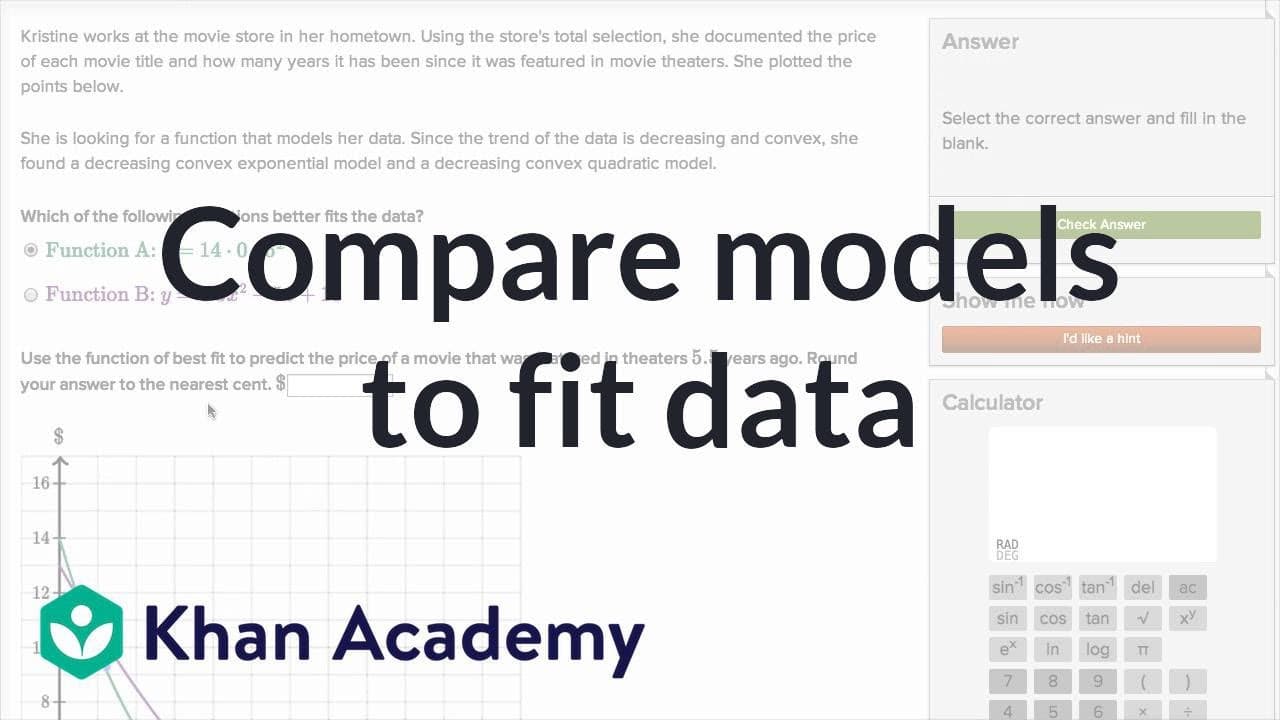
Christine analyzes the price of movies based on the number of years since they were released in theaters, using two different models to fit the data and determine which one provides a better fit.
Transcript
- Christine works in a movie store in her hometown. Using the store's total selection, she documented the price of each movie title and how many years it has been since it was featured in movie theatres. She plotted the points below. So let's see what's going on below here. Looks like there's two curves that she tries to fit. I'm assuming we're goi... Read More
Key Insights
- 🎥 Christine collected data on movie prices and their release year duration.
- 🛀 The data showed a decreasing and convex trend.
- ❓ The analysis compared an exponential and a quadratic model.
- ❓ The quadratic model provided a better fit to the data.
- ❓ The exponential model consistently underestimated the prices.
- ❓ The quadratic model had a more balanced distribution of overestimates and underestimates.
- 😇 Using the quadratic model, the price of a movie released 5.5 years ago is predicted to be 63 cents.
Install to Summarize YouTube Videos and Get Transcripts
Explore YouTube Video Summarizer or Get YouTube Transcript Extractor
Questions & Answers
Q: What is the purpose of Christine's analysis?
Christine's analysis aims to find the best model that fits the data on movie prices based on the number of years since their release in theaters.
Q: How does Christine determine which model is a better fit?
Christine compares the exponential and quadratic models by analyzing their estimates for the movie prices and comparing them to the actual data points. The model that provides estimates closer to the actual prices is considered a better fit.
Q: What is the difference between the exponential and quadratic models?
The exponential model assumes that the movie prices decrease exponentially with the number of years since release, while the quadratic model assumes a more concave-shaped decrease in prices.
Q: Which model does Christine conclude is a better fit for the data?
Christine determines that the quadratic model provides a better fit to the data because it has a more balanced distribution of overestimates and underestimates compared to the exponential model.
Summary & Key Takeaways
-
Christine collected data on the price of movies and the number of years since their release in theaters.
-
She found that the data followed a decreasing and convex trend.
-
Christine compared an exponential model and a quadratic model to determine which one better fits the data.
Read in Other Languages (beta)
Share This Summary 📚
Summarize YouTube Videos and Get Video Transcripts with 1-Click
Try YouTube Summary with ChatGPT & Claude or YouTube Transcript Generator
Explore More Summaries from Khan Academy 📚



Summarize YouTube Videos and Get Video Transcripts with 1-Click
Try YouTube Summary with ChatGPT & Claude or YouTube Transcript Generator