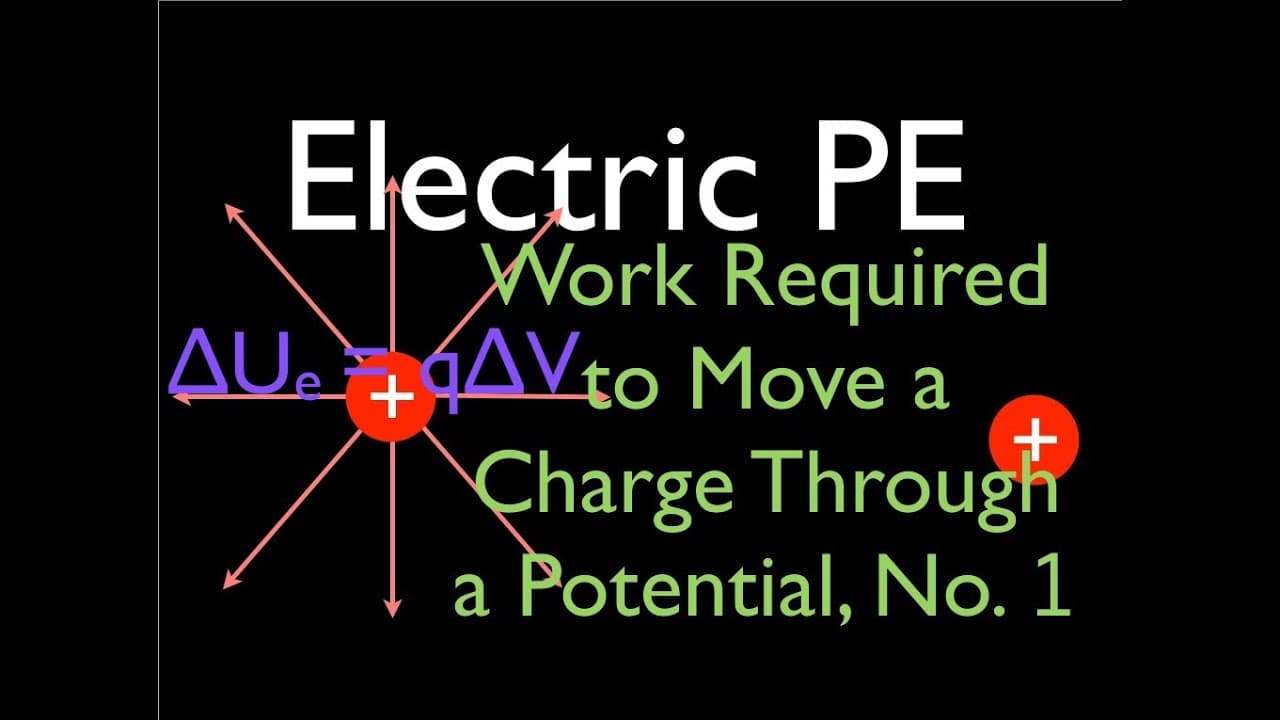
Point Charges (8 of 10) Work Done Moving a Point Charge thru a Potential Difference: No 1
TL;DR
Learn how to calculate the work done when moving a charge through a potential difference.
Transcript
okay in today's video I am going to over how to calculate the amount of work done when you move a charge through a potential difference alright now this is pretty straightforward all it says here is how much work does it take to move a -5 micro Coulomb charge micro Coulomb charge through a potential difference of plus 50 volts okay you'll you shoul... Read More
Key Insights
- 💦 Calculating work done involves multiplying the charge being moved by the potential difference.
- 💦 Negative work is done when moving a charge to a place it wants to be.
- 💦 Positive work is done when moving a charge to a place it doesn't want to be.
- 💦 Work done is equal to the change in potential energy.
- 💦 Work is measured in joules, which is the unit of energy.
- 🈂️ Negative work can occur when moving a charge closer to a positive charge or farther away from a negative charge.
- 💪 The equation for calculating work done is Q x Delta V.
Install to Summarize YouTube Videos and Get Transcripts
Explore YouTube Video Summarizer or Get YouTube Transcript Extractor
Questions & Answers
Q: How is work done related to the change in potential energy?
Work done is equal to the change in potential energy. When you change the potential energy of a charge, work is done in the process.
Q: How do you calculate the amount of work done in moving a charge through a potential difference?
The amount of work done is equal to the product of the charge being moved and the potential difference through which it is moved. In this case, the equation is Q x Delta V.
Q: Can work done be negative? What does it mean?
Yes, work done can be negative. Negative work means that the charge is being moved to a place it wants to be, either closer to a positive charge or farther away from a negative charge.
Q: What is the significance of the unit joules in calculating work done?
Joules is the unit of energy, and work done is a form of energy. Therefore, calculating work done in joules allows for comparing it to other forms of energy.
Summary & Key Takeaways
-
Work done in moving a charge through a potential difference is equal to the change in potential energy, which is equal to the product of the charge and the potential difference.
-
Negative work is done when moving a charge closer to a place it wants to be, while positive work is done when moving a charge to a place it doesn't want to be.
-
The amount of work done in this specific case is -3 x 10^-4 joules.
Read in Other Languages (beta)
Share This Summary 📚
Summarize YouTube Videos and Get Video Transcripts with 1-Click
Try YouTube Summary with ChatGPT & Claude or YouTube Transcript Generator
Explore More Summaries from Step by Step Science 📚
Summarize YouTube Videos and Get Video Transcripts with 1-Click
Try YouTube Summary with ChatGPT & Claude or YouTube Transcript Generator