How to Design Bio-Inspired Aerial Robots with Flexible Wings?
TL;DR
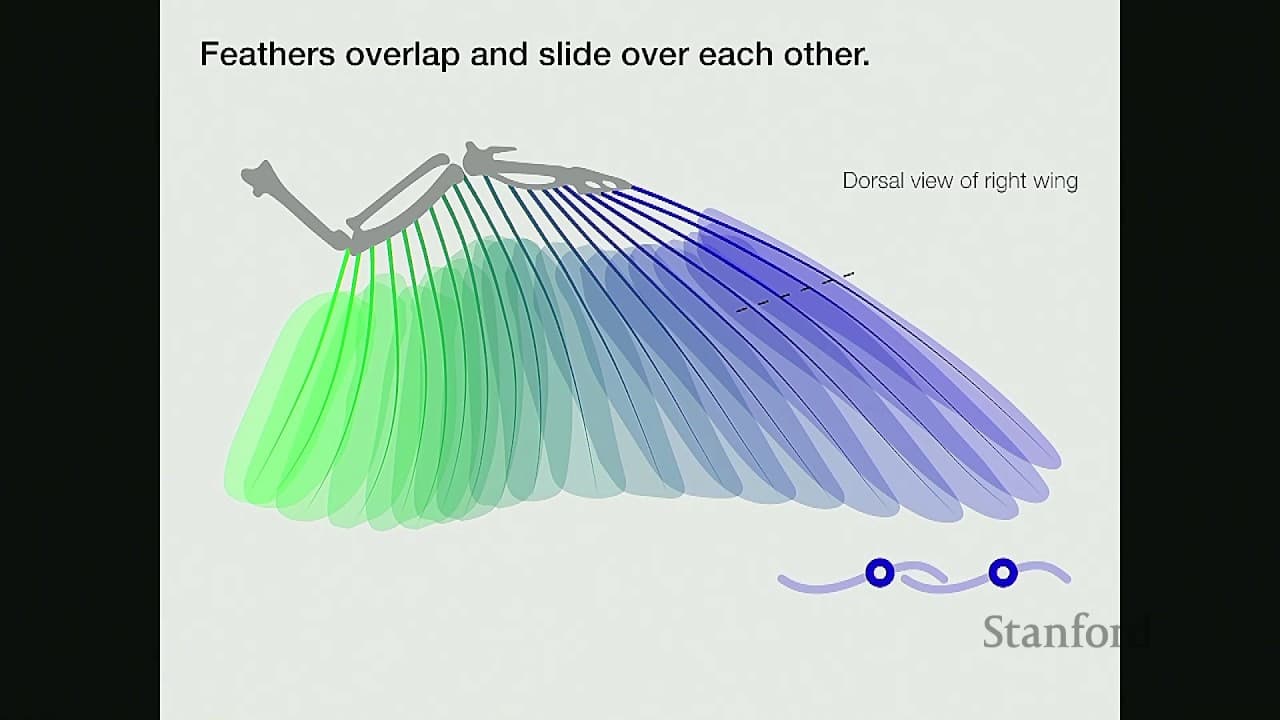
To design bio-inspired aerial robots with feathered morphing wings, researchers analyze bird wing mechanics and microstructures. By incorporating soft feather dynamics and biologically inspired design principles, they aim to enhance adaptability and performance, enabling robotic systems to better maneuver in varying wind conditions.
Transcript
so today I'll talk about my work on bio-inspired design and building feathered morphing winged robots so bio-inspired design starts with biology and birds are pretty amazing creatures that can fly in just about they can fly better than just about anything their size even including a current aerial robots so for example here's some bald eagles that ... Read More
Key Insights
- 😘 Birds have highly adaptable wings that enable them to optimize their flight performance in different wind conditions.
- 😘 Birds outperform traditional winged robots in terms of robustness, adaptability, flight speed, glide ratio, and maneuverability.
- 🪶 Feather microstructures, including hooks and cilia, play a crucial role in enabling feather contact and sliding during wing morphing.
- 😘 The combination of bone movements, feather contact, and elastic ligaments allows birds to seamlessly transition between different wing shapes during flight.
- 😘 The bio-inspired design principles developed for pigeon wings can be applied to other bird species to enhance the performance and adaptability of robotic flying systems.
- 🪡 Further research is needed to explore the use of different materials and manufacturing methods to replicate the unique properties of bird feathers in robotic wings.
- 😘 Robotic wings that mimic the flexibility and adaptability of bird wings have the potential to revolutionize aerial robotics and improve their performance in various applications.
Install to Summarize YouTube Videos and Get Transcripts
Explore YouTube Video Summarizer or Get YouTube Transcript Extractor
Questions & Answers
Q: How do birds' wing shapes differ from traditional winged robots?
Birds have the ability to tuck and extend their wings, allowing them to optimize their wing shape for different wind conditions. Traditional winged robots lack this capability, leading to less adaptability and performance.
Q: How do birds compare to robots in terms of flight performance?
Birds generally outperform robots in categories such as robustness (ability to withstand collisions) and adaptability (ability to change wing shape). They also have comparable flight speeds, glide ratios, and maneuverability.
Q: What mechanisms enable birds to morph their wings during flight?
Biological measurements and kinematic modeling reveal that birds use a combination of bone movements, feather contact, and elastic ligaments to morph their wings. Feather microstructures, such as hooks and cilia, provide the necessary fastening and sliding capabilities.
Q: Can the design principles for pigeon wings be applied to other bird species?
While each bird species has specific flight adaptations, the bio-inspired design principles developed for pigeon wings can be adapted and applied to other bird species. However, further research is needed to understand the unique morphological and mechanical characteristics of each species.
Summary & Key Takeaways
-
Birds, especially those that spend a majority of their time in the air, possess remarkable flight capabilities, including the ability to tuck and extend their wings for optimal performance in different wind conditions.
-
Researchers have compared the performance of birds with traditional winged robots using metrics such as robustness, adaptability, flight speed, glide ratio, and maneuverability, and found that birds outperform robots in most categories.
-
By incorporating soft feathered morphing wings into robot design, researchers hope to improve the adaptability and performance of robotic flying systems.
Read in Other Languages (beta)
Share This Summary 📚
Summarize YouTube Videos and Get Video Transcripts with 1-Click
Try YouTube Summary with ChatGPT & Claude or YouTube Transcript Generator
Explore More Summaries from Stanford Online 📚

Summarize YouTube Videos and Get Video Transcripts with 1-Click
Try YouTube Summary with ChatGPT & Claude or YouTube Transcript Generator