Will We Run Out of Cosmic Microwave Background Radiation?, Cosmic Microwave Background Radiation 2
TL;DR
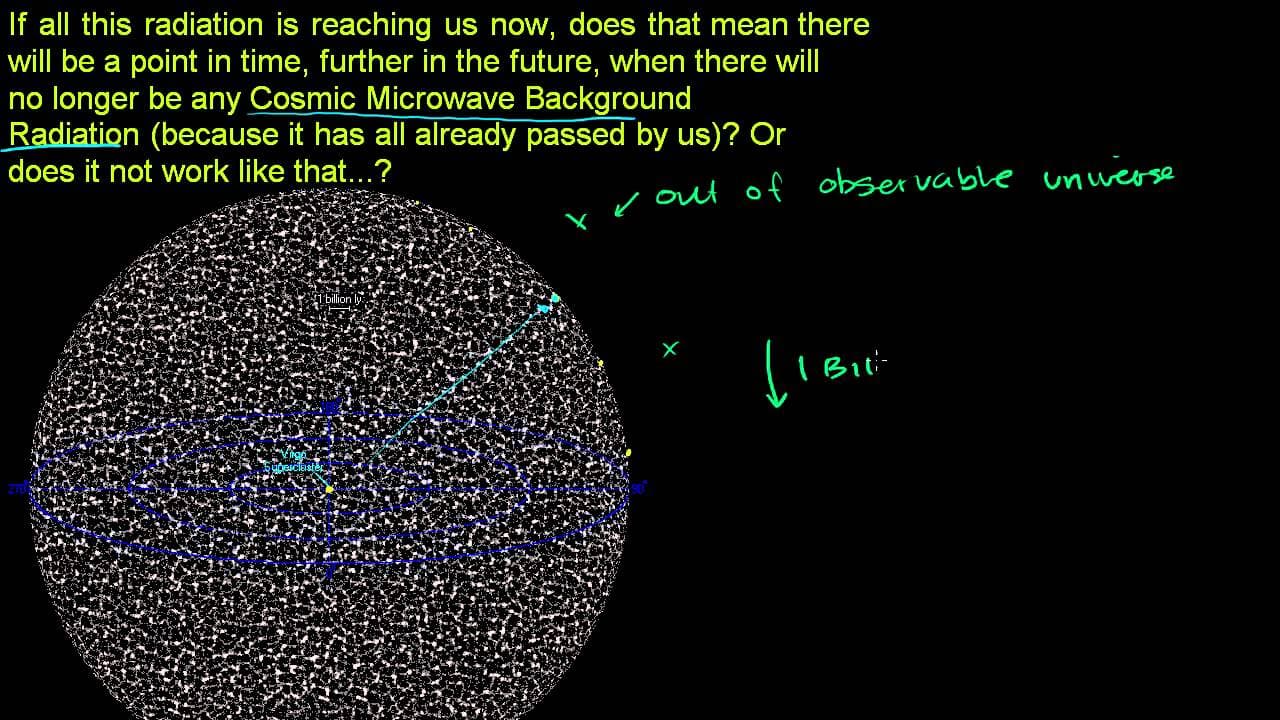
No, we will not run out of cosmic microwave background radiation because photons from increasingly distant regions will continue reaching us as our observable universe grows. The radiation observed now comes from a uniform hydrogen plasma seen as it existed 13.7 billion years ago. Read on to understand why older photons can pass us while background radiation remains observable.
Transcript
after the last video on the cosmic microwave background radiation madori fan 10 asked this question and I want to do a whole video on it because it's a really good question and he or she I I I'm sorry Midori fan 10 I I don't know whether you are here or she if all this radiation is reaching us now does that mean that there will be a point in time t... Read More
Key Insights
- 🏚️ The cosmic background radiation is the relic radiation from a time when the universe was in a uniform state of hydrogen plasma.
- 🧑🌾 The photons we observe from the cosmic background radiation are not only from far distances, but also from a past time.
- 💱 As the universe evolves, the cosmic background radiation will change, but it will still exist.
- ❓ The expansion of the universe means that we will always have more cosmic background radiation to observe.
- ❓ The observable universe is not the entire universe, and there is likely more cosmic background radiation beyond our current observations.
- ❓ The cosmic background radiation is evidence of the early stages of the universe's development.
- ❓ The presence of cosmic background radiation suggests that the universe was once in a state of uniformity.
Install to Summarize YouTube Videos and Get Transcripts
Explore YouTube Video Summarizer or Get YouTube Transcript Extractor
Questions & Answers
Q: Will we ever run out of cosmic microwave background radiation?
No, cosmic microwave background radiation will not simply disappear after the photons currently reaching us pass by. As more time passes, photons from farther beyond our current observable universe will reach us after being emitted during the same early hydrogen-plasma state.
Q: What is cosmic microwave background radiation?
It is relic radiation emitted when the universe was a uniform, white-hot hydrogen plasma or haze. The plasma had not yet differentiated into stars and galaxies.
Q: Why does looking farther into the universe mean looking further into the past?
Light from more distant regions takes longer to reach us. Consequently, observing photons from the edge of the observable universe shows those regions as they were when the photons departed, not as they are now.
Q: How old is the universe we see in the cosmic microwave background radiation?
The observed radiation shows the universe as it appeared 13.7 billion years ago. At that point in the account, the visible material was a uniform hydrogen-plasma haze rather than a differentiated collection of stars and galaxies.
Q: Why does the cosmic microwave background look uniform?
The photons come from a time when hydrogen plasma was uniform across the universe. Because stars and galaxies had not yet formed from that plasma, radiation arriving from that distance appears uniform.
Q: What would happen to the background radiation we observe after another billion years?
Photons then arriving from regions currently observed would show a later, more differentiated universe containing early stars rather than the original uniform haze. However, photons taking 14.7 billion years to reach us would arrive from farther regions and still show the earlier hydrogen-plasma state.
Q: Is the observable universe the entire universe?
No, the current observational boundary is not presented as the universe’s true boundary. The explanation assumes, with extremely high probability, that much more exists beyond the region we can currently observe.
Q: Why have some early photons already passed us while the background radiation remains visible?
Photons emitted nearby during the early plasma state passed us long ago, so nearby regions are now seen at later stages of development. At the same time, equivalent early photons from increasingly distant regions are only now reaching us, so cosmic background radiation remains visible.
Summary & Key Takeaways
-
When we observe light from the edge of the observable universe, we are not only seeing light that has traveled a long distance, but also light that was emitted a long time ago.
-
The cosmic microwave background radiation is the radiation emitted by a hydrogen plasma that was uniform across the universe about 13.7 billion years ago.
-
As the universe continues to evolve and differentiate, the cosmic microwave background radiation will change, but it will still be present.
Read in Other Languages (beta)
Share This Summary 📚
Summarize YouTube Videos and Get Video Transcripts with 1-Click
Try YouTube Summary with ChatGPT & Claude or YouTube Transcript Generator
Explore More Summaries from Khan Academy 📚






Summarize YouTube Videos and Get Video Transcripts with 1-Click
Try YouTube Summary with ChatGPT & Claude or YouTube Transcript Generator