Trapezoidal sums | Accumulation and Riemann sums | AP Calculus AB | Khan Academy
TL;DR
Learn how to estimate the area under a curve using trapezoids.
Transcript
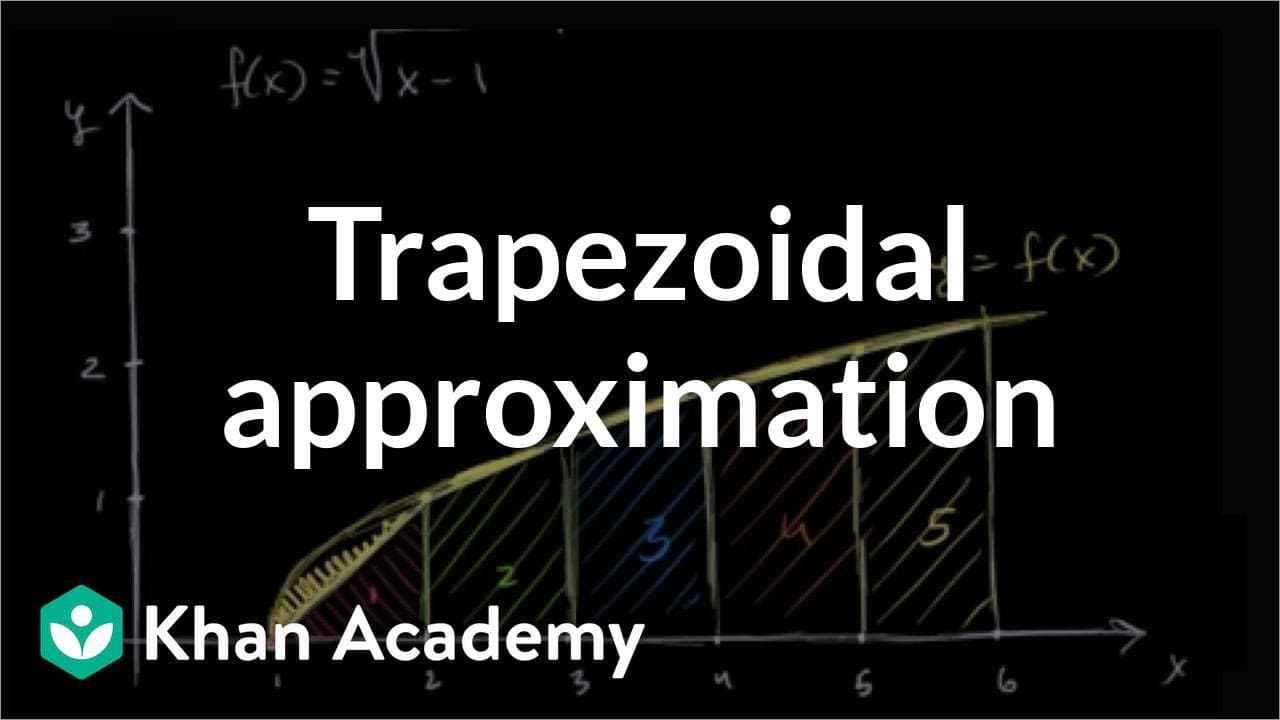
For fun, let's try to approximate the area under the curve y is equal to the square root, the principal root, of x minus 1, between x is equal to 1 and x is equal to 6. So I want to find this entire area. Or I want to at least approximate this entire area. And the way I'll do it is by setting up five trapezoids of equal width. So this will be the l... Read More
Key Insights
- ❓ Trapezoids can be used to approximate the area under a curve.
- 🟰 The width of each trapezoid should be equal for accurate approximation.
- 🙃 The area of each trapezoid can be calculated by taking the average of the heights of its two parallel sides.
- 🍹 Summing up the areas of all the trapezoids provides an approximation of the total area under the curve.
- ❓ The more trapezoids used, the more accurate the approximation.
- ❓ The technique of using trapezoids can be applied to various curves and functions.
- ❓ Trapezoid approximation is a practical method for estimating areas where the curve's equation cannot be easily integrated.
Install to Summarize YouTube Videos and Get Transcripts
Explore YouTube Video Summarizer or Get YouTube Transcript Extractor
Questions & Answers
Q: How do you approximate the area under a curve using trapezoids?
To approximate the area, divide the curve into multiple trapezoids of equal width. Then calculate the area of each trapezoid by taking the average of the heights of its two parallel sides. Finally, sum up the areas of all the trapezoids to get an approximation of the total area.
Q: What is the formula for calculating the area of a trapezoid?
The formula for the area of a trapezoid is the average of the heights of the two parallel sides, multiplied by the base width. In the context of approximating the area under a curve, you can also multiply the average height by the width of each trapezoid.
Q: Is the approximation using trapezoids always accurate?
The approximation using trapezoids is not always exact, but it can be a good estimate depending on the number of trapezoids used. Increasing the number of trapezoids leads to a more accurate approximation.
Q: Can you explain why the area of a trapezoid is calculated by taking the average of its two parallel sides' heights?
Taking the average of the heights allows us to approximately treat the shape as a rectangle. By doing so, we simplify the calculation while still accounting for the curvature of the curve.
Summary & Key Takeaways
-
The video explains how to approximate the area under a curve using trapezoids.
-
The width of each trapezoid is equal, and the area of each trapezoid can be calculated by taking the average of its two parallel sides.
-
By summing up the areas of each trapezoid, one can obtain an approximation of the area under the curve.
Read in Other Languages (beta)
Share This Summary 📚
Summarize YouTube Videos and Get Video Transcripts with 1-Click
Try YouTube Summary with ChatGPT & Claude or YouTube Transcript Generator
Explore More Summaries from Khan Academy 📚



Summarize YouTube Videos and Get Video Transcripts with 1-Click
Try YouTube Summary with ChatGPT & Claude or YouTube Transcript Generator