Differentiating functions: Find the error | Derivative rules | AP Calculus AB | Khan Academy
TL;DR
The key to finding these differentiation errors is to identify the expression’s structure and apply the matching product, chain, quotient, or power rule correctly. Nate treats a product’s derivative as the product of derivatives, while Katy omits the inner derivative, 4x, from the chain rule. Njoman misreads multiplication after a correct chain-rule step, and Tom’s correct quotient-rule work could be simplified. Read on for each diagnosis and correction.
Transcript
- [Instructor] What we're gonna do in this video is look at the work of other people as they try to take derivatives and see if their reasoning is correct and if it's not correct, try to identify what they should have done or where their reasoning went wrong. So over here it says Nate tried to find the derivative of X squared plus five X times sine... Read More
Key Insights
- 🥡 Taking the derivative of a product requires the application of the product rule.
- 📏 The chain rule is essential when finding the derivative of a composition of functions.
- 😨 Care must be taken when dealing with transcendental functions like sine or cosine, as their derivative application can be misleading.
Install to Summarize YouTube Videos and Get Transcripts
Explore YouTube Video Summarizer or Get YouTube Transcript Extractor
Questions & Answers
Q: How can you identify errors when differentiating functions?
First identify whether the expression contains a product, composition, or quotient, then compare the work with the corresponding derivative rule. The examples show errors caused by replacing the product rule, omitting part of the chain rule, and misreading multiplication written with parentheses.
Q: What was Nate’s error when differentiating (x² + 5x)sin(x)?
Nate assumed that the derivative of a product equals the product of the two derivatives. In general, he needed to apply the product rule instead.
Q: What is the correct derivative of (x² + 5x)sin(x)?
Applying the product rule gives (2x + 5)sin(x) + (x² + 5x)cos(x). This combines the derivative of the first factor times the second with the first factor times the derivative of the second.
Q: What does the product rule require?
For a product f(x)g(x), differentiate the first function and multiply by the unchanged second function. Then add the unchanged first function multiplied by the derivative of the second.
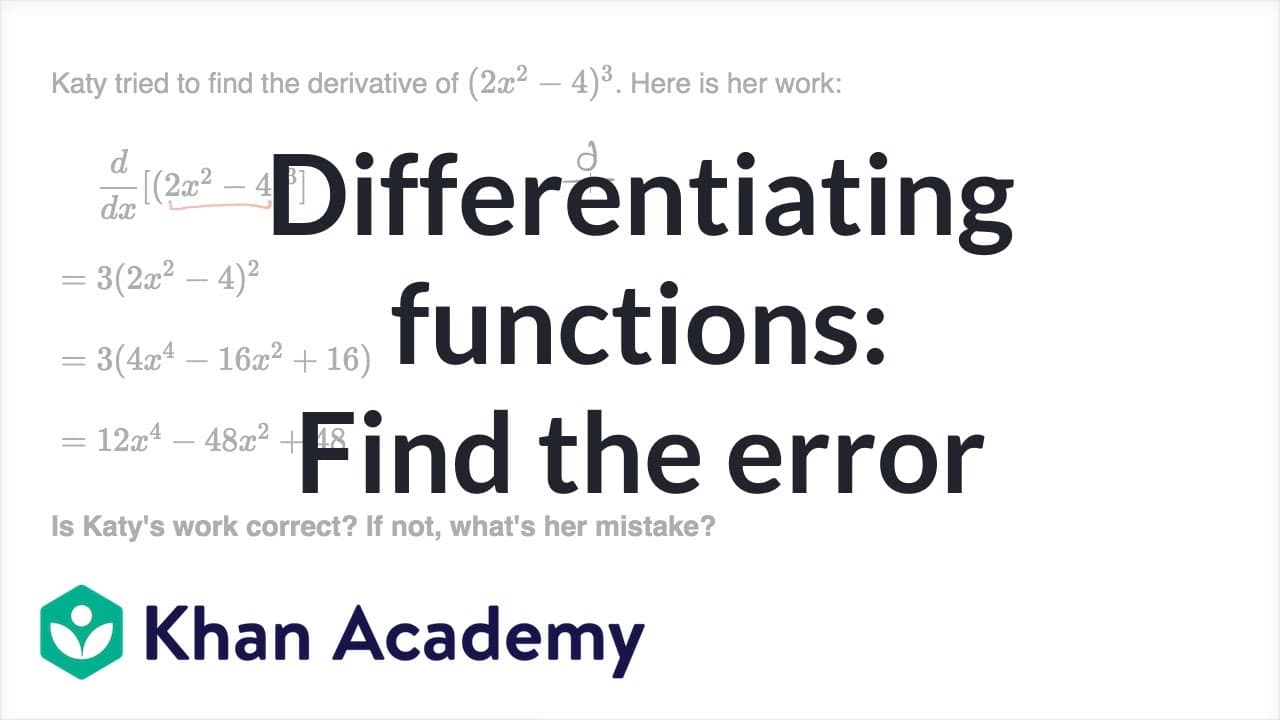
Q: What was Katy’s error when differentiating (2x² − 4)³?
Katy differentiated the outer third-power expression but did not multiply by the derivative of the inner function. The missing inner derivative is 4x.
Q: How is the chain rule applied to a composite function?
For f(g(x)), take the derivative of the outer function evaluated at g(x), then multiply by g′(x). Katy’s work was incomplete because it omitted that second factor.
Q: What was Njoman’s mistake when differentiating sin(7x² + 4x)?
Njoman initially applied the chain rule correctly, obtaining cos(7x² + 4x) multiplied by 14x + 4. He then became confused by the parentheses and incorrectly combined the expressions instead of preserving that multiplication.
Q: Was Tom’s differentiation of √x divided by x⁴ incorrect?
No, Tom correctly applied the quotient rule. However, he could have simplified the expression first and then used the power rule.
Summary & Key Takeaways
-
The first example shows Nate's mistake of assuming the derivative of a product is the product of the derivatives, instead of applying the product rule.
-
Katy's mistake in finding the derivative of a function to the power of 3 is not properly applying the chain rule.
-
Njoman's error lies in multiplying expressions by assuming they should be multiplied because of the presence of parentheses, resulting in an incorrect application of the chain rule.
-
Tom correctly applies the quotient rule but could have simplified the expression further using the power rule.
Read in Other Languages (beta)
Share This Summary 📚
Summarize YouTube Videos and Get Video Transcripts with 1-Click
Try YouTube Summary with ChatGPT & Claude or YouTube Transcript Generator
Explore More Summaries from Khan Academy 📚



Summarize YouTube Videos and Get Video Transcripts with 1-Click
Try YouTube Summary with ChatGPT & Claude or YouTube Transcript Generator