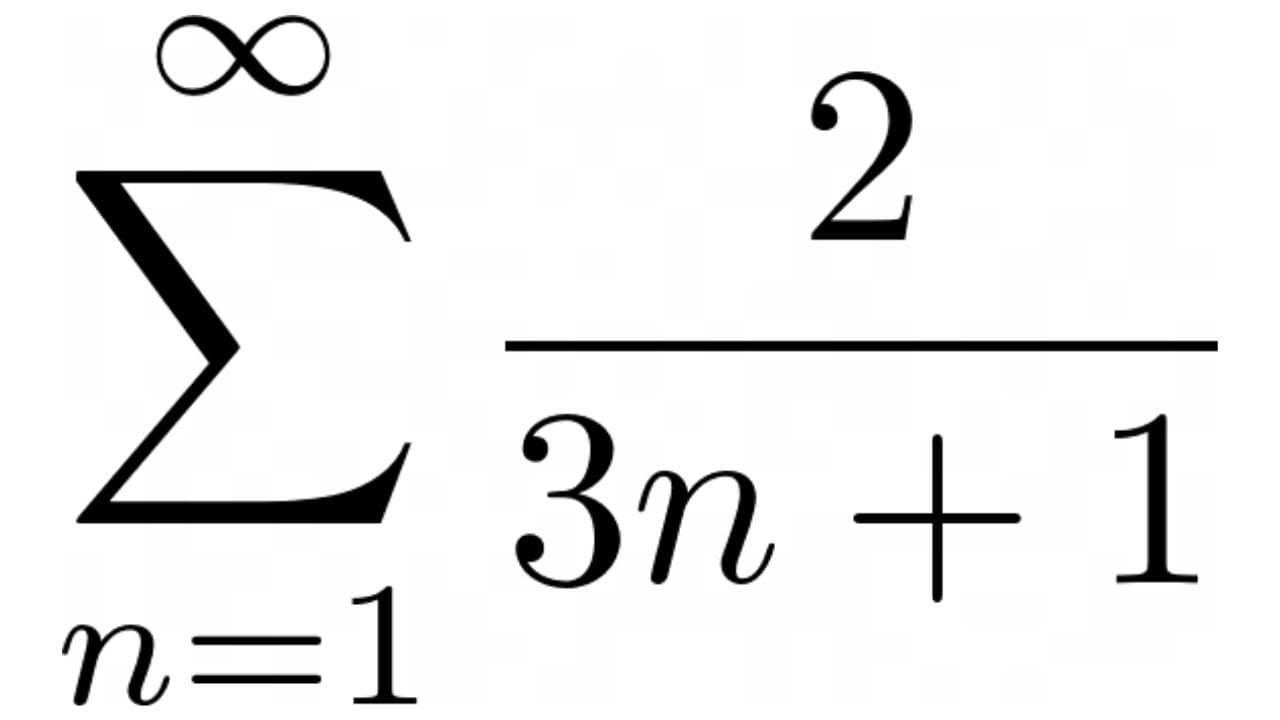
Integral Test for Infinite Series Example with SUM(2/(3n + 1))
TL;DR
Use the integral test to determine if the given infinite series converges or diverges.
Transcript
hi everyone and this problem we're being asked to use the integral test to determine whether this infinite series converges or diverges it's the first step when you're using the integral test is to take this piece here and call it f of X so we'll start by saying set f of X equal to 2 over 3x plus 1 the second step is to at least state the condition... Read More
Key Insights
- 🏆 The integral test can be used to determine the convergence or divergence of an infinite series.
- 🏆 Checking the conditions of the integral test is necessary to ensure accurate results.
- 🏆 The integral test is applicable in situations where other tests may not be suitable.
- ☺️ The integral test involves setting a function of X equal to the series, stating the conditions, and evaluating the corresponding improper integral.
- 🏆 The integral test is useful to know, even though it may involve more writing and take longer to complete compared to other tests.
- 🏆 The integral test provides a method to determine convergence or divergence based on an associated improper integral.
- 🏆 Understanding the graph of the natural logarithm function can help visualize the behavior of the series in the integral test.
Install to Summarize YouTube Videos and Get Transcripts
Explore YouTube Video Summarizer or Get YouTube Transcript Extractor
Questions & Answers
Q: How do you apply the integral test to determine if an infinite series converges or diverges?
To apply the integral test, set a function of X equal to the given series, state the conditions of the integral test, and check if the series satisfies these conditions. If satisfied, the series will either converge or diverge along with the corresponding improper integral.
Q: What are the conditions for the integral test?
The conditions for the integral test are that the function must be positive for X greater than or equal to 1, continuous for X greater than or equal to 1, and decreasing for X greater than or equal to 1.
Q: Why is it important to check the conditions for the integral test?
Checking the conditions ensures that the integral test can be applied correctly. If the conditions are not met, the test may not provide accurate results in determining the convergence or divergence of the series.
Q: What happens if the series passes the conditions for the integral test?
If the series satisfies the conditions of the integral test, the test states that the series will either converge or diverge along with the corresponding improper integral.
Summary & Key Takeaways
-
The integral test involves setting a function of X equal to the series, stating the conditions of the test, and determining if the series satisfies these conditions.
-
The conditions for the integral test include the function being positive for X greater than or equal to 1, continuous for X greater than or equal to 1, and decreasing for X greater than or equal to 1.
-
If the conditions are satisfied, the integral test states that the series will either converge or diverge along with the corresponding improper integral.
Read in Other Languages (beta)
Share This Summary 📚
Summarize YouTube Videos and Get Video Transcripts with 1-Click
Try YouTube Summary with ChatGPT & Claude or YouTube Transcript Generator
Explore More Summaries from The Math Sorcerer 📚
Summarize YouTube Videos and Get Video Transcripts with 1-Click
Try YouTube Summary with ChatGPT & Claude or YouTube Transcript Generator