How to Perform Matrix-Vector Multiplication
TL;DR
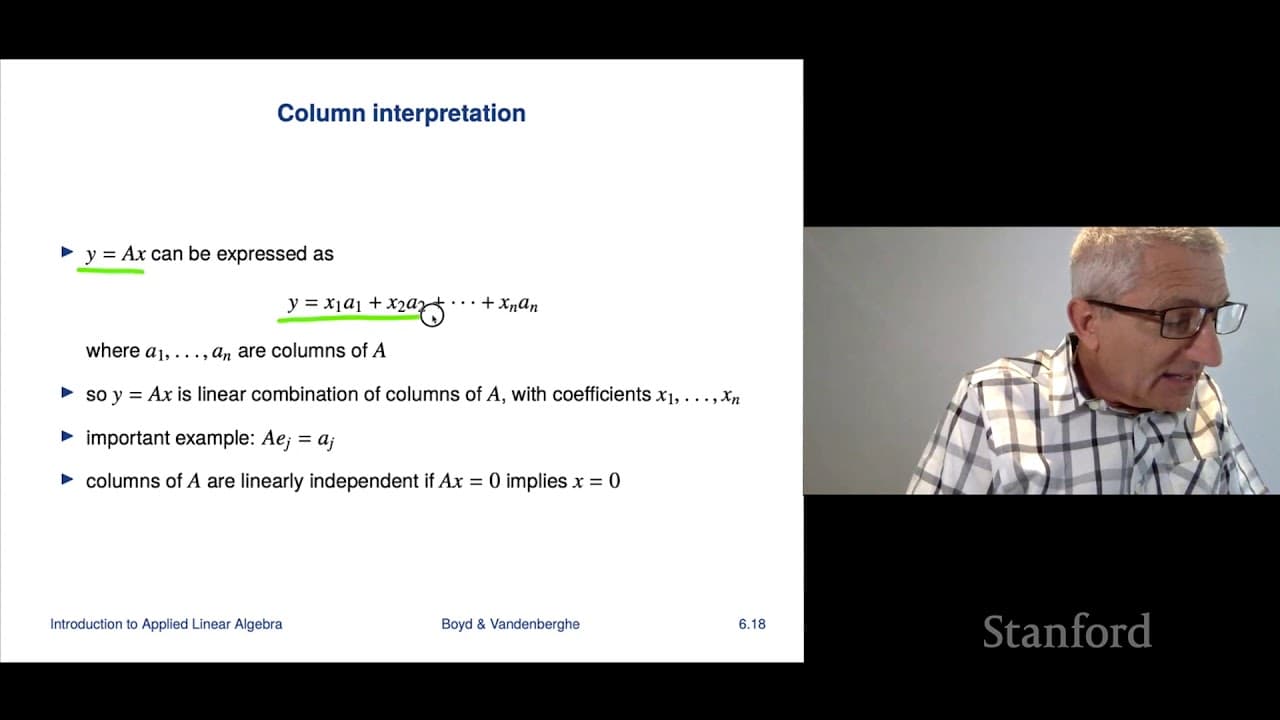
Matrix-vector multiplication combines an m by n matrix with an n-dimensional vector to produce an m-dimensional vector. This operation is essential in various mathematical contexts and can be interpreted as taking inner products of matrix rows with the vector or as a linear combination of the matrix's columns.
Transcript
we're now going to talk about a very important operation uh involving matrices and vectors it's matrix vector multiplication it's not something we've seen before but where it's actually going to be used basically throughout the entire book and class from now on it's matrix vector multiplication so here's what it is if i have an m by n matrix and n ... Read More
Key Insights
- ✖️ Matrix-vector multiplication involves multiplying an m by n matrix with an n-dimensional vector to produce an m-dimensional vector.
- 🤨 The result of matrix-vector multiplication is obtained by taking the inner product of each row of the matrix with the vector.
- ✖️ Matrix-vector multiplication can be interpreted as a linear combination of the columns of the matrix using the coefficients from the vector.
- 🛻 Multiplying a matrix by the jth unit vector picks out the jth column of the matrix.
- 0️⃣ Linear independence of the columns of a matrix implies that if the product of the matrix and a vector is zero, the vector must be zero.
- 🍹 Matrix-vector multiplication has applications in computing row sums, column sums, and picking out specific columns of a matrix.
Install to Summarize YouTube Videos and Get Transcripts
Explore YouTube Video Summarizer or Get YouTube Transcript Extractor
Questions & Answers
Q: What is matrix-vector multiplication?
Matrix-vector multiplication involves multiplying an m by n matrix with an n-dimensional vector to produce an m-dimensional vector. It can be interpreted as taking the inner product of each row of the matrix with the vector.
Q: How is matrix-vector multiplication denoted?
Matrix-vector multiplication is denoted by concatenating the matrix symbol and the vector symbol, such as Ax. This represents the product of the matrix and vector.
Q: How can matrix-vector multiplication be interpreted in terms of rows and columns?
Matrix-vector multiplication can be interpreted as taking the inner product of each row of the matrix with the vector or as a linear combination of the columns of the matrix using the coefficients from the vector.
Q: What are some applications of matrix-vector multiplication?
Matrix-vector multiplication can be used to compute row sums of a matrix, column sums of a matrix, and pick out specific columns of a matrix. It is also fundamental in representing linear combinations and determining linear independence of the columns of a matrix.
Summary & Key Takeaways
-
Matrix-vector multiplication is performed by multiplying an m by n matrix with an n-dimensional vector.
-
The result of matrix-vector multiplication is an m-dimensional vector that can be computed by taking the inner product of each row of the matrix with the vector.
-
Matrix-vector multiplication can be interpreted as taking the inner product of each row of the matrix with the vector or as a linear combination of the columns of the matrix using the coefficients from the vector.
-
(Content reviewed on 2026-08-27.)
Read in Other Languages (beta)
Share This Summary 📚
Summarize YouTube Videos and Get Video Transcripts with 1-Click
Try YouTube Summary with ChatGPT & Claude or YouTube Transcript Generator
Explore More Summaries from Stanford Online 📚


Summarize YouTube Videos and Get Video Transcripts with 1-Click
Try YouTube Summary with ChatGPT & Claude or YouTube Transcript Generator