Cyclic Structure of Glucose - Biomolecules - Chemistry Class 12
TL;DR
This video explains how to represent the cyclic structure of glucose and discusses the different forms of glucose.
Transcript
click the bell icon to get latest videos from equator reference in the previous topic we have discussed about the chemical reactions of glucose and now in this topic we are going to talk about the cyclic structure of glucose so now let us understand that is how we can represent these cyclic structure of glucose so friends we decide that is we can d... Read More
Key Insights
- 🤗 Glucose can exist in both an open chain structure and a cyclic structure.
- #️⃣ The cyclic structure is formed when carbon number 1 is bonded to carbon number 5 through an oxygen atom.
- ❓ The cyclic structure of glucose is known as glucopyranose.
- 💁 Glucopyranose can exist in two forms, glucopyranose and beta-d-glucopyranose, based on the orientation of the OH group on carbon number 1.
- 🫀 The cyclic structure consists of a 6-membered ring with five carbon atoms and one oxygen atom.
- 😋 The cyclic structure is also known as a pyranose ring structure.
- 💁 Glucose in its cyclic form is more stable and commonly found in nature.
Install to Summarize YouTube Videos and Get Transcripts
Explore YouTube Video Summarizer or Get YouTube Transcript Extractor
Questions & Answers
Q: How do you draw the open chain structure of glucose?
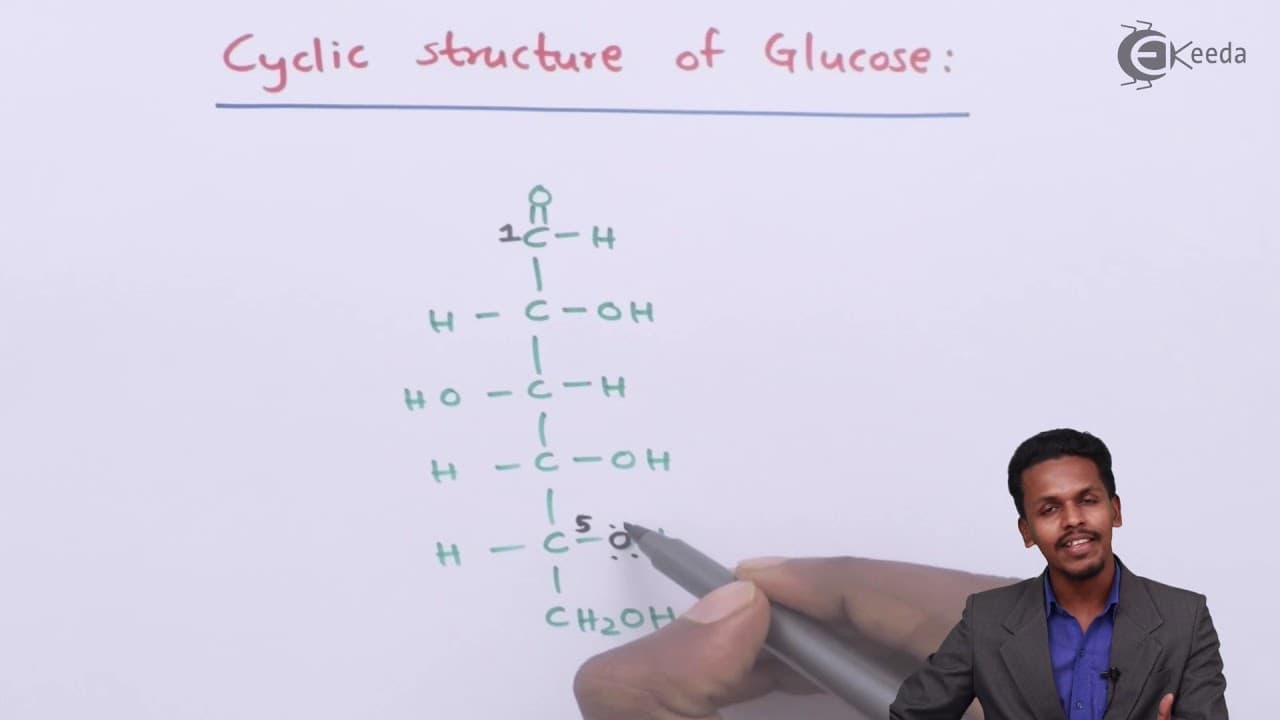
The open chain structure of glucose consists of a carbon double bonded to an oxygen atom, with various carbon and hydrogen atoms attached to it. The structure has a 6-carbon atom arrangement with a CH2OH group on one end.
Q: How is the cyclic structure of glucose formed?
The cyclic structure is formed when carbon number 1 is associated with carbon number 5 through an oxygen bond. This bond creates a 6-membered ring structure and leads to the formation of glucopyranose.
Q: What is the difference between glucopyranose and beta-d-glucopyranose?
The difference lies in the orientation of the OH group on carbon number 1. In glucopyranose, the OH group is on the right-hand side, while in beta-d-glucopyranose, the OH group is on the left-hand side.
Q: What are the epimer carbon atoms in the cyclic structure of glucose?
The epimer carbon atoms are carbon atoms that differ in configuration. In the case of glucose, the epimer carbon atoms are the ones with the OH group on either the right-hand side or the left-hand side.
Summary & Key Takeaways
-
The video discusses how to draw the open chain structure of glucose, which consists of an aldehyde group.
-
It explains how the aldehyde group can be converted into a cyclic form, creating a cyclic structure of glucose.
-
The video introduces two forms of the cyclic structure, known as glucopyranose and beta-d-glucopyranose.
Read in Other Languages (beta)
Share This Summary 📚
Summarize YouTube Videos and Get Video Transcripts with 1-Click
Try YouTube Summary with ChatGPT & Claude or YouTube Transcript Generator
Explore More Summaries from Ekeeda 📚






Summarize YouTube Videos and Get Video Transcripts with 1-Click
Try YouTube Summary with ChatGPT & Claude or YouTube Transcript Generator