What Is Civet and How Does It Simplify Coding?
TL;DR
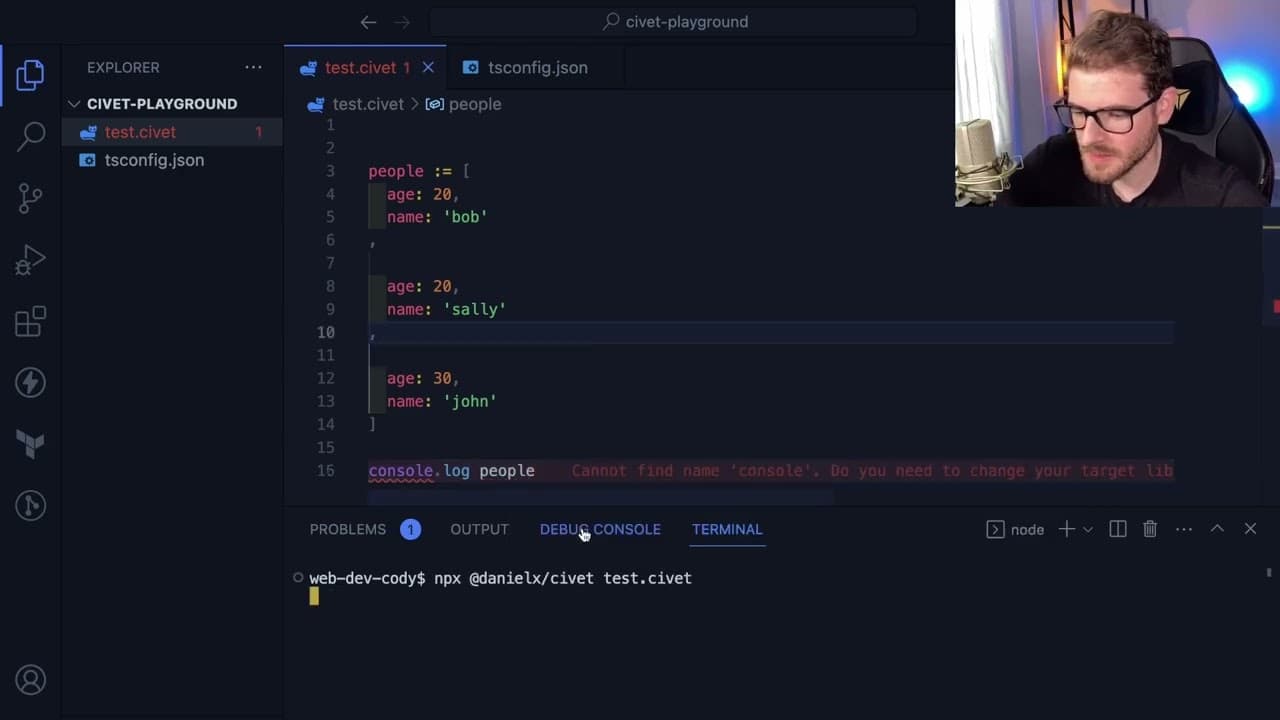
Civet is a CoffeeScript-like language that compiles to TypeScript, offering a more concise syntax for coding. It allows for easier variable declarations, control structures, and array manipulations with less syntax than traditional TypeScript or JavaScript. While it has some challenges related to indentation and setup, Civet aims to create a clearer and more efficient coding experience.
Transcript
I made a joke on Twitter saying that I think this industry is going to come full circle back to Coffee script one day and someone linked me this project called civet which basically looks like a coffee script that compiles down to typescript it has like a less syntax to write the same code in a typescript and when they kind of play around is live a... Read More
Key Insights
- 👻 Civet emerges as a modern take on CoffeeScript, allowing for concise syntax that compiles to TypeScript, appealing to developers seeking simplicity.
- 🫥 The author appreciates the reduced syntax in Civet, enabling complex operations like array manipulations with fewer lines of code compared to JavaScript and TypeScript.
- 👨💻 Specific coding practices, such as variable declarations and function calls, in Civet emphasize clarity and efficient code writing, fostering better developer experience.
- 👨💻 Implicit returns in Civet streamline the function structure, promoting less clutter in code and a focus on the essential logic.
- 👶 Challenges in getting started with Civet serve as reminders that new languages can require adjustments and learning curves, regardless of their simplification goals.
- 💗 The comparison of Civet's syntax with Python underscores a growing trend in programming languages favoring indentation-based structures for enhanced readability.
- 👨💻 Builder IO's sponsorship suggests a collaborative effort in advancing tools that enhance developer productivity through simplified coding paradigms.
Install to Summarize YouTube Videos and Get Transcripts
Explore YouTube Video Summarizer or Get YouTube Transcript Extractor
Questions & Answers
Q: What is Civet and how does it relate to CoffeeScript?
Civet is a programming language that offers a syntax reminiscent of CoffeeScript while compiling down to TypeScript. It aims to provide a more concise coding experience by allowing developers to express complex ideas with less code. This may appeal to those who appreciated the simplicity CoffeeScript offered before it was overshadowed by ES6 features.
Q: How does Civet handle variable declarations differently from TypeScript?
In Civet, variable declarations are simplified; constants can be declared without the traditional const keyword, which can lead to confusion if proper understanding of their behavior, such as immutability, isn't grasped. Civet enhances code readability and encourages understanding by relying on a more straightforward syntax, reducing the need for verbose declarations.
Q: What challenges does the author face while running Civet?
The author encounters several issues while attempting to run Civet, including installation failures and configuration challenges with TypeScript settings. These problems underline the necessity of ensuring the proper setup of TypeScript configurations, demonstrating that while Civet is exciting, it also requires a bit of tinkering to operate correctly.
Q: Can you explain how Civet improves array manipulation compared to JavaScript?
Civet provides a more streamlined approach to array manipulation, such as filtering and mapping. It reduces syntax verbosity by eliminating the need for parenthesis in function calls and curly braces for control statements. This approach allows developers to express logic more fluidly and focuses on clarity, ultimately improving coding efficiency and reducing errors.
Q: What are implicit returns in Civet, and how do they work?
Implicit returns in Civet refer to the language's ability to return values from functions without explicitly using the return keyword. The last evaluated expression in a function is automatically returned, simplifying coding and making it easy to understand the flow of data without extra syntax. This feature enhances the language's readability and reduces redundant code.
Q: How does Civet compare to other languages like Python in terms of syntax?
Civet's indentation-based syntax is reminiscent of Python, which many developers find appealing due to its clarity and reduced complexity. Unlike JavaScript, which requires brackets and semicolons, Civet promotes readability by allowing code to be organized through whitespace, similar to Python, which can enhance code maintainability and ease of understanding.
Q: What is the role of Builder IO in the development of Civet?
Builder IO sponsors Civet as well as Quick JS, suggesting that they are invested in creating and promoting tools that enhance developer experience by simplifying coding practices. Their involvement highlights the growing interest in languages and frameworks that prioritize reducing verbosity and improving readability, which could reshape the way developers approach JavaScript frameworks.
Q: What future plans does the author have regarding their coding journey?
The author plans to explore Civet further as it rekindles their interest in less verbose coding. They also express intent to create a comprehensive SAS course, inviting viewers to subscribe to their newsletter for updates, reflecting their commitment to fostering developer education and community engagement through shared coding experiences.
Summary & Key Takeaways
-
The author reflects on the simplicity of CoffeeScript, expressing nostalgia for its less verbose syntax compared to TypeScript and JavaScript, showcasing a new project called Civet that allows a similar experience.
-
The exploration of Civet reveals its capabilities, including variable declaration, console logging, conditional statements, and array manipulation, emphasizing its reduced syntax in comparison to traditional TypeScript.
-
The author also mentions potential challenges with Civet's syntax regarding indentation and the need for proper configuration, ultimately concluding that the language streamlines coding significantly, appealing to those frustrated with TypeScript's verbosity.
Read in Other Languages (beta)
Share This Summary 📚
Summarize YouTube Videos and Get Video Transcripts with 1-Click
Try YouTube Summary with ChatGPT & Claude or YouTube Transcript Generator
Explore More Summaries from Web Dev Cody 📚

Summarize YouTube Videos and Get Video Transcripts with 1-Click
Try YouTube Summary with ChatGPT & Claude or YouTube Transcript Generator