Exploring the solution set of Ax = b | Matrix transformations | Linear Algebra | Khan Academy
TL;DR
Linear transformations can be defined using matrices, and the solution set to a linear transformation with a non-zero vector b is a combination of a particular vector and the null space of the matrix.
Transcript
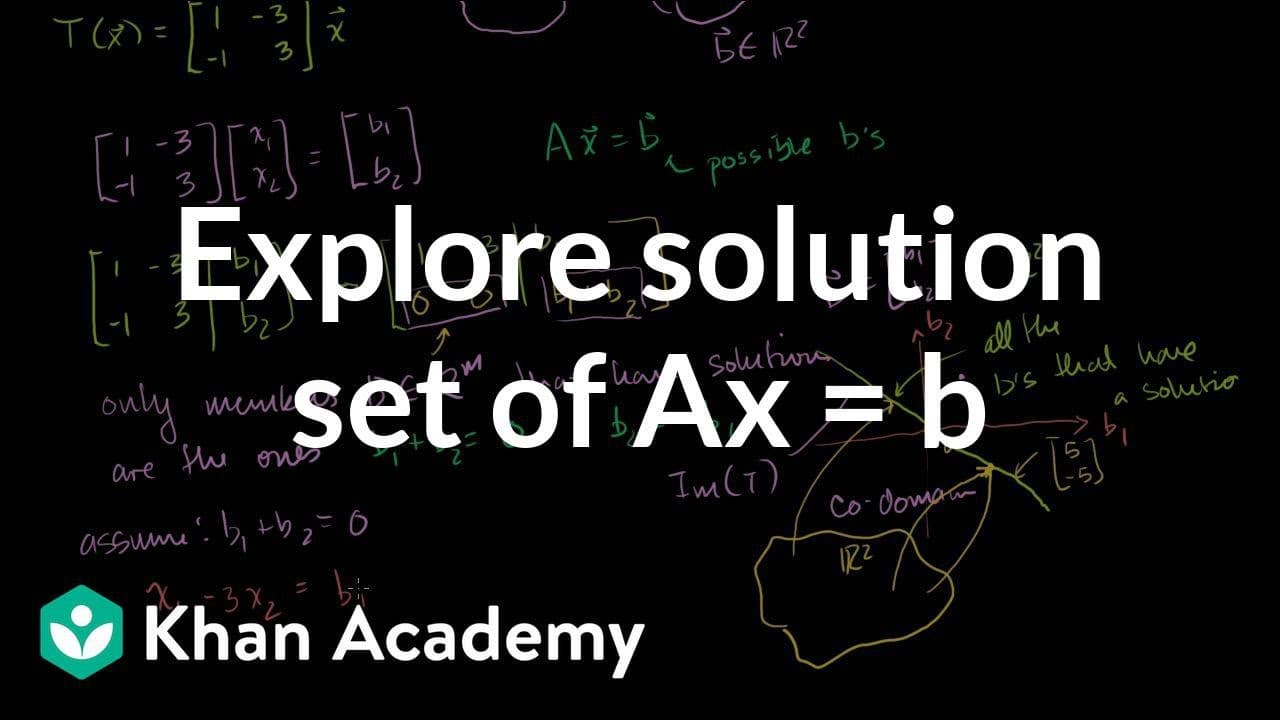
Let's say I have some linear transformation T from R2 to R2. So that is R2, and then this is R2. T just maps from any member of R2 to another member of R2, just like that. And I'm going to define T. It's a linear transformation. I'm going to define it. When I take the transformation of some member of R2, it's equivalent to multiplying it by this ma... Read More
Key Insights
- 👾 Linear transformations can be represented by matrices and can map vectors from one space to another.
- 🛰️ The solution set to a linear transformation Ax=b, where b has a solution, is a combination of a particular vector and the null space of the matrix A.
- ☺️ The null space of a matrix A is the set of all vectors x that map to the zero vector in the codomain.
- 👾 The null space of a matrix A must be trivial for the matrix to be invertible.
Install to Summarize YouTube Videos and Get Transcripts
Explore YouTube Video Summarizer or Get YouTube Transcript Extractor
Questions & Answers
Q: What does it mean for a linear transformation to be onto?
A linear transformation is onto if every vector in the codomain has at least one preimage in the domain. In other words, for every b in the codomain, there exists at least one x in the domain such that Ax=b.
Q: How does the null space relate to the solution set of a linear transformation with a non-zero vector b?
The solution set to a linear transformation Ax=b, where b has a solution, is a combination of a particular vector and the null space of the matrix A. The null space contains all vectors x that map to the zero vector in the codomain.
Q: Can the null space of a matrix contain vectors other than the zero vector?
No, the null space of a matrix A is the set of all solutions to the homogeneous equation Ax=0. It can only contain the zero vector because any scalar multiple or combination of vectors that add up to zero must involve the zero vector.
Q: How does the concept of invertibility relate to the null space?
For a matrix to be invertible, meaning it has an inverse matrix, its null space must be trivial, meaning it only contains the zero vector. If the null space has any other vectors, the matrix is not invertible.
Summary & Key Takeaways
-
This video discusses linear transformations from R2 to R2 using the matrix representation of the transformation.
-
It explains how to find the possible values of the transformation in the codomain by solving the equation Ax=b and putting it in reduced row echelon form.
-
The video introduces the concept of the null space, which is essential in understanding the solution set to a linear transformation with a non-zero vector b.
Read in Other Languages (beta)
Share This Summary 📚
Summarize YouTube Videos and Get Video Transcripts with 1-Click
Try YouTube Summary with ChatGPT & Claude or YouTube Transcript Generator
Explore More Summaries from Khan Academy 📚



Summarize YouTube Videos and Get Video Transcripts with 1-Click
Try YouTube Summary with ChatGPT & Claude or YouTube Transcript Generator