BEGINNER Javascript Practice - Iteration & Strings - Filtering out characters from a string
TL;DR
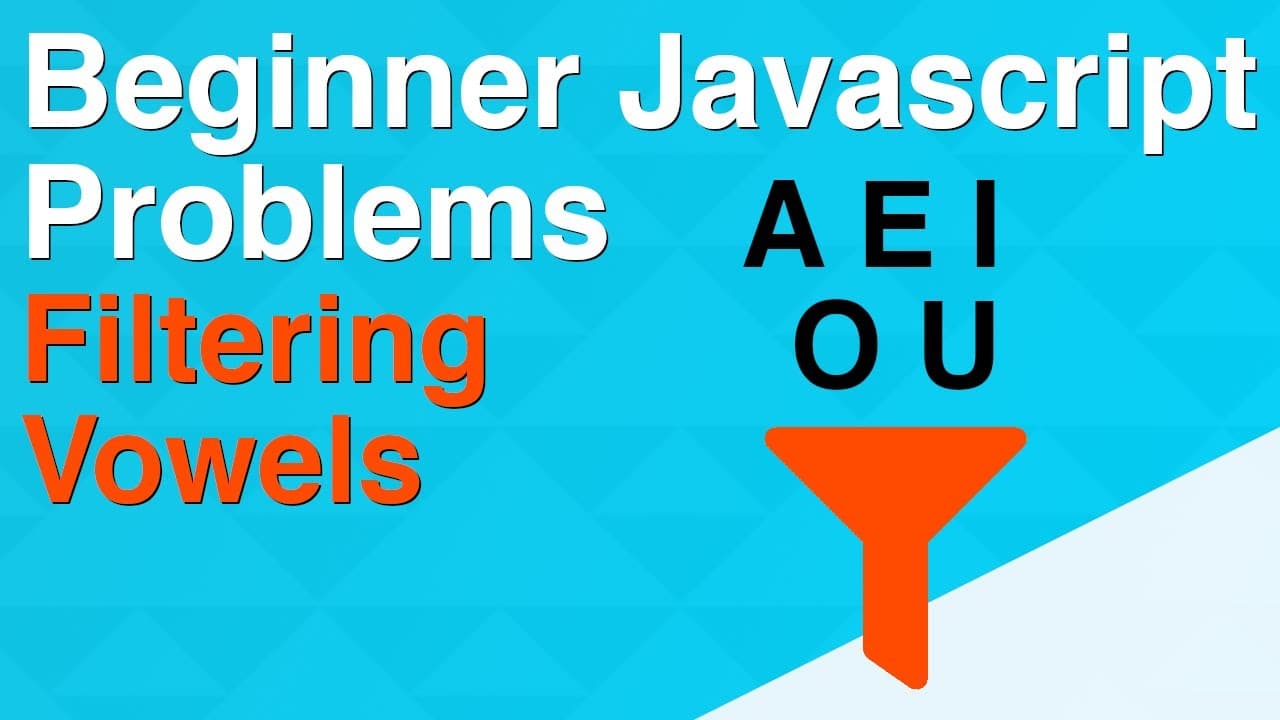
This tutorial demonstrates how to remove vowels from a string using JavaScript.
Transcript
hey everyone welcome back to another video tutorial where I'm going to be talking about a practice problem in JavaScript where basically the problem is we want to loop through this string of letters and we want to filter out any vowels so if you know what a vowel is is basically a e io in you and after we run this algorithm what this should print o... Read More
Key Insights
- ❓ The tutorial provides a clear methodology for tackling string manipulation problems in JavaScript, focusing on vowel removal.
- ❓ It emphasizes the importance of defining which characters are vowels before proceeding with the algorithm.
- 🦻 Using a debugger can significantly aid in understanding and verifying the functionality of the code being written.
- 👶 The approach of building a new string rather than modifying the original can improve code readability and logic flow.
- 😒 The use of an array to store vowels makes it easier to check for their presence in the original string.
- 😫 The structure of the algorithm involves setting up new variables, loops, and conditional logic, which are fundamental concepts in programming.
- 🫵 The presentation encourages viewer engagement by inviting suggestions for future tutorials, fostering community interaction.
Install to Summarize YouTube Videos and Get Transcripts
Explore YouTube Video Summarizer or Get YouTube Transcript Extractor
Questions & Answers
Q: What are the vowels that need to be filtered in this tutorial?
In this tutorial, the vowels considered are a, e, i, o, and u. These characters are specifically targeted for removal from the string, allowing the algorithm to create a new string comprised only of consonants. Understanding these vowels is essential for correctly implementing and testing the code.
Q: What is the purpose of using a debugger in this video?
The debugger is used to step through the code line by line to inspect the logic as it executes. This lets the programmer observe how the new string is being built through each iteration of the loop, and ensures each character is processed correctly. It serves as a valuable tool for identifying bugs and confirming desired outcomes in the code.
Q: Why does the presenter choose to append non-vowel characters to a new string?
The presenter opts to append non-vowel characters to a new string instead of removing vowels from the original string for clarity and simplicity. This approach makes it easier to understand the transformation process, as the goal is clearly to construct a new representation of the input while preserving relevant non-vowel parts.
Q: How does the string filtering algorithm handle characters that are not vowels?
The algorithm checks each character against the list of vowels using a conditional statement. If the character is determined not to be a vowel (i.e., its index in the vowels array is negative one), it gets appended to the constructed new string. This effectively filters out any vowels while accumulating consonants.
Summary & Key Takeaways
-
The tutorial focuses on solving a JavaScript problem where the goal is to filter out vowels from a given string. The vowels in this context are defined as a, e, i, o, and u.
-
The method to achieve this involves initializing a list of vowels, looping through each character of the string, checking if it is a vowel, and building a new string with non-vowel characters.
-
Finally, the implementation is tested using a debugger in VS Code, which allows for step-by-step examination of the code’s functionality and final output, confirming the successful removal of vowels.
Read in Other Languages (beta)
Share This Summary 📚
Summarize YouTube Videos and Get Video Transcripts with 1-Click
Try YouTube Summary with ChatGPT & Claude or YouTube Transcript Generator
Explore More Summaries from Web Dev Cody 📚
Summarize YouTube Videos and Get Video Transcripts with 1-Click
Try YouTube Summary with ChatGPT & Claude or YouTube Transcript Generator