Salient Dimension, Clearance, Width of Carriageway, Shoulder, Median, Width of Roadway, Right of Way
TL;DR
This content explains the different dimensions and clearances needed in roadway design, including carriageway width, shoulder width, median width, roadway width, and right-of-way.
Transcript
hello students today we are going to study salient dimensions clearance width of carriageway shoulders medians width of roadway and right of way now we will first start with the width of carriageway now the width of pavement or carriageway depends on width of traffic lane and number of lanes the portion of carriageway width that is intended for one... Read More
Key Insights
- ✈️ Carriageway width depends on the number of lanes, width of traffic lanes, and clearance requirements for different vehicle classes.
- 🅰️ Roadway width includes carriageway width, separators, and shoulders, and varies depending on the type of road and terrain.
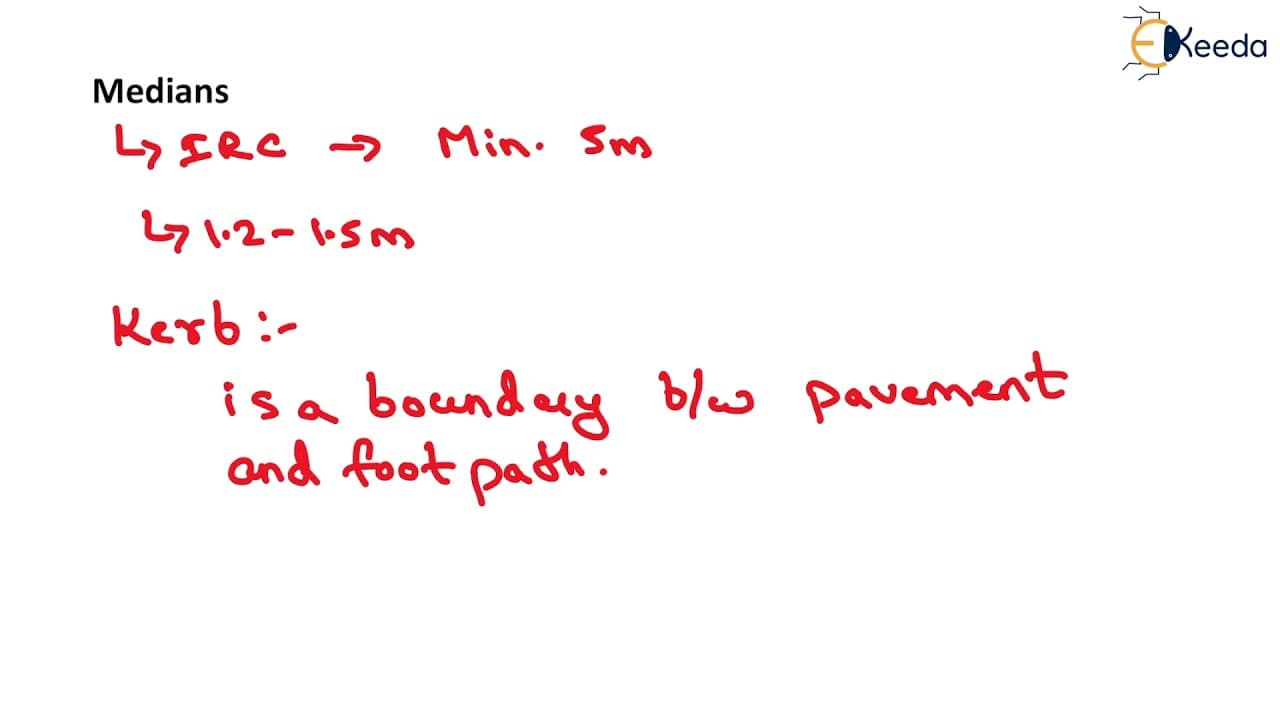
- 🤕 Medians are provided in divided carriageways to prevent head-on collisions.
- 😒 Shoulders provide support, emergency and service lanes, and discourage regular traffic use.
- 💨 Right-of-way acquisition should consider future needs and development.
- 🏝️ Consideration of side distance, embankment height, slope, drainage, and visibility is crucial in determining land width requirements.
- 💨 Land width for right-of-way should be planned in advance to accommodate future widening needs.
Install to Summarize YouTube Videos and Get Transcripts
Explore YouTube Video Summarizer or Get YouTube Transcript Extractor
Questions & Answers
Q: What factors determine the width of a carriageway?
The width of a carriageway is determined by considering the width of traffic lanes, the number of lanes, and the need for sufficient lateral clearance for vehicles.
Q: Why is a median necessary in highways with divided carriageways?
A median is necessary to prevent head-on collisions between vehicles moving in opposite directions and to provide a separation between traffic streams.
Q: What functions do shoulders serve in roadway design?
Shoulders provide structural stability to the pavement, act as emergency lanes and service lanes for disabled vehicles, and discourage regular traffic use by being rougher than the traffic lanes.
Q: Why is it important to acquire more land for the right-of-way during road construction?
Acquiring more land for right-of-way allows for future widening and development, as the cost of adjacent land increases after road construction and roadside development begins.
Summary & Key Takeaways
-
The width of the carriageway depends on the number of traffic lanes and the width of each lane, taking into account the size of different classes of vehicles.
-
The width of the roadway includes the carriageway and any separators, and varies for different types of roads and terrains.
-
A median is provided in divided carriageways to separate traffic moving in opposite directions and prevent head-on collisions.
-
Shoulders are provided on the sides of the pavement to offer structural stability, emergency lanes, and service lanes for disabled vehicles.
-
Right-of-way refers to the land acquired for road construction and should consider future development and widening needs.
Read in Other Languages (beta)
Share This Summary 📚
Summarize YouTube Videos and Get Video Transcripts with 1-Click
Try YouTube Summary with ChatGPT & Claude or YouTube Transcript Generator
Explore More Summaries from Ekeeda 📚






Summarize YouTube Videos and Get Video Transcripts with 1-Click
Try YouTube Summary with ChatGPT & Claude or YouTube Transcript Generator