Every Brain Glitch Explained
TL;DR
Explore 16 brain glitches affecting memory, perception, and reality.
Transcript
Read and summarize the transcript of this video on Glasp Reader (beta).
Key Insights
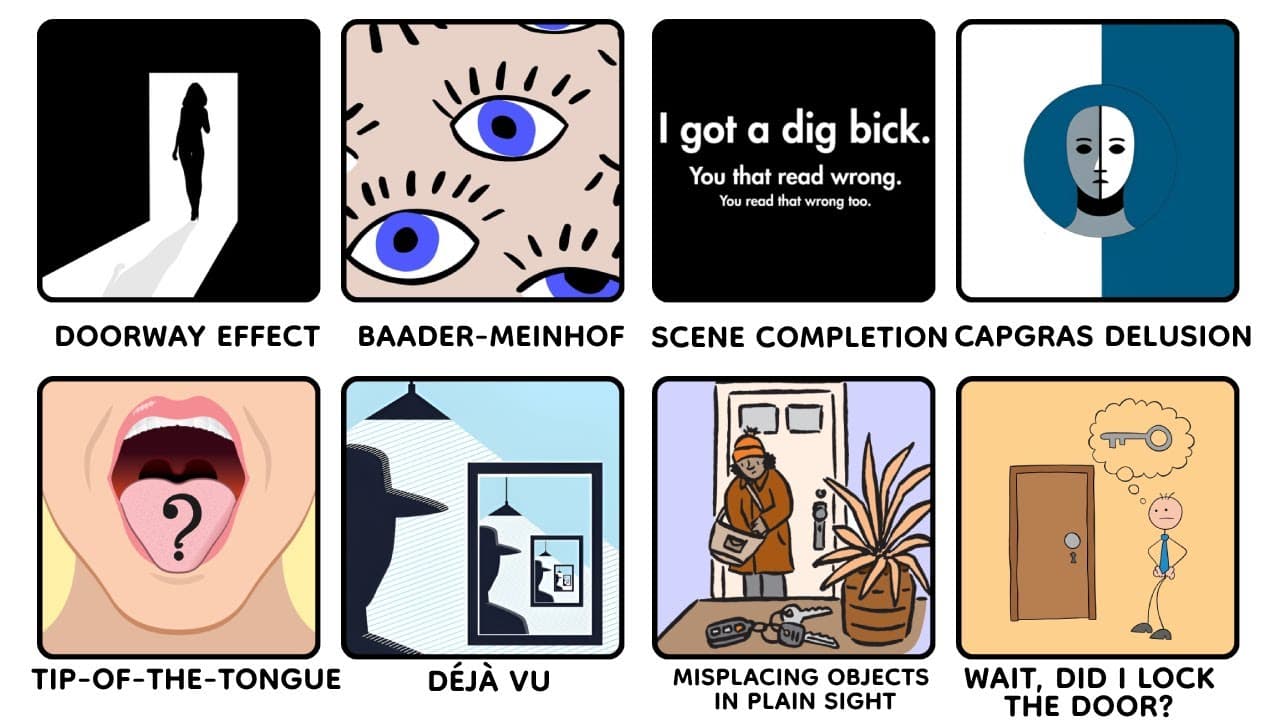
- The Doorway Effect causes brain context switching, leading to forgotten intentions when entering new rooms.
- Time Dilation occurs in high-stress situations, making time feel slower due to detailed information processing.
- The Baader-Meinhof Phenomenon explains why new concepts seem more frequent after first noticing them.
- False Memories reveal that memories are reconstructed, leading to inaccuracies and unreliable eyewitness accounts.
- Déjà Vu is an unexplained sensation of familiarity in new environments, possibly due to brain processing errors.
- The McCollough Effect involves prolonged afterimages, showing how the brain reshapes visual input.
- Capgras Delusion causes familiar faces to seem like impostors due to a disconnect between recognition and emotion.
- The Scene Completion Illusion shows how the brain fills in missing information, leading to misinterpretations.
Install to Summarize YouTube Videos and Get Transcripts
Explore YouTube Video Summarizer or Get YouTube Transcript Extractor
Questions & Answers
Q: What is the Doorway Effect?
The Doorway Effect is a cognitive phenomenon where entering a new room causes your brain to switch contexts, leading to forgetting the reason you entered. This occurs because crossing a doorway acts as a mental event boundary, prompting your brain to dump the old context and focus on the new one.
Q: How does Time Dilation work during stressful events?
Time Dilation is a brain glitch where time seems to slow down during high-stress situations. This happens because your brain processes more details than usual, akin to switching from 30 to 120 frames per second. This increased detail processing creates the illusion of time stretching, aiding in threat assessment.
Q: Can you explain the Baader-Meinhof Phenomenon?
The Baader-Meinhof Phenomenon, or frequency illusion, occurs when you learn a new word or concept and suddenly notice it everywhere. This happens because your brain, constantly filtering information, starts prioritizing the new item, making it seem more frequent, though the world hasn't changed.
Q: What are False Memories and how do they form?
False Memories are inaccuracies in recollection where the brain reconstructs events, sometimes filling gaps with details that never occurred. This can lead to vivid but incorrect memories. Studies show people can be convinced of experiences they never had, highlighting the unreliability of eyewitness testimony.
Q: What is Déjà Vu and why does it occur?
Déjà Vu is the sensation of familiarity in a new environment. While not fully understood, one theory suggests it happens when a new experience is mistakenly filed as a memory. Another theory links it to minor brain delays, creating a glitch that feels like a time loop.
Q: Describe the McCollough Effect.
The McCollough Effect is an optical illusion where staring at color patterns causes hallucinations of colors that aren't there, lasting for hours or days. Unlike typical afterimages, this effect rewires how the brain interprets visual input, demonstrating the brain's active role in reshaping information.
Q: What causes Capgras Delusion?
Capgras Delusion is a rare brain glitch where an individual believes loved ones have been replaced by impostors. It's believed to result from a disconnect between facial recognition and emotional response, where the brain recognizes the face but fails to trigger familiarity, causing a disturbing sense of replacement.
Q: How does the Scene Completion Illusion affect perception?
The Scene Completion Illusion occurs when the brain fills in missing information based on expectations, leading to misinterpretations. This is useful for processing incomplete data quickly but can cause errors, such as misreading words or messages, as the brain tries to predict and complete information efficiently.
Summary & Key Takeaways
-
This video discusses various brain glitches that affect our memory and perception, like the Doorway Effect, which causes us to forget intentions when entering new rooms. It also explores Time Dilation, where high-stress moments feel slower, and False Memories, highlighting how our recollections can be inaccurate.
-
The video delves into phenomena like Déjà Vu, a feeling of familiarity in new places, and the McCollough Effect, which involves hallucinating colors after staring at patterns. It also covers Capgras Delusion, where loved ones are perceived as impostors, and the Scene Completion Illusion, where the brain fills in gaps.
-
Additional topics include the Tip-of-the-Tongue Phenomenon, where words are temporarily inaccessible, and word substitutions in texting. The video also touches on misplacing objects in plain sight, auditory glitches like mishearing lyrics, and the digital equivalent of the Doorway Effect when using apps.
Read in Other Languages (beta)
Share This Summary 📚
Summarize YouTube Videos and Get Video Transcripts with 1-Click
Try YouTube Summary with ChatGPT & Claude or YouTube Transcript Generator
Explore More Summaries from BoNa 📚
Summarize YouTube Videos and Get Video Transcripts with 1-Click
Try YouTube Summary with ChatGPT & Claude or YouTube Transcript Generator