What Are the Key Advances in Transformer Models?
TL;DR
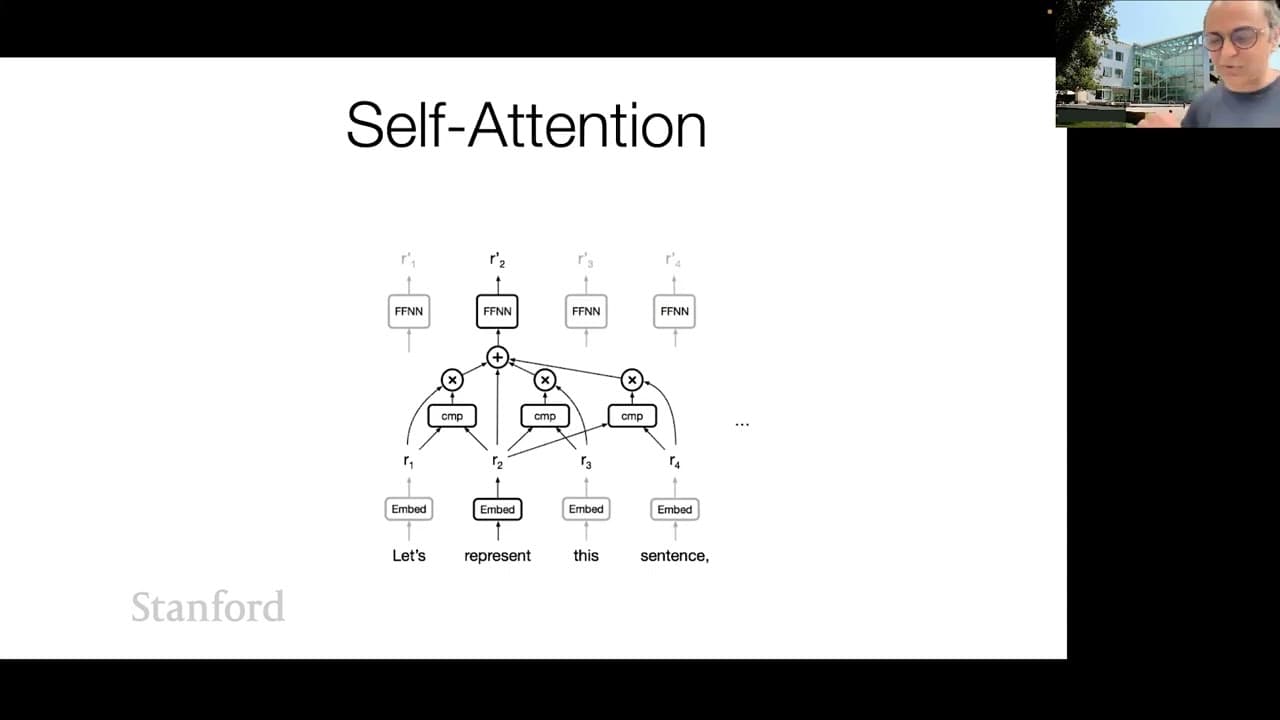
The Transformer model has evolved significantly, featuring enhancements in relative position encodings, attention mechanisms, and memory optimization. These advancements not only improve performance in language tasks like translation but have also extended its capabilities to areas such as music generation and other complex applications.
Transcript
um do folks there stand stand foration you know which one oh person what what is this what's going the first that's right and then what is Association stand for I believe this is M yeah who started sale I if I understand correctly is that right he started sale yeah I think he I think he did but anyways uh so so so what's interesting is so it's it's... Read More
Key Insights
- 🧘 Relative position encodings, such as rotary position encodings, have improved the modeling of temporal relationships in sequences.
- 🪘 Sparse attention mechanisms, either through local attention or unstructured sparse attention, have helped address the computational and memory challenges of long-context modeling.
- 👥 Memory optimization techniques, such as grouped query attention and online softmax computation, have reduced memory movement and improved efficiency.
- 🚨 Speculative decoding has emerged as an effective approach for generating diverse outputs and leveraging the capabilities of large language models.
Install to Summarize YouTube Videos and Get Transcripts
Explore YouTube Video Summarizer or Get YouTube Transcript Extractor
Questions & Answers
Q: What are some challenges in implementing the Transformer model?
One challenge is modeling long-context relationships, which has been addressed through relative position encodings. Another challenge is memory movement, which has been tackled through techniques like grouped query attention.
Q: How do relative position encodings improve the Transformer model?
Relative position encodings allow the model to capture relative distances between tokens in a sequence, enhancing its ability to model complex relationships and patterns.
Q: What are some techniques for optimizing memory usage in the Transformer model?
One approach is to decrease activation memory by using grouped query attention, where multiple queries attend to the same keys and values. Another technique is to compute the softmax in an online fashion, reducing the need for memory writes.
Q: How does speculative decoding work?
Speculative decoding involves generating initial outputs from a light model and then reranking the results using a heavy model. This technique helps capture diversity while leveraging the power of large models for scoring.
Summary & Key Takeaways
-
The Transformer model, originally developed for language translation, has been refined and enhanced over time.
-
Advancements include improvements in relative position encodings, attention mechanisms, and memory optimization.
-
These developments have led to better performance in various tasks, such as music generation and machine translation.
Read in Other Languages (beta)
Share This Summary 📚
Summarize YouTube Videos and Get Video Transcripts with 1-Click
Try YouTube Summary with ChatGPT & Claude or YouTube Transcript Generator
Explore More Summaries from Stanford Online 📚

Summarize YouTube Videos and Get Video Transcripts with 1-Click
Try YouTube Summary with ChatGPT & Claude or YouTube Transcript Generator