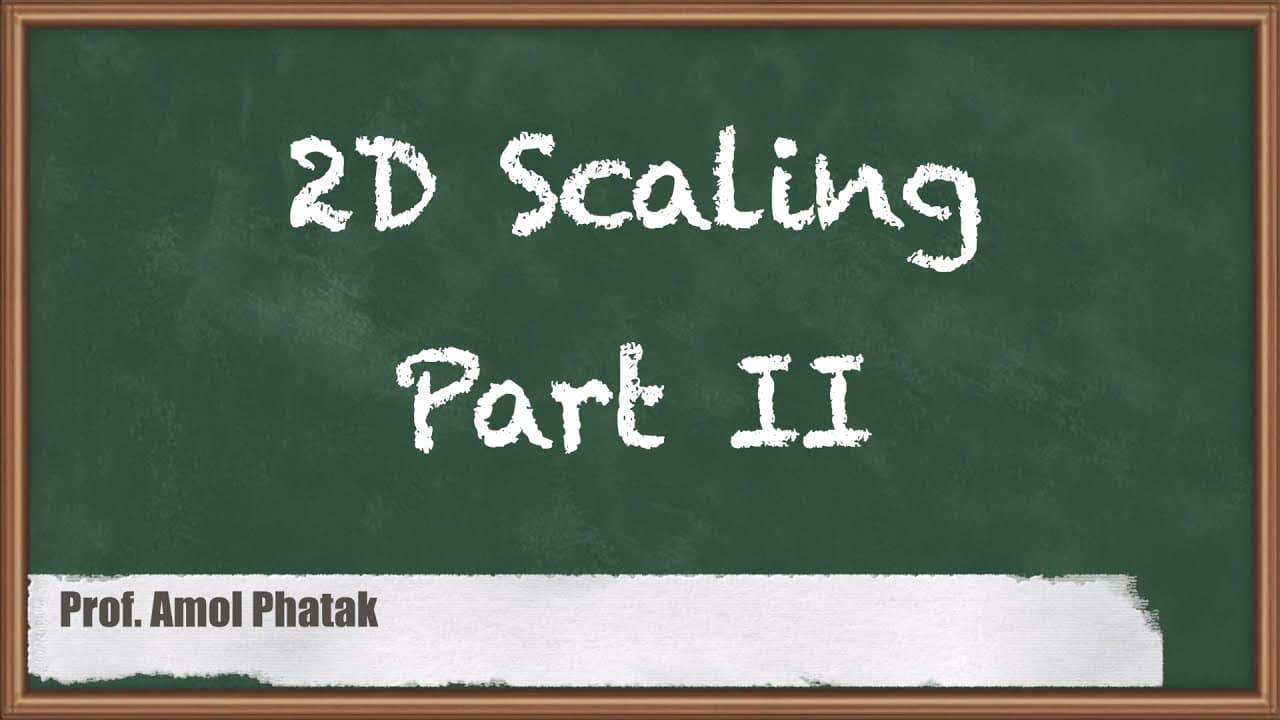
2D Scaling Part II - Two Dimensional Geometric Transformation - Computer Graphics
TL;DR
This video explains the implementation of two-dimensional scaling transformation with an example of scaling a triangle and rectangle.
Transcript
i welcome all the students today we are going to learn the implementation part of the two-dimensional scaling transformation okay when we apply the two-dimensional scaling the object may be enlarged okay so we may want to enlarge the size of the object or we may want to reduce the size of the object or there may be the compression of the object or ... Read More
Key Insights
- ❓ Two-dimensional scaling can enlarge or reduce the size of an object.
- ❣️ Scaling factors determine the degree of scaling in x and y directions.
- 😒 The program uses graphics functions and arrays to store and transform the object's vertices.
- ⚖️ Drawing the original and transformed objects helps visualize the effects of scaling.
- 🥋 Different scaling factors can result in uniform or non-uniform scaling.
- ❣️ Scaling is applied from the origin (0, 0) in x and y directions.
- 🥋 Uniform scaling preserves the shape of the object, while non-uniform scaling may distort it.
Install to Summarize YouTube Videos and Get Transcripts
Explore YouTube Video Summarizer or Get YouTube Transcript Extractor
Questions & Answers
Q: What is two-dimensional scaling?
Two-dimensional scaling is a transformation that adjusts the size of an object by applying scaling factors to its vertices in x and y directions.
Q: What is the purpose of the "drawOriginalObject" function?
The "drawOriginalObject" function is used to draw the original object on the screen. It clears the screen, sets the color to white, divides the screen into four quadrants, connects the vertices, and closes the shape by connecting the last point with the first point.
Q: How is the transformed object drawn differently from the original object?
The transformed object is drawn using the "drawTransformObject" function. It sets the color to yellow, uses a for loop to transform the object's vertices using the scaling factors, and plots the transformed object using the transformed vertices.
Q: What is the difference between uniform scaling and non-uniform scaling?
In uniform scaling, the scaling factors in x and y directions are the same, resulting in equal scaling of the object. In non-uniform scaling, the scaling factors can be different, leading to non-equal scaling and potentially changing the shape of the object.
Summary & Key Takeaways
-
The video discusses the implementation of the two-dimensional scaling transformation, which can enlarge or reduce the size of an object.
-
The program takes input vertices for the original object and applies scaling factors to create a transformed object.
-
The program uses graphics functions to draw the original object in white and the transformed object in yellow.
Read in Other Languages (beta)
Share This Summary 📚
Summarize YouTube Videos and Get Video Transcripts with 1-Click
Try YouTube Summary with ChatGPT & Claude or YouTube Transcript Generator
Explore More Summaries from Ekeeda 📚

Summarize YouTube Videos and Get Video Transcripts with 1-Click
Try YouTube Summary with ChatGPT & Claude or YouTube Transcript Generator